

Washington has moved past refereeing markets to actively engineering them. The United States now subsidizes the construction of semiconductor fabs, battery plants, and critical minerals. For the first time in decades, “industrial policy” is more than an academic theory; it’s become a national mission.
But there is a tension at the heart of this revival that we ignore at our peril.
The high-minded goal of industrial policy is to rebuild the middle class through high-productivity, high-wage careers. Unfortunately, the political incentives default to a much cruder metric: the body count of new jobs. In the theater of the campaign trail, a ribbon-cutting for 5,000 “new jobs” is a guaranteed win, but a 4% increase in inflation-adjusted manufacturing wages is an invisible footnote. We see this in the reflexive branding of both administrations: Biden’s “16 million jobs” victory lap and Trump’s “Jobs, Jobs, Jobs!” mantra.
The trade-off between maximizing the number of workers and maximizing the value of their work is the dilemma at the heart of industrial policy. When the political “win” is tied to the number of new jobs, we risk turning industrial policy into a mechanism for making employment a higher priority than economic vitality. The more democratic the country, the more irresistible this “quantity trap” becomes.
Until we confront the trade-off between “Jobs” and “Wages,” we can’t build a powerhouse economy, and we’re at risk of just subsidizing a busy one.
Manufacturing Nostalgia
A lot of the emotional energy behind industrial policy comes from nostalgia for mid-20th-century manufacturing. In 1950, manufacturing accounted for roughly a third of U.S. nonfarm employment. Today it’s about 8–9%. For many communities and blue-collar men, this decline represents a loss of status, identity, and middle-class security.
Has the U.S. hollowed out its manufacturing capability? We made a colossal error in training a geopolitical adversary to take over entire strategic industries such as batteries, solar, pharmaceuticals, EVs, and drones. Nonetheless, real manufacturing output in the U.S. is near historic highs. The decline in manufacturing employment is largely attributable to productivity growth, meaning automation, greater capital intensity, and process innovation.
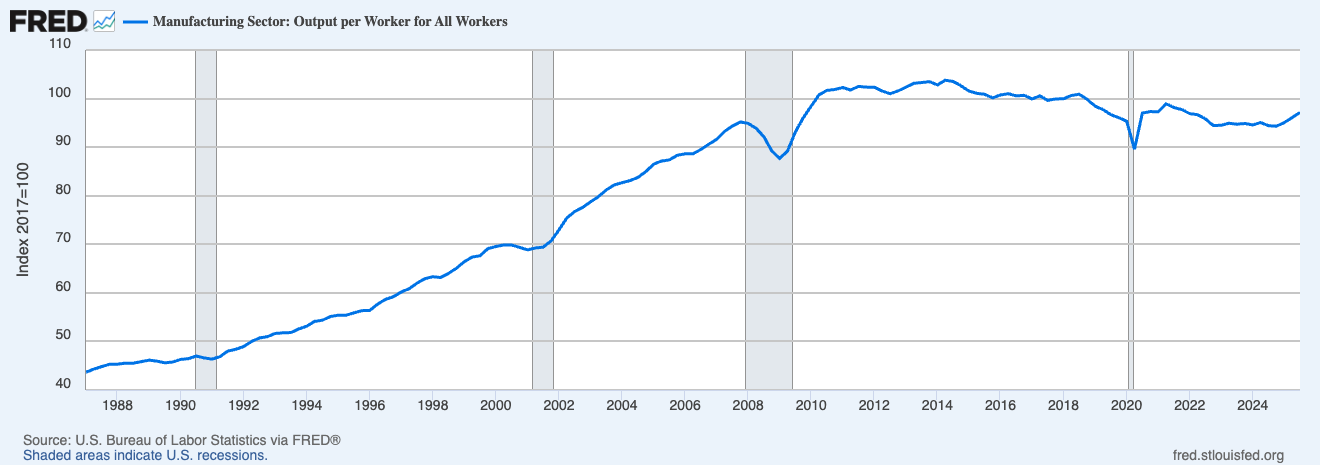
This is success, not failure. In many sectors, the U.S. didn’t “stop making things.” It learned to make things with far fewer workers. A graph of manufacturing output per worker clearly shows this (if anything, it indicates a troubling lack of productivity gains in manufacturing after 2012).
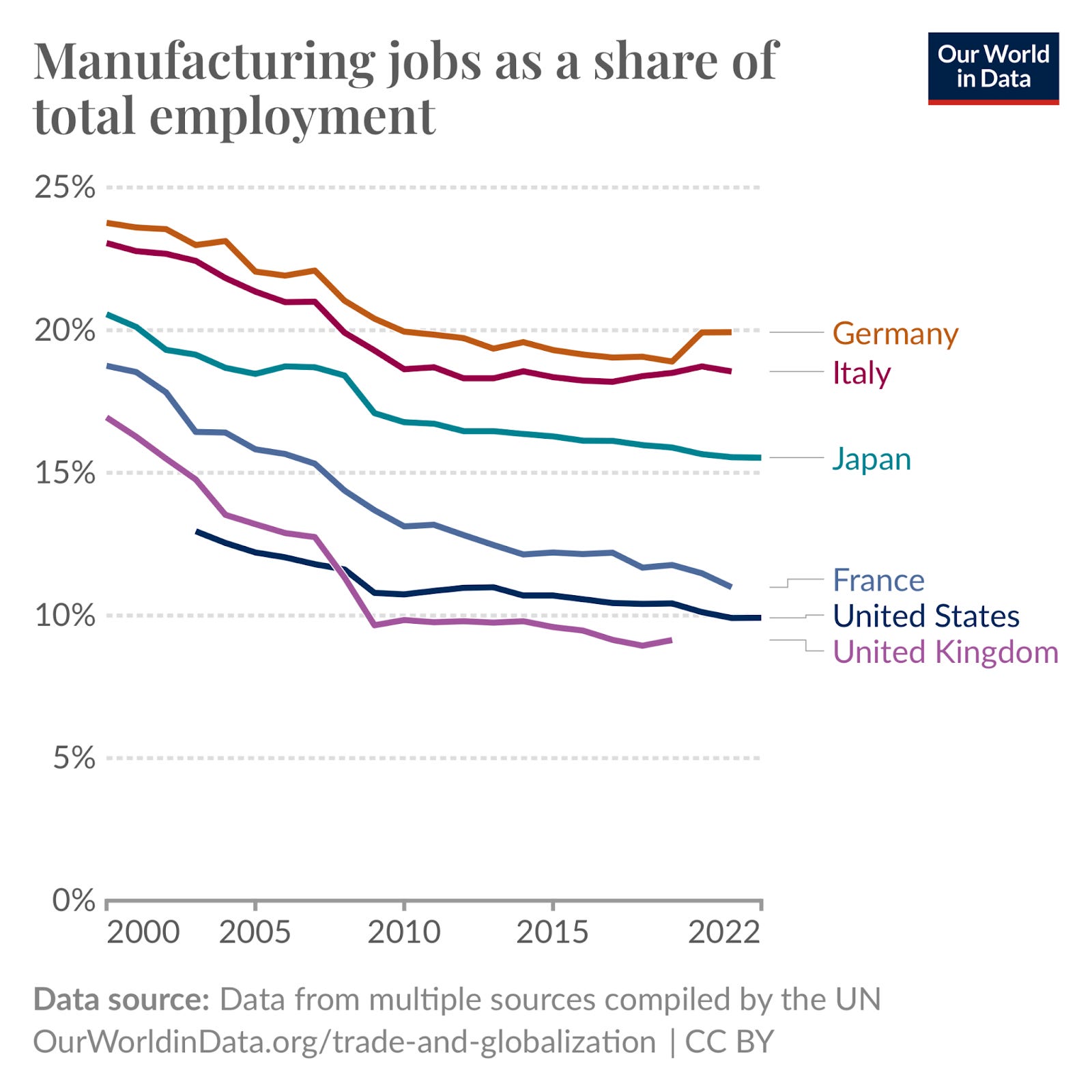
Manufacturing productivity has grown everywhere, just as it did in agriculture. The share of U.S. manufacturing jobs peaked in 1953. It peaked in Germany and Japan in the 1970s and in Korea in the 2010s. The World Bank estimates that it peaked in China more than 10 years ago (although its share of manufacturing jobs has declined more slowly than in other countries). Advanced economies tend to converge toward service-heavy employment structures as productivity in goods production rises. As economist Dani Rodrik demonstrates in an important new book, an industrial policy that seeks to recreate an employment structure from the 1960s is fighting arithmetic.
The central question for industrial policy must be “How do we ensure that the jobs we create in manufacturing and services are highly productive and well paid?” not “How do we get more factory jobs?” These are very different goals.
The Siren Call of “Job-Count Populism”
A joke surfaced in 1901 that mocked Irish immigrant workers in the U.S. It evolved, as jokes do, until conservative economist Milton Friedman offered a modern version. He claimed that while touring a massive overseas canal-digging project, he was shocked to see workers using shovels instead of modern earth-moving machinery. When he asked his government host why they weren’t using more efficient equipment, the official explained, “You don’t understand. This is a jobs program.”
Friedman responded, “Oh, I thought you were trying to build a canal. If it’s jobs you want, remove the shovels and give these workers spoons!”
“Job-count populism” is not always so easily lampooned. Not only are jobs countable, tangible, and politically legible, they’re also geographically concentrated. This makes for great headlines: “2,000 new jobs in Ohio.” “10,000 jobs coming to Arizona.” Elected officials can show up at a plant opening, cut a ribbon, and smile for the cameras. They do it for public-sector projects all the time.
In democratic countries, industrial policy is subject to a gravitational pull toward job-count populism because of the relentless politics of geography and job-count visibility. To pass a bill, Congress distributes subsidies and investments across states. Legislators want projects in their districts. “Place-based” development becomes a goal in itself.
Politicians rarely receive credit for higher wages, which are less visible than jobs. If wages rise because of productivity growth, a new labor agreement, or tighter labor markets, it’s hard to attribute that to a single policy. So politicians naturally optimize for what’s visible. They embrace job-count populism.
Worse, elected officials want local jobs, not jobs in the next district or state. But many high-productivity industries cluster in specific regions. Silicon Valley exists for a reason. (My wife, scholar AnnaLee Saxenian, documented its dense network of firms, specialists, and institutions that drive innovation and productivity.) Industrial policies that seek to distribute advanced industries evenly across politically strategic states dilute those agglomeration benefits. The result can easily be lower overall productivity.
Job-count populism creates incentives for elected officials to create low-wage jobs. Policymakers (including labor unions, who value a growing membership) often equate “industrial revival” with “large numbers of factory jobs”. They often prefer to subsidize labor-intensive production methods or to resist automation to preserve jobs. That might raise job counts in the short term, but it can come at the cost of long-run productivity growth, competitiveness, and higher wages. You can protect jobs by lowering productivity. Just replace shovels with spoons. But you cannot sustainably raise wages that way.
If a politician wants a headline with a big number, they will resort to job-count populism and support labor-intensive industries. But labor-intensive industries are, by definition, those that have failed to achieve the productivity gains necessary to pay high wages. By focusing on the “body count,” Washington is effectively subsidizing the least efficient parts of the economy.
Job-count populism isn’t new. For many decades, state-level economic development policy has offered tax incentives to attract new factories and corporate offices. These subsidies often cost hundreds of thousands of dollars per job created. Worse, many of the subsidized projects would have happened anyway.1 The spillovers are minimal, but the jobs get counted.
Job-count populism drives traditional economic development (e.g., a city subsidizing the cost of a new warehouse or a call center). The traditional “rule of thumb” was to create $35,000 to $50,000 in total incentives per job. If the cost exceeded the first year’s salary, it was often viewed as a “bad deal” for taxpayers. At $1.4 million per job for the Samsung plant in Taylor, it would take nearly 19 years of a $75k salary just to break even on the subsidy. By that standard, the math is indefensible.
Of course, these subsidies aren’t actually “buying jobs” and should not be. They are paying for the physical presence of a leading-edge logic fab on U.S. soil to mitigate the risk of a conflict over Taiwan. We are paying for the “ecosystem” effect—the engineers, researchers, and graduate students who will gravitate to Texas or Arizona. We are placing capital-intensive bets on the future of AI and compute.
The absurdity of the ‘$1.4 million per job’ metric isn’t just the price tag; it’s that we are using a job-count populism yardstick to measure a capital-intensive moonshot. If we justify a $6 billion grant by the 4,500 people walking through the gate, we’ve already lost the argument. We shouldn’t be asking ‘how much is a job worth?’; we should be asking ‘how much is American leadership in the silicon frontier worth?’ and then demanding that the productivity gains from that leadership actually reach the rest of the workforce.
Making Productivity Pay
Increasing productivity has a bad reputation in progressive circles, and for good reason: increasing productivity does not always increase pay. Productivity is necessary for wage growth, but it is not sufficient — labor market conditions and workers’ bargaining power also matter. Anyone wishing to rebuild a middle class with higher wages must consider not only how technology, capital deepening, firm dynamism, knowledge spillovers, and competitive pressure can increase productivity, but also how wage bargaining and competition policy can ensure that these gains are equitably shared.
There is no God-given guarantee that pay will increase if workers produce more value. Indeed, strong evidence suggests that pay has not kept up with productivity for the past fifty years. Over the past few decades, the labor share of income in many advanced economies has drifted downward. Market concentration, declining unionization, global supply chains, and superstar firm dynamics have all contributed.2
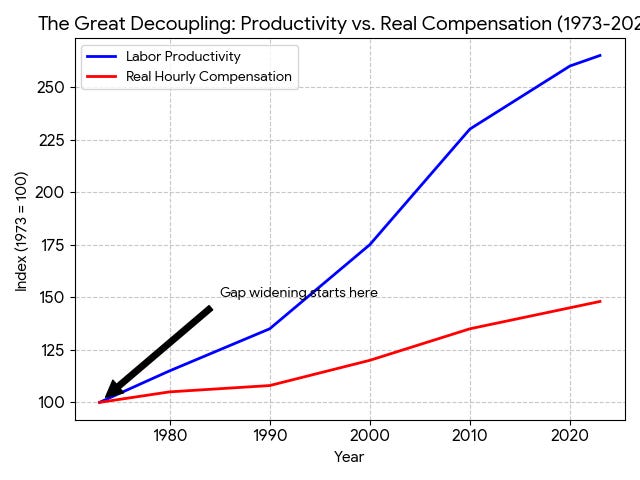
As a result, a strategy focused solely on upgrading key sectors may increase profits more than wages. If industrial policy is going to deliver “good jobs,” it can’t ignore labor market institutions. The postwar manufacturing era wasn’t just about factories. It was about unions, collective bargaining, and norms that linked productivity gains to wage gains.
Restoring our weakened labor market institutions is a complex problem. I have argued that American labor law marginalizes private-sector unions and that sectoral bargains should be a central part of any national industrial policy. This is a substantial political challenge at the moment, but without it, even successful national industrial policies may not translate into higher living standards.


Embrace Technology
Historically, the sectors that pay the highest wages have been technologically advanced and globally competitive – not sectors that maximize headcount. A dangerous temptation is to treat automation as a threat to industrial employment. Artificial Intelligence poses a specific example of this threat – a topic I will turn to in the next Modern Times post.
Although automation reduces labor demand for specific tasks, it also lowers costs and can expand output in ways that enable higher wages (and in some cases, higher employment). In many energy-intensive industries, for example, lower energy costs have led to higher employment, even though fossil fuels have shed workers due to lower demand growth and automation.
Industrial policies designed to protect labor-intensive methods or obsolete technologies, such as internal combustion engines, may preserve jobs in the short term but can lock the country into lower productivity and lower standards of living. Our goal should be to create fewer but better jobs in certain sectors and to ensure that displaced workers have pathways to high-productivity employment. That requires complementary policies: education, mobility, social insurance, and dynamic labor markets. Industrial policy alone can’t do that.


If industrial policy wants to achieve higher wages through productivity growth while avoiding job-count populism, it needs guardrails.
Measure success by productivity and wage growth, not employment. Public reporting should emphasize value added per worker, export performance, and wage levels.
Preserve competitive discipline. Subsidies should be conditional and time-limited. Firms should face international competition. No company gets permanent life support.
Lean into agglomeration. Accept that some regions will specialize. Don’t spread projects so thin that clusters never form.
Integrate labor policy thoughtfully. Encourage worker voice, sector bargains, and training systems that enhance productivity, not “everything bagel liberalism” provisions that increase costs much faster than social value.3
Support mobility and adjustment. Not every region can host a semiconductor fab. National policy should help workers move to opportunity rather than freeze economic geography in place.
The Deeper Tradeoff
The tension between jobs and wages reflects two differing visions of economic justice. One concerns the importance of work as a form of belonging. It emphasizes the preservation of stable employment in industries that anchor communities. Oren Cass and his team at American Compass articulate this vision very effectively. The other concerns work and productivity: dynamic sectors that push the technological frontier and generate rising incomes.
In the 20th century, for a few decades, those visions overlapped. High-productivity manufacturing was also labor-intensive enough to employ millions. That era was unusual and shows no signs of returning.
In the 21st century, frontier industries are capital-intensive and automated. They can generate enormous value with relatively few workers. Especially as AI advances, trying to force them to become mass employers is likely to undermine what makes them productive in the first place.
Those wishing to modernize U.S. industry face a political challenge. Voters often measure success by the headcount at a factory gate, but the economic imperative is to organize, equip, and train workers to maximize their output. If we treat industrial policy as a job-creation program, we risk building a museum of 20th-century labor instead of an engine of 21st-century growth. Ask Europe how that works out.
Productivity gains drive national prosperity, but they don’t always win elections. If we prefer a competitive future to a comfortable past, we need an industrial policy that can withstand the politics of fewer, better jobs rather than a large number of inefficient ones.
ICYMI
I am replacing the Musical Coda with ICYMI (in case you missed it), which will display brief links that I find important, surprising, or amusing.
Denmark is eliminating its post office.
Nonfiction book sales have dropped by almost 25% in five years
We live much longer than our ancestors, and this is not primarily due to reduced child mortality.
Prefer to work from home? Find a company with a younger CEO.
Don’t deport customers. Around the U.S., increasing the deportation of immigrants briefly increased the wages of native-born workers. Then wages fell by twice as much as they had briefly risen. (Why? At first, there is less competition for the tools and machines already in place. Soon, however, businesses stop investing because there are fewer people to buy products and perform the work. In the end, the whole economy shrinks, and native workers’ paychecks fall. )
Notes
A critical finding from the Upjohn Institute study is that in roughly 75% to 90% of cases, the company would have made the same location decision even without the incentive. This implies the actual cost per “newly created” job (a job that wouldn’t have otherwise existed) is much higher than the face-value sticker price.
The figures in the table represent the number of direct manufacturing jobs that companies committed to creating in exchange for the incentives. They do not include the thousands of temporary construction jobs or “indirect” jobs (suppliers, local services) that government officials often highlight.
Samsung & TSMC: The $6.6 Billion figure for each represents the “Direct Funding” (grants) portion of their CHIPS Act awards. Both companies were also offered billions more in federal loans and 25% investment tax credits, which would significantly increase the “Cost Per Job” if included.
Ford BlueOval: This deal has been particularly scrutinized because Ford later “right-sized” the project. While the initial promise was 2,500 jobs, they revised this down to 1,700 in late 2023. If the subsidy amount remains unchanged, the cost per job exceeds $1 million.
Intel Ohio: The $2.0 Billion reflects state-level incentives (grants and infrastructure). Intel was also awarded up to $8.5 billion in federal CHIPS Act grants in 2024, which is separate from the previously provided state-level table.
Micron NY: Their $5.8 Billion in state tax credits is tied to a massive 20-year investment plan. The 9,000 jobs are the target for the first two “megafabs.”
Real hourly compensation includes benefits. The McKinsey Global Institute analyzed the contributions of various factors to the decline in the labor share of income across the dozen industrial sectors that account for most of the decline. They found that:
Increased profits from rapidly rising real estate and commodity prices (often driven by Chinese demand) accounted for about a third of the decrease in the labor share of income.
Increased depreciation and the shift toward intangible and intellectual capital accounted for another quarter (higher depreciation reduces the amount of capital firms deploy, thereby increasing the capital share of income, especially in pharmaceuticals, technology, and information services).
Industry consolidation and reduced competition accounted for approximately a fifth of the decline.
Automation, which substitutes capital for labor, accounted for another 12 percent.
The decline in union contracts accounted for only 11 percent of the decrease, in part because so few private-sector workers were unionized during the period under review.
They did not assess the impact of using different inflation measures for wages and productivity. The CPI (used for wages) has risen faster than the GDP Deflator (used for productivity), which makes the gap appear larger from a firm’s perspective, although perhaps not from a worker’s.
NY Times columnist Ezra Klein coined the term “Everything Bagel Liberalism“ to refer to public projects that are forced to address multiple social, economic, and environmental problems at once. Like an everything bagel loaded with multiple toppings, these projects are weighed down by competing mandates such as local hiring requirements, environmental impact studies, child care mandates, and affordability quotas until the original goal becomes too expensive or slow to actually achieve.