
Progressive schadenfreude — the secret pleasure that many Democrats take in Trump’s self-inflicted blunders — is a dangerous emotion. It leads Dems to imagine that a blue wave this November is all but inevitable. It is not.
Trump is profoundly unserious and at times dangerous, but Democrats cannot build an opposition movement merely by laughing at the clown. The working-class voters who once formed the party’s backbone won’t return simply because Democrats mock Trump. Too often, what those voters hear is not solidarity but the condescending laughter of the elite professionals who drove them from the party in the first place.
And even if the schadenfreude were justified, there is the problem of the map.
It’s Hard to See a Blue Wave From Here
Even if Trump’s ratings collapse as oil prices skyrocket, there is an upper limit to how many seats Congressional Democrats can actually win. The gold-standard Cook Political Report assigns every US Congressional district to one of seven buckets: Solid, Likely, and Lean either Democrat or Republican, and a “Toss Up” bucket for races that are too close to predict. They work hard at these classifications, and they have a very impressive record.1
Their latest House Race Ratings show that Republicans are unlikely to retain their majority — but they are hardly facing a wipeout. Cook sees only 17 GOP seats in the “Toss Up or worse for Republicans” category. Assume that Democrats win every one. Then add the next tier — seats that “lean Republican” — and you still only reach 20 competitive races. That’s well below the post–World War II average midterm loss of 26 seats for the president’s party.
Even if you give Democrats all 15 seats Cook rates “Likely Republican,” you would still only reach 35 potentially vulnerable seats. Democrats may win a few of these, but they cannot win most of them.
In short, Democrats could have a great election and still fall short of what they achieved in the genuine blue waves of 2006 and 2018. Other respected forecasters — Inside Elections with Nathan L. Gonzales and Larry Sabato’s Crystal Ball — reach similar conclusions. Despite Trump’s appalling ratings, the map simply does not foretell a historic Democratic rout.
The reasons are structural, and they start with the 185 “Solid Republican” districts.
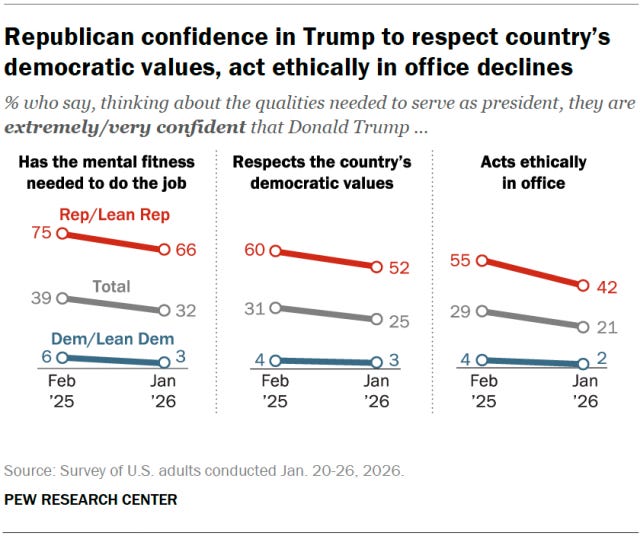
The Trump floor. Most Republicans in Congress sit in deep-red districts where Trump’s overall approval among Republicans is still in the low 60s. With oil prices rising daily and questions about Trump’s mental acuity, authoritarianism, and ethics becoming widespread, that floor could crack — but it would crack from a very high base.
Vulnerable Republicans are already gone. The GOP is down to just 218 seats. Compare that to the 241 they held before losing 41 in 2018, or the 256 seats Democrats held before Obama’s catastrophic 2010 midterm. Today, only three Republican House members represent districts that Kamala Harris won in 2024. The low-hanging fruit has been picked.
Purple voters are gerrymandered out. Among independents, Trump’s numbers are dismal — approval in the high 20s and low 30s — but gerrymandering and political self-sorting have reduced the number of truly competitive districts to the point where those independents don’t have enough leverage to swing many races. Only 8% of Congressional Districts “Lean” red or blue, or are rated “Toss Up.” The vast majority of Americans are independents, but they vote in Congressional Districts gerrymandered to favor one of the two major parties.

So what does all this mean for Democrats? It means that antipathy toward Trump is necessary but insufficient. They need voters to actually want to vote for them. And that requires confronting an uncomfortable truth about why so many voters find the party hard to like.
A Party That Lost Its Base
The Democrats’ likability gap is both a cause and a consequence of a demographic earthquake that reshaped the Democratic coalition over the past three decades.
Non-college voters walked away. In 1992, white voters without a college degree made up roughly half of the Democratic vote. Machinist union members in Ohio, waitresses in Pennsylvania diners, construction workers in Michigan — they had voted blue since their grandparents pulled the lever for FDR. By 2020, that share had been cut in half, to around 25 percent. In a single generation, the Democratic Party’s center of gravity shifted from the shop floor to the corner office.
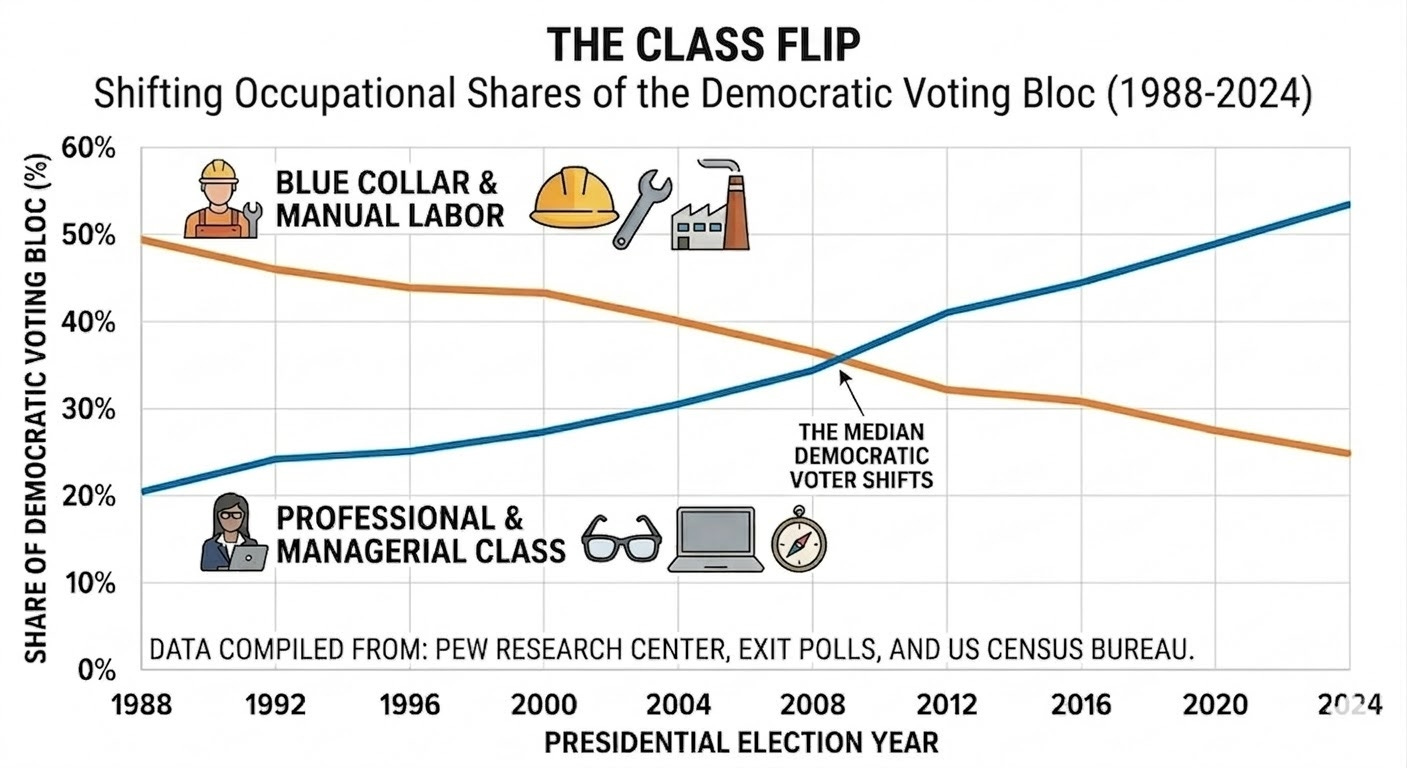
This is the “diploma divide” at work, and its consequences are everywhere. In 1996, Bill Clinton was the last Democratic presidential nominee to win a majority of white voters without a college degree. By 2020 and 2024, Biden and Harris were winning roughly 60 percent of college-educated voters while Trump was capturing about 66 percent of white non-college voters. Education, which was once a weak predictor of voter choice, slightly favoring Republicans, is now one of the most powerful sorting mechanisms in American politics.
Research published by the National Academy of Sciences in 2024 confirms the pattern: voters in the top 10 percent of household income, those with advanced degrees, and those in professional white-collar occupations have moved steadily leftward over the past 40 years. Accusing the Democratic party of being led by and optimized for elites may sound like a Republican talking point. It is also a painful demographic fact.
A seeming counterpoint: Democrats did not lose union members, who still vote Democratic roughly 59 to 39 percent. But today’s union members are more likely to have a college degree than nonunion workers.2 “Union member” now means teacher, government employee, and healthcare manager — not the private-sector industrial worker who anchored the New Deal coalition. The curriculum coordinator and the registered nurse have more political influence in the party than the autoworker, the coal miner, or the steelworker.
Democrats lost rural voters. The diploma divide has a geographic mirror. Professional-class Democrats are increasingly clustered in knowledge hubs — the Bay Area, Austin, the Research Triangle, the Northeast corridor — creating an urban-rural split that maps almost perfectly onto the professional-manual labor divide. Democrats are strongest where the knowledge economy thrives and weakest where people work with their hands.
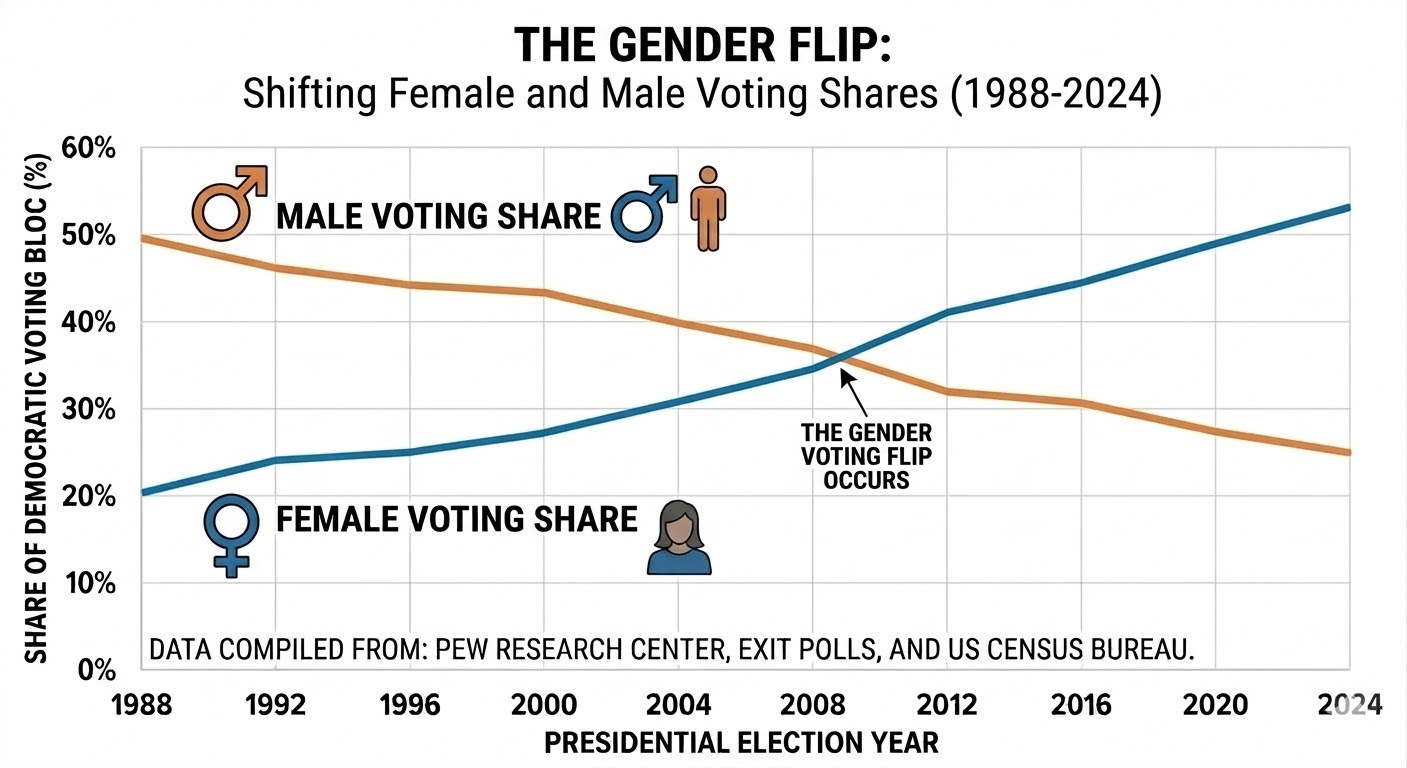
Democrats lost men. The diploma divide also tracks a gender divide. Since 1982, more women than men have earned four-year college degrees; since 1987, more women have earned master’s degrees; since 2006, more women have earned PhDs. Over this same period, the Democratic party moved from a relatively balanced (or even male-majority) industrial-era coalition to a predominantly female-majority one. Women have favored Democratic candidates since the early 1980s, but the compositional flip — where women became the overwhelmingly dominant share of the party’s voters — accelerated in the late 2000s.3
These three losses — non-college voters, rural voters, men — are not separate crises. They are the same crisis, viewed from different angles. And they would be manageable if the shift were simply a matter of coalition arithmetic. Parties evolve. But the diploma divide hasn’t just changed who votes Democratic. It has changed how the party talks, what it prioritizes, and how it makes people feel.
Why This Makes Democrats Unlikable
Analytic messaging. A party dominated by professionals tends to communicate like professionals. It favors complexity over simplicity, frameworks over feelings, white papers over bumper stickers. For all their internal contradictions, Republicans communicate clearly: “Drill, baby, drill.” “Build the wall.” “Make America Great Again.” You can disagree with every one of those slogans and still admit they communicate something immediate and visceral. What is the Democratic equivalent? “Build Back Better” fell flat. “No Kings” and “Democracy is on the ballot” resonate with the base but sound abstract to a swing voter worried about grocery prices.
Elitist messaging. Status-conscious professionals can be condescending — and too many Democrats with graduate degrees who live in a handful of prosperous metro areas treat disagreement as ignorance. Even when they are right on the merits, phrases like “science says” and “experts agree” communicate an unmistakable subtext: we know better than you do. For a voter working for a living in a town that the knowledge-economy boom passed by, that message lands like a slap.
This is the likability gap at its most corrosive. The policies are often not the problem. Majorities support the party’s positions on healthcare, Social Security, and prescription drug prices. The problem is that the messenger class has become so socially and economically distant from the persuadable voter that the message consistently misses the mark. Customers will walk away from the best product in the world if the salesperson makes them feel stupid.
Relatability, Clarity, and Generosity of Spirit
When I say Democrats need to become more likable, I don’t mean they need to smile more or crack better jokes at town halls (although that never hurts). I mean that they need to fundamentally rethink how they present themselves to voters who aren’t already in the coalition — and, crucially, to voters who were in it but walked away.
Likability in politics comes down to three things: relatability, clarity, and generosity of spirit.
Relatability means talking about kitchen-table issues in language that doesn’t sound like it was drafted by a policy shop. It means acknowledging that people’s frustrations with government are often legitimate — even when those frustrations don’t map neatly onto the party platform. It means more beer and less whine.
Clarity means having a message simple enough to repeat. Democrats are often so afraid of oversimplifying that they end up saying nothing memorable at all. The party needs an economic message that a worker on a break can repeat to a coworker. “Your grocery bill should not win the race with your paycheck” makes rising costs personal without mentioning “inflation.” “They cut their taxes and your healthcare” is simple, adversarial, and points at a specific policy choice rather than a vague villain.
Generosity of spirit is the hardest — and the one Democrats most urgently need. It means not treating every disagreement as a moral failing. It means making room in the coalition for people who might vote with you on economics but disagree with you on immigration enforcement or cultural questions. It means retiring the instinct to call people bigots for holding views that were mainstream Democratic positions ten years ago. A professional-class party tends to enforce ideological conformity the way professional-class institutions do — through social sanctions, HR-speak, and the implication that dissent reveals a character defect. Sanctimony is poison in a party that needs to win in Scranton as well as San Francisco.
Follow the Leaders
Fortunately, Democrats already have a proof of concept. The candidates who win tough districts despite a toxic national brand tend to share certain traits: they run on local issues, they don’t sound like Twitter, they project warmth rather than righteousness, and they treat voters as adults capable of holding complex views.
Jared Golden represents a rural, working-class Maine district that Trump won by 10 points in 2024. Golden consistently breaks with his party on gun control and spending, maintaining a credibly independent profile. (Regrettably, he is retiring.)
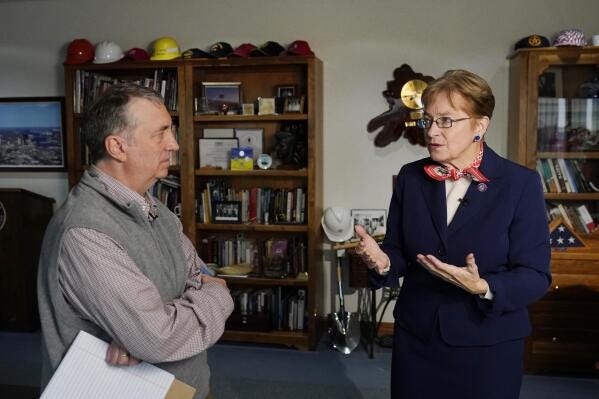
Marcy Kaptur, the longest-serving woman in House history, represents a manufacturing-heavy district in Northern Ohio that has trended significantly Republican. Her relentless focus on trade, labor, and bread-and-butter economics has allowed her to survive even as the surrounding region shifted.
Vicente Gonzalez and Henry Cuellar both represent South Texas districts that saw massive Republican gains in 2024. Despite Trump winning their districts, both won re-election by taking border security and local energy and agriculture interests seriously.
If Democrats want to flip those 20 competitive Republican seats and hold their own vulnerable ones, they need more candidates like these — and fewer candidates who sound like they’re running for the editorial board of a prestige magazine. The impulse to nationalize every race around Trump is understandable but self-defeating. In the districts that actually matter, voters already know how they feel about Trump. What they don’t know is why they should trust the Democrat on the ballot.
This also means the national party needs to give local candidates breathing room. Let the candidate in a Central Valley swing district talk about water policy without having to answer for every progressive position that polls well in Brooklyn. Let the suburban mom running in a Virginia exurb emphasize fiscal responsibility and public safety without being accused of betraying the cause. A party that disciplines its moderates into silence is a party that cannot grow.
The Stakes of Getting This Wrong
The Cook data makes one thing brutally clear: the ceiling on Democratic gains is lower than the base wants to believe, and the floor on Republican losses is higher than it should be given Trump’s pathetic incompetence and growing unpopularity. Democrats could win back the House with a net gain of as few as four seats. But they could also fall short — not because voters approve of what Republicans are doing, but because they don’t find the alternative compelling enough to show up.
Trump’s die-hard MAGA base is deeply committed, but it is shrinking. At the start of this year, his approval among Republicans was locked in the 80s. The ICE shootings, the Epstein files, and the attacks on Venezuela and Iran have eroded it significantly — though he remains above 50% with Republicans. More important than the base’s erosion, however, is what it reveals: an enlarging middle of the electorate, reachable by Democratic candidates who stop treating persuasion as beneath them.
Those candidates need to meet people where they are, not where the party’s professional class thinks they should be. They will need to project competence and warmth instead of credentialism and superiority.
The Democratic party spent the past 30 years trading blue collars for blue checks. That transformation brought real strengths — fundraising, institutional power, cultural influence. But it created a party that millions of working Americans no longer recognize as their own. Reversing that perception doesn’t require abandoning the college-educated voters who now anchor the coalition. It requires remembering that a winning party has to feel like home to more than one kind of American — and that nobody likes the HR Department, or a party that sounds like one.
Democrats don’t need a wave. They need a reason for people to join them rather than to avoid the other side. The voters are there for the winning. The question is whether Democrats are willing to do the harder, humbler work of earning their support.
Modern Times will slow down a bit during the next month as your scribe heads to China.
ICYMI
Matt Yglesias on detoxing the Democratic brand.
Richard Haass: Open Hormuz for everyone — or close it to everyone. Smart.
Cass Sunstein on the death of Jurgen Habermas, a postwar intellectual titan.
Why do we eat popcorn in movie theaters?
As idiot teens, my wife and I both chose our colleges in part because the weather was nice on the day we visited. Turns out lots of people do.
Singapore has built cyborg cockroaches to rescue people from earthquake rubble and test old sewer lines. Seems to work.
Cook incorporates private and public polling, candidate incumbency advantages, fundraising, and baggage, national trends including presidential approval ratings and “wedge issues” likely to drive turnout, and interviews with candidates, pollsters, and campaign professionals. The results are widely recognized as the leading nonpartisan political analysis.
Over the past 20 years, their rankings accurately predicted:
99.97% of their “Solid” districts (average winning margin: 36.8 percentage points).
96.5% of their “Likely” districts (average margin: 18.2 percentage points).
92.87% of their “Lean” districts (average margin: 10.6 percentage points).
For technical reasons, this data is a bit hard to come by, but in a 2017 analysis, the pro-union think-tank EPI estimated that 42% of union members had a bachelor’s degree or higher. That same year, the BLS estimated that 40% of the US workforce had a four-year degree or higher.
These charts show the share of Democratic voters among men and women in the total electorate. Republican and third-party voters are not shown, so numbers in any one year do not add to 100%.
Rich kids don’t belong in what should be the labor party. The professionalist takeover of the Democratic machine means working people are being taxed without representation.
Name one city run by democrats where you want to live. I don't know how they keep getting elected