
Even his supporters have decided that Donald Trump is starting to wear thin. Some MAGA fans object to his promiscuous corruption and dishonesty about the Epstein files. Others are annoyed by his autocratic wars and tariffs. Resurgent measles, spiking oil prices, and the killing of Americans by masked ICE agents have proven unpopular. Most voters (56%) now disapprove of Trump’s performance.
At this stage, low approval ratings do not predict presidential election results. Those who wish to elect U.S. Senate and House members who can slow Trump down a notch need to surface leaders who can win elections the hard way. They need to earn the votes of people who hate Democrats.1
Voters dislike Democrats at least as much as they dislike Trump. In polls taken last summer, voters gave Democrats a disapproval rating of over 60% – the highest in 35 years. Even if Democrats’ awful reputation has improved a notch since then, the party has paid a fearsome price for its sustained political malpractice that began during the second half of the Biden administration and continues in many quarters today.
Most Voters are Now Independent
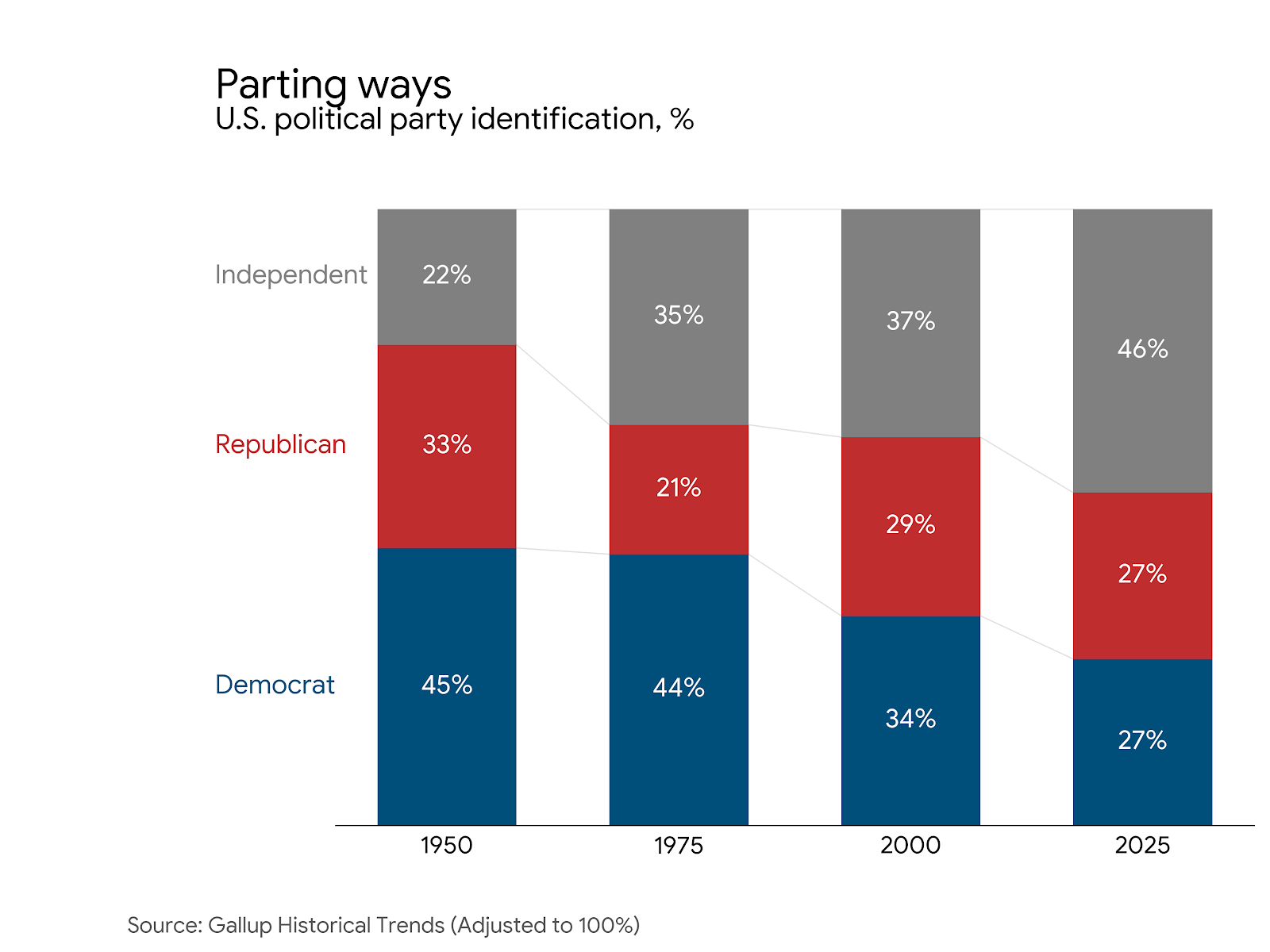
Who are “independents” and why do they matter? In 1950, Gallup found that 45% of voters identified as Democrats, a third as Republicans, and 22% as independents. Today, those numbers have inverted: 46% of voters identify as independents, who now make up a large plurality of American voters.2
Why the big change? Voters have many reasons for identifying as independent, but three matter most.
Views. Roughly 25% of Americans say neither major party represents their interests even “somewhat well.” Some independents are libertarian. Others hold views that are to the right of the Republican party or to the left of the Democrats. Others fled as parties became more ideologically pure. Ryan/Romney Republicans feel as homeless as many globalist Clinton Democrats.
A social shield. As political conversations have become more stressful, more than 60% of Americans now find talking politics with those they disagree with to be “frustrating.” Many identify as Independent to opt out of the perceived toxicity of the two-party system.
Youth. The Independent label is very popular among younger voters. A staggering 56% of Gen Z voters identify as Independent, compared to only 33% of Baby Boomers.
These classifications have many important limitations. On election day, very few voters are “pure” independents who oscillate between the established parties. Most “lean” toward one side, which is why the electorate ends up sorted into roughly equal camps. Gallup finds that when you include “leaners”, approximately 47% of voters identify as or lean Democratic, compared to 42% who identify as or lean Republican.
Why Have Independents Fled the Democratic Party?
Look again at the above chart. In the past 75 years, Republicans lost 6% of their electoral “market share”, but Democrats lost three times that. It is easy to imagine that unpopular Democratic policies drove political independents away. This is only part of the story – and may not be the main problem. With many voters, trust, competence, and cultural resonance matter more than specific policy views.
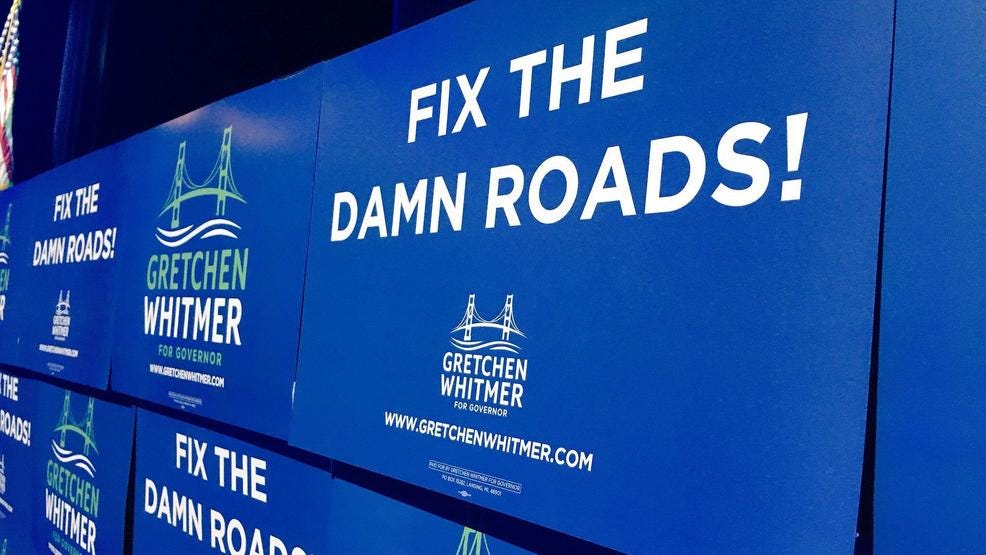
The Competence and Trust Gap. Post-election analyses from groups like Third Way and the Center for Working-Class Politics find that many independents have lost trust in Democrats’ ability to govern effectively. In much of the Rust Belt, for example, research finds that voters have little confidence that Democrats will actually deliver on their promises once in power. In contrast, when “Big Gretch” Whitmer promised to “Fix the Damn Roads,” voters elected her governor of Michigan. When she actually fixed them, they re-elected her.
Many independent and working-class voters have concluded that Democrats prioritize symbolic progress over bread-and-butter economic relief and effective government services. The high cost of housing and groceries remains a primary grievance for many voters, who do not see tangible results from Democrats.
Strange Cultural Orthodoxies. A significant segment of independent voters perceives the Democratic party as “captured” by its most progressive wing, which expresses attitudes that alienate them. Some of this reflects a growing fatigue with race- and group-based identity politics, which many independent voters perceive as either divisive or as the obsessions of highly educated, college elites that ignore more immediate middle-class concerns.
The tendency of some progressives to “name and shame” those who do not embrace the novel use of pronouns, land acknowledgements, or affirmative action is especially off-putting. The use of a parallel language containing words like “gender fluid,” “microaggression,” “BIPOC,” “Latinx, and “LGBTQQIP2SAA+” repels more voters than it attracts.3 It especially offends young men, who are inclined to view the Democratic party as overly scripted and cautious, in contrast to Republicans, who are seen as confident, strong, and unafraid to offend.
Feminization. Democrats have lost men, especially young men. In 2020, young men (18–29) backed the Democratic candidate by roughly +15 points. In 2024, they backed Republican candidates by roughly +2 points – a 17-point swing in just four years. No group in the history of U.S. polling has swung that far in four years.
Astonishingly, young women favored Democratic candidates by 24 points – a 26-point gender gap.4 Again, there is simply no precedent for this in U.S. political history. Until 1980, there was rarely a discernible difference between men’s and women’s party preferences.
Policy Disagreements. On a handful of high-salience issues, independents express a marked preference for either the conservative or the “neither” option. Democratic tolerance of inflation, border insecurity, and crime has caused some moderate voters to become independents. Instead of inspiring a return to liberal or democratic principles, anti-Trump “resistance” rhetoric has often confirmed many of these voters’ views that Democrats have nothing constructive to offer.
Some Democrats Excel at Reaching Independent and Republican Voters
Importantly, not every Democrat is unpopular. Some Democratic leaders have demonstrated the ability to avoid the elitist attitudes, tone-deaf cultural progressivism, and loopy policies that drive away mainstream independents essential to defeating Trump and his successors. They focus on winning independent and moderate Republican voters instead of counting on Trump to self-destruct.
These leaders are not always the largest vote-getters. As an example, picture two successful Democratic governors. One carried his state by five points, the other by 18 points. Many voters might conclude that the second governor would make a stronger presidential candidate. But the first governor overperformed in a deep-red state; the second underperformed in a deep-blue one. How effectively a candidate recruits independent voters is a much stronger indicator of national electoral potential than raw vote totals.
The governor who won by five points is Andy Beshear, who was elected governor of deep-red Kentucky in 2023. A year later, Donald Trump carried the state by 31 points. Beshear outperformed partisan expectations by 36 points by isolating his personal brand from the national Democratic party. In 2022, Josh Shapiro did the same thing in Pennsylvania, where he won by 15 points in a state Trump narrowly carried.
The governor who won by 18 points is Gavin Newsom, who in 2022 was elected governor of a state that Joe Biden carried by 29 points two years later. Given how blue California is, Newsom arguably underperformed by 11 points. Likewise, JB Pritzker won the Illinois governorship by 12.5 points in 2022. This is a strong victory in any context, but he trailed Biden’s 2020 margin by roughly 4.4 points.
Among political analysts, comparing a candidate’s performance to the state or district’s partisan baseline is sometimes called a “Wins Above Replacement” analysis – a reference to a Moneyball metric used in baseball. A WAR analysis shows which candidates outperform either the national ticket or the partisan baseline voter registration in their states.5
To win nationally, Democrats should field their most electable candidates – those best able to reach independent and opposition voters despite the ideological headwinds in their state or district. The following chart shows a WAR analysis of how different Democratic candidates performed not against Biden, but against the share of registered Democratic votes in their state or district after accounting for incumbency effects. This is a measure of broad electability.
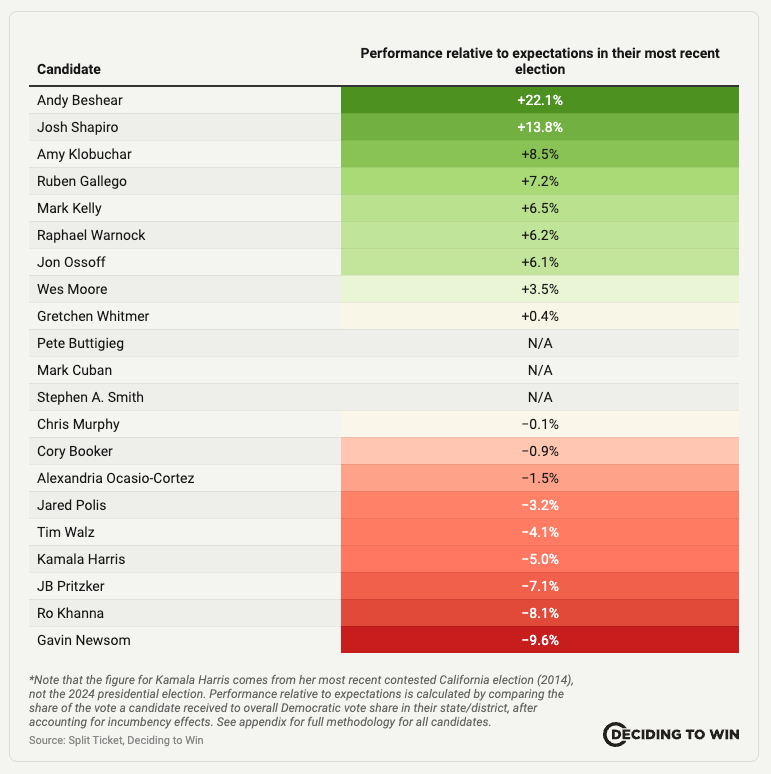
These rankings make it immediately obvious that Democrats are not prioritizing candidates with a proven ability to attract independent and opposition voters. Instead, they are boosting those at the very bottom (or fourth from the bottom). But politicians from deep blue states are never forced to reach independent and Republican voters.
The main problem with the two Democrats that Trump beat was not that they were women — it was that they hailed from deep-blue states and had no experience or instinct for reaching independent voters. For this reason, I’d prefer all Democrats from California and New York to stay out of the 2028 presidential contest.
Mobilize the Democratic Base – Then Ignore Its Advice
Democrats from red or purple states who consistently win independent and moderate Republican votes have several things in common. They uphold core Democratic values, but rebrand their progressivism less around policy details and more around competence, caring, and common sense.6
They emphasize speed and deep competence in getting things done, even if it upsets the bureaucracy or its public-sector unions.
They uphold health care, education, and housing as human necessities that cannot be left entirely to private markets. They listen to and speak for men – especially young men.
They repudiate cultural views and elitist attitudes that have made the Democrat brand toxic to many independent and male voters, even when it alienates the dozens of well-funded groups built to promote specific identities or causes.
These purple or red state candidates recognize that their party base can be their worst enemy if it lures or browbeats them into taking positions that are untenable with independent voters. They have demonstrated the skills and charisma to both win primary contests and reach independent voters in a general election. These skills are not always compatible – but Bill Clinton and Barack Obama each found a way.
Democratic leaders such as Beshear, Klobuchar, Shapiro, and Gallego, and dozens of local counterparts, have demonstrated an ability to reach independent voters. They represent the Democrats’ strongest hope for a national movement to remove the stain of Trumpism from American life.
ICYMI
The always-worthwhile Martin Wolf argues that we are overthinking the fertility crisis.
It was the most graceful and most Oaklandish performance at the Milan Winter Olympics. My neighborhood already has its first Alysa Liu street art. Our hero returned home today, and the Town is abuzz.
Working with AI, she published more than 200 romance novels last year.
Brains, brawn, and batteries: the market for humanoid robots explodes.
Congress restored most of Trump’s budget cuts.
Presidential approval ratings are weak predictors during the first three years of a presidency, but become significant by March of the election year. For example, the same presidents achieved both the highest and lowest approval ratings ever recorded. George W. Bush hit 90% approval after 9/11, and Harry Truman scored 87% after winning World War II. But Truman also recorded the lowest presidential approval rating ever, at 22% in December 1952, and George W. Bush hit 25% during the 2008 financial crisis. Truman was so unpopular that he chose not to run for re-election.
An updated Gallup poll in January 2026 found that 45% of Americans considered themselves independent.
Lesbian, Gay, Bisexual, Transgender, Queer, Questioning, Intersex, Pansexual, Two-Spirit, Androgynous, and Asexual.
Some datasets, like the Tufts CIRCLE analysis, place this “gender chasm” even higher—at 31 points—arguing that young men actually favored the Republican candidate by as much as 14 points (56% to 42%). In comparison, women favored the Democrat by 17 points (58% to 41%).
No metric is perfect, and any metric can deceive. For example, WAR rankings reward candidates who draw comically weak opponents (Hershel Walker raised Raphael Warnock’s WAR). The best WAR calculations, including the Deciding to Win chart, adjust the baseline for incumbency bias. Because WAR computations require a solid baseline, they are difficult to establish from primary races. Pete Buttigieg ran in several primaries in 2020 and dramatically outperformed his polling expectations in Iowa and New Hampshire. By the time the race moved to South Carolina and Nevada, however, he underperformed his polls, which, in any case, are a problematic baseline for judging performance.
Also coherence, but that is one “C” too many. Trump’s TACO tariff policy has been visibly incoherent, as has his offer this week to negotiate with the decapitated Iranian regime while urging its citizens to overthrow it. His energy, foreign affairs, and immigration policies fuel the inflation he claims to be fighting. It’s not enough that Trump’s policies are bad – they frequently contradict each other.
How do the “plus” Democrats succeed in the Presidential primary system where their broader appeal is not an advantage without independent voters? For example, consider Amy Klobuchar in 2020.
I feel like any voter who HATES one party isn't really independent. Unless they also HATE the other party. I've always felt like at least half the "libertarians" I meet can call themselves that, but they vote almost always for Republicans. It's telling that a lot of Republican voters aren't proud enough to register as Republicans, even if that's how they vote. The real issue for me are the progressive voters who reject Democratic candidates for not being 100% with them on every issue. And the uneducated voters who believe everything they see on Fox News, hear in church, etc., and understandably don't vote for the Democrats they believe eat babies and want to make any gun ownership illegal, etc.