
When the President of the United States proposes something completely insane and then backs down, it is helpful to ask what happened. How important were the reactions of capital markets, his supporters, and his adversaries to his decision to reverse course?
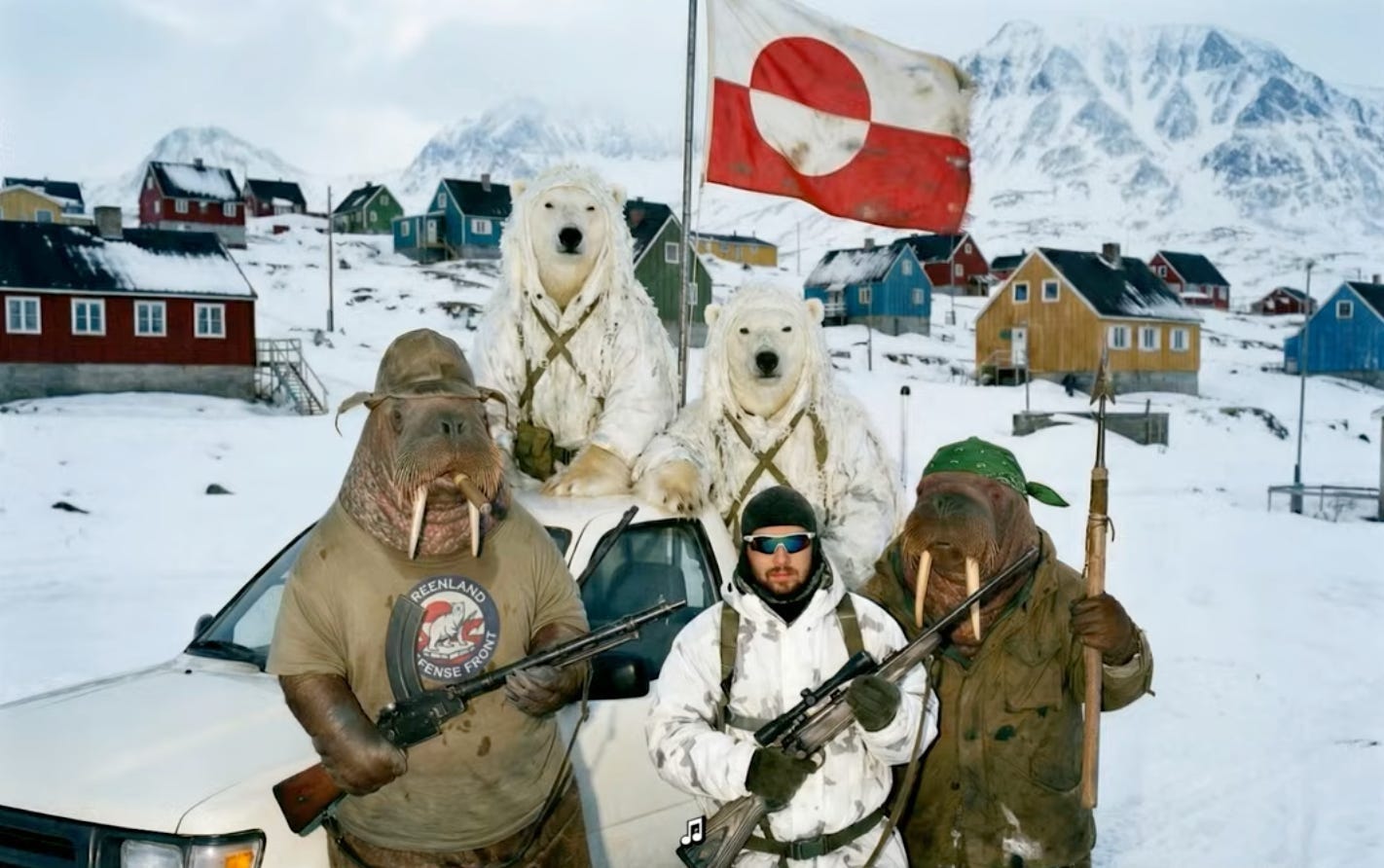
An increasingly demented Trump repeatedly and seriously proposed to seize Greenland from Denmark and to impose tariffs on any country that stood in his way. This idea qualifies as insane because:
We already get everything we want from Greenland, a massive island covered with tundra a mile thick that supports fewer people than the city of Kalamazoo, Michigan. Why steal the cow when we already get the milk for free?
Denmark, a staunch NATO ally that sacrificed more men per capita in Afghanistan than the U.S. did, does not want to give it up.
Taking Greenland by force would destroy NATO, which needs a proper scrubbing, not a neutron bomb. (Pro tip: when Putin’s henchmen assure you that by proposing to seize Greenland, you will “undoubtedly go down in the history books, and not only in the history of the United States, but in world history,” it’s time to pause and reflect.)
Trump’s plan was comically ill-considered. He told the New York Times that he felt owning Greenland was “a psychological necessity”. He then explained to the Prime Minister of Norway that he wanted Greenland because the Nobel Committee had not awarded him its Peace Prize.
The Reactions
This led to an interesting week.
Market Reaction. On Monday, Trump threatened to impose tariffs on European allies and use force to seize Greenland. On Tuesday, markets suffered their biggest losses since October. The S&P 500 dropped around 2.1%, wiping out $1.2 trillion in value and all of the 2026 gains to date. The Nasdaq Composite plunged more than 2.4%, so it’s down more than 1% so far in 2026. On Wednesday, Trump backed down. He ruled out military force, suspended his tariffs scheduled for February 1, and announced a vague “framework of a future deal”. Wall Street rallied immediately.
Republican Reaction. GOP leaders nominally allied with Trump stood up to him to an unusual degree. Sen. Mitch McConnell warned of “catastrophic strategic self-harm”, asserting that seizing sovereign territory would “shatter the trust of allies.” At the same time, Sen. Roger Wicker, ranking member of the Armed Services Committee, stated the topic “should be dropped” entirely. With any Greenland treaty requiring a two-thirds vote in the Senate, Trump faced a wall of opposition from his own party, making the formal acquisition of Greenland legally impossible.
Allied Reaction. Rather than scrambling to make individual deals, EU leaders promised an “unflinching, united and proportional” response to any U.S. tariffs. NATO Secretary General Mark Rutte intervened directly. He brokered the obviously face-saving “framework” at NATO meetings in Davos by shifting the conversation from a bilateral hostile takeover to a multilateral security discussion.
Canadian Prime Minister Mark Carney gave an outstanding speech at Davos that captured this sentiment magnificently. He described the end of the era underpinned by United States hegemony as “a rupture.” He outlined options for “middle countries” like Canada and EU members that are democratic and wealthy but not hegemonic. At the end of his speech, business and political leaders from around the world rose to give him a prolonged standing ovation, which is unheard of at Davos. It may prove to be a historic speech. I strongly recommend reading it.
The Third Bazooka
When Trump says he wants negotiations “immediately,” or claims to have reached some “framework” with NATO, European audiences are not reassured. They hear a willingness to normalize territorial bargaining backed by asymmetric power. They recall Churchill’s warning to Neville Chamberlain after he signed the disastrous Munich agreement with Hitler in 1938: “You were given the choice between war and dishonor. You chose dishonor, and you will have war.” It sets off massive alarms in countries whose entire security architecture is built on rejecting that logic.
Some European leaders even fantasized about a European “bazooka” — dumping U.S. Treasury bonds in retaliation. That particular bazooka would backfire.1
Others talk about a “second bazooka” – penalizing U.S. tech companies by aggressively enforcing regulations like the Digital Markets Act and Digital Services Act that impose heavy fines and restrictions for non-compliance. Europe hopes this regulatory push will impose hefty penalties on U.S. companies that violate EU data privacy, AI, sustainability, and defense procurement rules. To the extent that Carney’s view of “rupture” with the United States prevails, this sort of enforcement will increase. It will irritate Trump and U.S. companies — but it is no bazooka.
However, even before world leaders gathered at Davos, politicians across Europe began to contemplate a third bazooka. Should they threaten the upcoming World Cup? This would have been unthinkable even a few months ago. A French lawmaker asked whether Europe can “imagine going to play the World Cup in a country that attacks its neighbors” and undermines international law. A senior German conservative said it would be “hard to imagine” World Cup participation if Trump followed through on his threats.
European leaders are right to view the 2026 FIFA World Cup as an exceptional opportunity. It is, by viewership, the largest sporting event in the world. The 2022 World Cup in Qatar reached around 5 billion people, with approximately 1.5 billion (nearly one in five humans worldwide) watching the final match. This dwarfs events like the Super Bowl (seen by about 115-125 million).
The 2026 World Cup will take place from June 11 to July 19, 2026, across 16 host cities: 11 in the U.S., 3 in Mexico, and 2 in Canada.2 This is no mere sporting event – it is a massive soft-power project with hundreds of thousands of visitors and billions of dollars of economic activity. Weeks of global television coverage will frame the host countries as competent, welcoming, and central to the world’s cultural life. The U.S. will celebrate its 250th birthday in the middle of the festivities.
Trump has always understood this kind of power instinctively. Status, spectacle, and displays of domination move him. For Trump, the World Cup is not mainly about soccer. It is about packed stadiums, cheering crowds, and himself in a global spotlight, greeting fawning foreign leaders. The implicit message is that the world has come to America on America’s terms.
Any visible criticism of Trump by world leaders or mass demonstrations during the World Cup will puncture that image. It would tell the world that a critical mass of advanced democracies believe the United States, under its current leadership, has crossed a line that disqualifies it from hosting the premier world sporting event.
French, German, English, and Scottish politicians have advocated for the EU to boycott the World Cup.3 A boycott is impractical for two reasons. First, national football associations, not governments, decide whether their national teams attend the World Cup. A boycott would face a massive collective-action problem in coordinating sovereign athletic federations with different domestic politics. Football associations would face backlash from players whose careers are finite, from sponsors with billions at stake, and from fans who have waited their entire lives for a World Cup.
More fundamentally, sports boycotts rarely work. The Moscow Olympics in 1980 and the retaliatory Los Angeles boycott in 1984 are the canonical cases — and both are widely viewed as failures that punished athletes more than governments. Calls to boycott Russia’s 2018 World Cup after it annexed Crimea went nowhere. So did efforts to derail Qatar’s 2022 tournament over labor abuses and human rights. These failures should make European soccer elites cautious.
Lessons in Combatting Trumpism
This week offers lessons for Trump’s adversaries at home and abroad.
First: American business needs a collective voice beyond the stock ticker. When CEOs oppose policies that plainly hurt their interests, markets notice—and Trump notices markets.
Second: Congressional Republicans should take note. Pushing back on Trump can work. Lawmakers have been ducking their responsibilities for years, but this episode is a reminder that Congress is a coequal branch, not a spectator. Individually, legislators are rarely brave. But when contradicting Trump is less dangerous than explaining his behavior to voters, they will choose self-preservation. Voters should remember that.
Third: Europe needs bigger bazookas. A World Cup boycott may be unrealistic, but using the tournament to embarrass Trump is not. European and Canadian leaders are hunting for leverage over what actually moves him—not tariffs, which come and go; not legal briefs or diplomatic protests, which he ignores—but prestige, spectacle, and dominance on the global stage. Alongside capital markets and fractures within his own coalition, this is where Trump is exposed.
The very discussion of a World Cup boycott signals something deeper: Europe no longer trusts the old mechanisms to restrain American power. It reflects a clear-eyed view that Trump’s America is more vulnerable to symbolic isolation than to history, moral suasion, or law. Domestic opponents of the President—a majority of Americans—can use the World Cup the same way: to affirm democratic norms and practical reforms in full view of the world.
That the World Cup is even being discussed as leverage tells us what’s at stake. Not just Greenland. Not just tariffs. But the norms that once kept geopolitical conflict from corroding long-standing alliances. When the World Cup becomes a weapon, the line between politics and everything else dissolves—and it’s a hard line to redraw.
Musical Coda
There are many reasons that the EU cannot damage the U.S. by dumping Treasuries.
The vast majority of the $8 trillion in U.S. assets held in Europe is owned by private entities, such as insurance companies, banks, and pension funds. The government cannot make them sell.
The move would boomerang if it sank the dollar and drove up the Euro’s value, damaging European exports.
Dumping T-bills would crash the price of the remaining bonds in European portfolios and generate massive losses for European banks and retirement funds.
The Federal Reserve can easily buy Treasuries to keep interest rates from spiking uncontrollably.
If EU entities sold their T-bills, they would have no “risk-free” asset of comparable scale in which to safely park trillions of euros.
In the United States, games will take place in New York/New Jersey (which will host the Final on July 19), as well as in Dallas, Los Angeles, Atlanta, Boston, Houston, Kansas City, Miami, Philadelphia, Silicon Valley, and Seattle. Mexico will host games in Mexico City, Guadalajara, and Monterrey; Canada will host in Toronto and Vancouver.
Calls for a boycott have come from lawmaker Eric Coquerel (France), CDU member Jürgen Hardt (Germany), several UK MPs, and Scottish National party (SNP) figures.