
Between 1990 and 2011, China joined the global trading system and quickly became the world’s factory. What economists now call the “China Shock” refers to the destruction of 2.4 million American jobs in low-wage textile, apparel, furniture, and electronics factories during this period.
This need not have been a shock. The US economy turns over more than 5 million jobs each month and usually creates even more. This means that the China Shock was less than a month of normal job losses spread over twelve years. But the China Shock was concentrated geographically among families with few robust alternatives.1 The US did appallingly little to help affected workers, so by 2016 many of them turned to Donald Trump.
Trump likes to condemn all trade with China as a ripoff for the US. It isn’t. American living standards are higher thanks to low-cost Chinese goods. America exports high-tech software, electronics know-how, aerospace, and finance to China. We have lost factory jobs, but most high-skill, high-margin industries are (or were) complementary rather than directly competing with China. Whether the US helping China to move up the value chain faster than they would have otherwise (as Apple famously did) was generous, strategic, or stupid depends heavily on your view of whether China is a US customer, supplier, or rival. Obviously, China is all three – whether our President can get his head around it or not.2
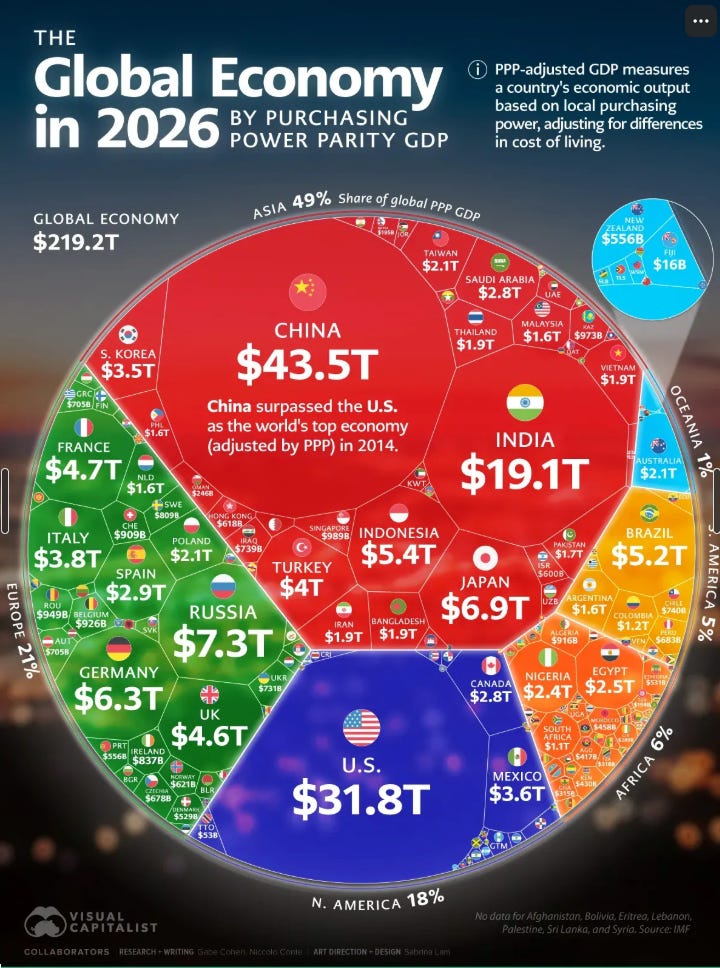
Today we are in the middle of a second China Shock. It is nothing like the first, in part because China is nothing like what it was three decades ago. Adjusted for local purchasing power and cost of living, China became the world’s largest economy twelve years ago. Its $44 trillion economic engine is now one-third larger than the US ($32 trillion) or the EU ($31 trillion, a trading bloc, not a nation).3
Because China is exporting to technically advanced, high-skill, high-wage manufacturing sectors such as automobiles, industrial machinery, chemicals, and precision tools, the second China Shock is hitting Europe harder than the US. Germany, Europe’s largest economy, is especially vulnerable. Germany bet its economy, its national identity, and its legendary social contract on dominating the market for high-end gas cars. China bet on electric vehicles built rapidly, cheaply, and at “good enough” quality. China’s bet is paying off — and the result is China Shock 2.
More China Shocks are coming, and in recent weeks, the outline of China Shock 3 has come into view. The US is now placing the largest bet in world economic history on leading-edge, closed-source frontier AI models and the chips and data centers required to support them. Large tech companies are borrowing real money to finance this bet. But open-source Chinese models now offer “good enough” automated intelligence at a fraction of the prices offered by OpenAI, Anthropic, or Google.
China has already commoditized mobile phones, solar panels, batteries, and much more. If it does the same to AI, our too-big-to-fail hyperscalers will generate too little revenue to cover their debt. Americans who despise big tech will get the bill.
This post describes the Second China Shock and suggests ways to measure whether or not a Third is on the way.
The Second China Shock
China’s explosive growth pulled 800 million people out of poverty – one of the most impressive economic achievements in history. But in the process, the Chinese economy came to rely on a vast, state-subsidized manufacturing ecosystem that, in part, depends on weak domestic demand. Rather than raise wages and expand its domestic market, China directs its surplus capacity outward through exports and foreign investment. It’s a novel form of mercantilism that bears little resemblance to the colonial mercantilists of 17th-century Britain, France, or Spain.
China is now increasing its share of EV sales in both Europe and overseas markets. EU tariffs and trade rules can temporarily protect domestic markets from Chinese EVs, but they cannot protect exports, which make up most of the revenue for European car companies. A worker whose plant is closed cares little whether it is due to the loss of foreign or domestic sales.
The macro environment is also different this time. America’s China Shock came during a period of robust (~3%) underlying GDP growth, but the Eurozone is facing China Shock 2 amidst structural stagnation (GDP growth <1% and falling). This increases the economic and political pain of trade losses.4
China Shock 2 threatens not only the sectors that underpin Europe’s economy but also its much-envied social contract. In one of the great ironies of the age, Chinese communists are refusing to raise the living standards of the proletariat they profess to honor, choosing instead to flood European markets and weaken its struggling social democracy.
Nowhere is China Shock 2 more obvious than the German car industry. Cars account for about 5% of German GDP and ~773,000 direct jobs, plus several million indirect ones. Cars represent 37% of all German business R&D – and the next sector is not close.
In one of the great ironies of the age, Chinese communists are refusing to raise the living standards of the proletariat they profess to honor, choosing instead to flood European markets and weaken its struggling social democracy.
Germany depends heavily on exporting cars to the rest of the world. More than three-quarters of German automotive revenue comes from exports – especially to China. In 2025, however, German auto exports to China fell 33%. Thanks to Trump’s tariffs, exports to the US fell 18%.
China is also squeezing German car sales in Europe. Despite the tariffs, Chinese brands took 10.9% of the European market in June and outsold Japanese brands for the first time in May. Much of that volume is sales of plug-in hybrids, which is how Chinese firms drove around tariffs written for all-battery EVs. Chinese cars are 20-30% cheaper to buy, cost less to operate, and are high quality, even at entry levels.
Chinese cars are rapidly gaining market share. BYD and Chery hit 3-4% share in the UK in a fraction of the time Toyota and Hyundai needed. On a recent trip to the UK, most of the taxis or Ubers we took were hybrids or EVs made by BYD or Chery. Every driver not only praised the quality of the car, but had calculated precisely how much their new car saved them on gas each month. The result: local carmakers lost three points of market share in the first six months of this year alone.
German families are now paying the price for their car industry’s stubborn attachment to internal combustion engines. Volkswagen forecasts up to 100,000 layoffs and has sought unsuccessfully to close four of the company’s ten plants. Porsche has declared that 20% of its workforce is at risk. BMW just announced 8,000 layoffs, and parts suppliers Bosch, Continental, and ZF announced another 33,000.
The German car industry is reacting to low-cost Chinese EVs the way the Swiss reacted to Japanese quartz watches: by reshaping their products from daily tools to luxury goods. Mercedes, Audi, BMW, and Porsche can retreat to upmarket niches, but Volkswagen is uniquely vulnerable (notwithstanding its Porsche and Audi holdings).
More than just cars are at stake. The German car industry is the load-bearing wall of the postwar European social contract. In Germany, codetermination laws give workers half the seats on corporate supervisory boards. The law turned fifty on July 1, and Volkswagen made the anniversary grim. In December 2024, IG Metall and the VW works council agreed to trade 35,000 jobs, 734,000 units of annual capacity, and years of forgone raises for a promise to keep all ten German VW plants open. Eighteen months later, management came back asking to close four plants. McKinsey had advised closing eight. The board, where the state of Lower Saxony votes 20% of the shares, said no. Only the original wage-and-hour concessions now stand. Investors took note, however, and VW’s stock has fallen more than 25% since February.
Codetermination finds itself in a corner. It gives workers dignity, information, and a negotiated pace of decline, which beats the unmitigated chaos that American workers face. German workers can also try to veto corporate responses to competitive pressure, but rejecting a restructuring plan without offering an alternative is a veto that may ultimately cost more jobs than it saves.
Worker influence is declining in Germany. Half of the country’s largest firms have found ways around supervisory boards. Union election turnout is at a record low, and the right-wing populist AfD is building support among workers at plants VW has threatened to close.
Are the Chinese Cheating?
Labor unions reflexively accuse Chinese carmakers of selling EVs at below-cost prices. This is one of the main justifications for tariffs against China (national security is the other, often stronger one).
To be sure, China provides all sorts of support to EV companies and to car buyers. Beijing stokes domestic EV demand through tax waivers, local fleet mandates, and consumer rebates—though, as in the US, many of these have lapsed. Some provinces offer financial incentives to retire gas cars and make it much easier to register an EV than a combustion vehicle. But subsidies to boost demand inside China don't explain why Chinese cars are crushing competitors abroad.
The Chinese government also subsidizes EV production. These subsidies include government financing for automotive R&D, state aid for land purchases, and low-cost loans. (Companies like Tesla that operate plants in China also receive these subsidies).
How big are these? Rhodium Group decomposed BYD’s $ 4,700-per-vehicle cost advantage over a Tesla built in China and found that direct government grants account for about 6 percent of it, roughly $292 per car. Vertical integration and lower overhead account for at least three-quarters of the advantage. Add plants running at very high utilization, suppliers paid on stretched terms, and development cycles able to ship a new model in eighteen months, and the Chinese have a structural cost advantage that tariffs can delay but never close.
Chinese cars became good, cheap, and ubiquitous in part because EV competition in China is a bloodbath. Most carmakers (56%) lost money in 2025. 227 models cut prices in 2024, bringing the industry profit margin to a record low 4.1%. Beijing has responded with an official “anti-involution” (反内卷) campaign and has summoned executives to justify below-cost pricing.
Chinese automotive overcapacity is stunning. Goldman estimates that the 126 car brands emerging from China could meet 100% of global EV demand. Once again, China has overbuilt an industry (it did the same in housing and solar panels). This time, however, it is exporting the wreckage. This past June, China became the first country to export over a million vehicles in a single month (partly to avoid tariffs that kicked in on July 1). Importantly, it did so as Chinese domestic car sales fell 21.1% in the first half of the year.
But China’s structural advantages gained through scale, vertical integration, and manufacturing know-how are formidable. For this reason, the US and Germany should combine tariffs with an invitation to China to open local assembly plants that guarantee workers the ability to bargain collectively and to have a voice, but not a veto, in workplace decisions. The US needs to force China to build an automotive supplier ecosystem in North America, just as China forced Apple to train the technicians that soon figured out how to build EVs.
The US and Germany should invite China to open local assembly plants that guarantee workers the ability to bargain collectively and to have a voice, but not a veto, in workplace decisions.
Tariffs are a tactic in this fight; they are not a strategy. They only work on things that arrive in containers. This matters, because the Third China Shock is arriving over the internet.
The Third China Shock
The third China Shock is coming in AI, and it will hit the US far harder than the EU. America has built roughly 44% of the world’s installed data center capacity. The EU holds about a tenth.
AI is a treacherous industry to analyze because so much is happening so quickly and because US tech companies are taking four simultaneous risks: investment risk, revenue risk, political risk, and retreat risk.
1. Investment risk.
Alphabet, Meta, Microsoft, and Amazon, the four largest players in the data center race, have now committed nearly $2.4 trillion to leases, buildings, energy, and equipment for AI infrastructure. This is 5-10 times the investment these companies announced just one year ago. Back then, these companies generated more than $200 billion in free cash flow, and activists (foolishly) complained about stock buybacks. Today tech companies consume more cash than they produce – and stock buybacks are a distant memory.
Tech’s share of total US investment in chips and data centers now accounts for nearly all recent economic growth. These investments now account for almost 5% of GDP (chart) and for a record 40% of all US capital investment. AI-driven companies account for 45% of the stock market and about that share of market growth. Increasingly, AI investment represents a systemic risk that is too big to fail – and investors know it.
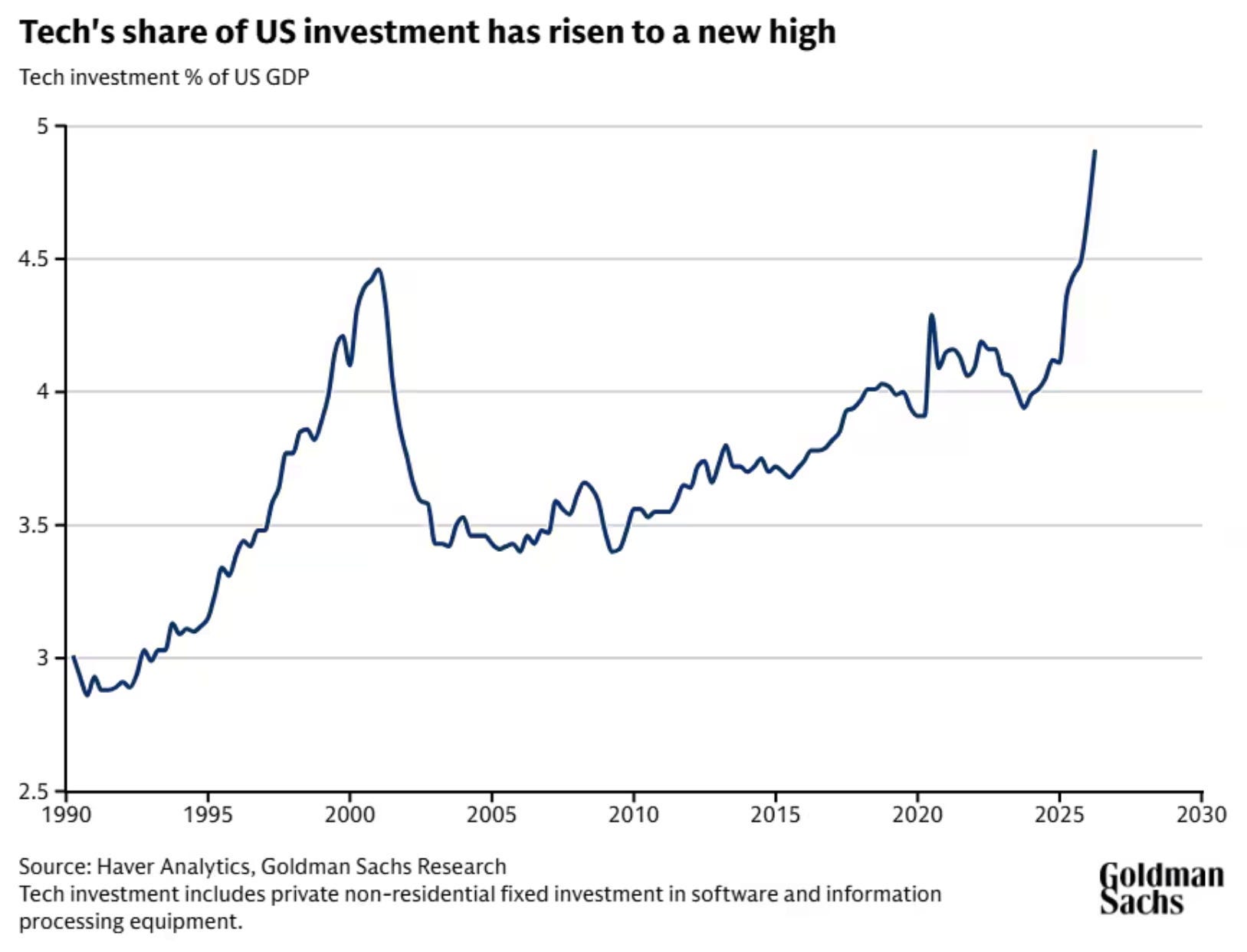
Worse than this moral hazard, AI investment is increasingly leveraged. A year ago, 10% of capex was funded by debt; today, it is 33%. Debt is now another constraint on data center buildout, in addition to chips, power, construction, and local political opposition.
2. Revenue risk.
The Volkswagen problem is repeating itself in AI software. Chinese models like the new Alibaba Qwen 3.8 max announced this week can do eighty percent of the work at one-fifth to one-tenth of the cost. Other Chinese models, like Moonshot’s Kimi K3, are approaching parity with Claude and are priced accordingly.
Evaluating AI revenue risk requires some caveats. To start, tokens are not tasks. To most companies, the cost per finished task matters more than cost per token, and Chinese models frequently require more tokens per task. Also, price gaps are rarely static. China may sell cheap tokens, take share, then move upmarket the way Toyota did when it launched Lexus. Complicating matters further, vendor financing overstates AI revenue and risk. 85% of Google’s net income in Q2 of this year was attributable to paper gains on its investments in Anthropic and SpaceX. For Amazon, it was two-thirds. If frontier lab valuations fall, these hyperscalers not only lose customer revenue, they lose investment gains that they have borrowed against as earnings.
Finally, it is very difficult to tariff AI. Cars ship in containers, but AI model weights ship over wires. Every protectionist instrument that Trump reached for on Liberation Day, or that Europe reached for in 2024, has no software equivalent.
With those caveats in mind, Artificial Analysis built an impressive cost-intelligence matrix of frontier models, showing the cheap-and-smart quadrant dominated by China. A similar chart prepared for automobiles in 2019 would have shown Chinese cars in the exact same position.
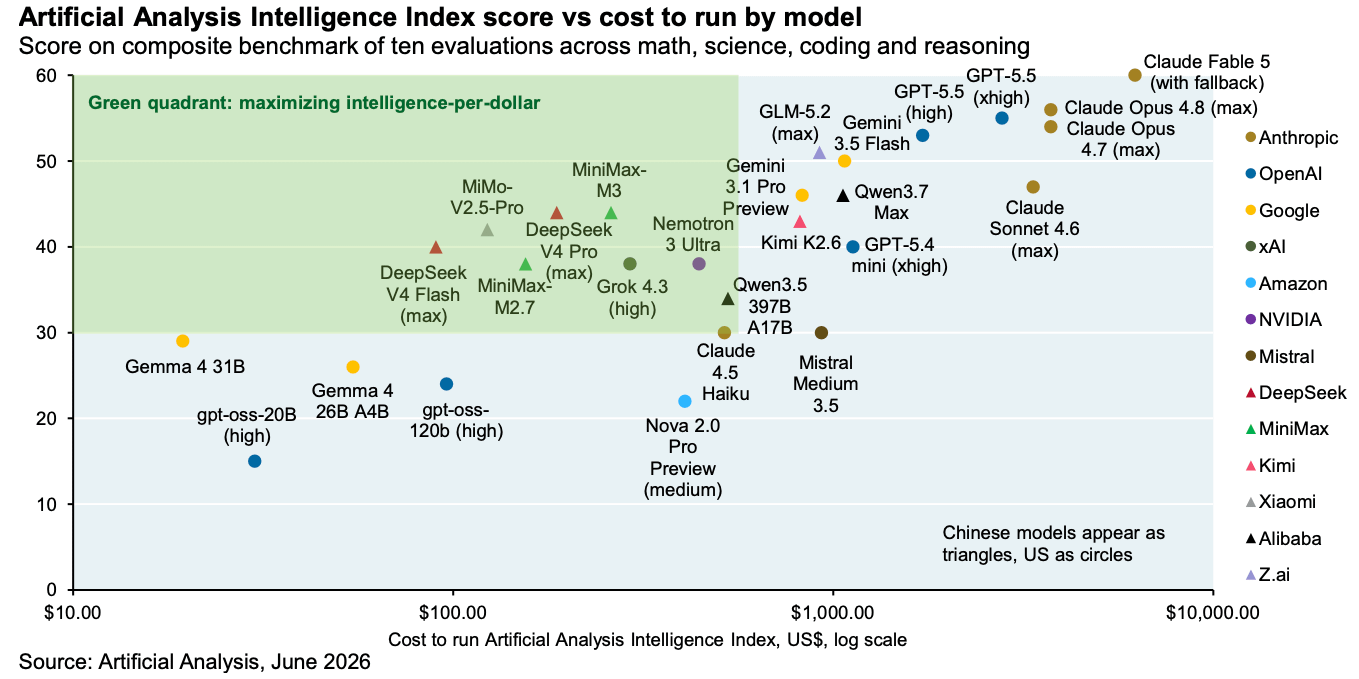
As with cars, low-cost Chinese models today can climb the value stack and become incredibly powerful tomorrow. Many industry analysts, including Stratechery’s formidable Ben Thompson, have argued that cheap Chinese models are good for everyone except OpenAI and Anthropic. Thompson argues that Chinese models enable chipmakers to sell more chips, data centers to run more models, and software firms to keep more margin.
But this is precisely what German automakers said about cheap Chinese batteries in 2019. They argued for commoditizing the inputs and retaining control of the value-added layer, which they took to be branding and mechanical engineering. It did not work because the party that commoditizes the input generates cash that enables them to walk up the stack. CATL did not remain a cell supplier; it evolved into a massive provider of energy technology, infrastructure, and supply chain ecosystems. BYD, now China’s largest automaker, also started as a battery company. Xiaomi, perhaps China’s fastest and most innovative carmaker, was a consumer electronics company known for cheap mobile handsets as recently as five years ago. Today it makes some of the finest cars in the world.
3. Political risk.
Until recently, political risk has been deeply underrated in Silicon Valley. No longer. At the exact moment that AI has provided America an indispensable tailwind to economic growth, opposition to it has become the most reliable applause line in American politics. Hatred of AI is one of the very few issues that bring Democrats and Republicans together.
At the moment anyway, Americans despise AI.
They are 20 points more likely to say AI’s effect on society will be negative than positive. Seven out of ten oppose having a data center near where they live.
Data Center Watch’s Q1 2026 report found at least 75 projects worth roughly $130 billion blocked or delayed in a single quarter, matching the whole of 2025 in three months.
Active data center opposition groups more than doubled from 396 at the end of 2025 to 833 by March. More than 300 state data center bills were filed in the first six weeks of 2026. Statewide moratorium proposals appeared in 14 states.

Opposition to data centers has several sources. Some people oppose all industrial construction. Some are concerned about water and power use and pollution.5 Many resent the widespread use of non-disclosure agreements and the granting of large tax exemptions by local governments to fabulously wealthy tech companies, who do not always honor their promises.
Seven out of ten Americans say they do not want a data center built in their community.
But many people fight data centers because they find AI itself objectionable. As journalist Jasmine Sun reported after visiting several communities fighting data centers, AI is “...an avatar for a small group of Silicon Valley billionaires’ ability to impose their vision of the world onto everybody else without their consent.”
Ultimately, political uncertainty and volatility represent a tax on technology development. We saw the impact of an uncertainty tax on federal clean energy policy when it ping-ponged from Carter to Reagan to Biden to Trump. In July, New York Governor Kathy Hochul, a pro-growth Democrat, ordered a pause on all state environmental permits for projects at 50 MW and above for up to a year. Her order includes a plan to repeal sales tax exemptions for large data centers. It is the first statewide data center moratorium in the country, and unlikely to be the last.
The contrast with China is acute. China set long-term goals and pushed its companies to build global monopolies in solar, EVs, electronics, drones, rare earth minerals, and more. It is doing the same thing in AI, whether people like it or not. But it has drastically reduced pollution.
4. Retreat risk.
High-cost American frontier labs may retreat to serving a small number of high-paying customers, as German carmakers are doing. Frontier labs like Anthropic, Google, and OpenAI are likely to focus on cybersecurity, robotics, and biology and let cheaper open-weight models absorb most coding challenges and the 80-90% of humdrum queries. Under this scenario, criminals, spy agencies, and hostile states will fund the recursive self-improvement of the most advanced models. This will force a growing share of tech spending to fund AI dedicated to containing AI malware.
As he often does, Derek Thompson offered a pithy summary of these risks with a question: “Can the US government become China faster than Kimi can become Claude?”
The answer, unfortunately, is no. The experience of Germany illustrates why, and it should serve as a warning to the US and the industry it now depends on. Recall that the German auto industry is being swept away by Chinese imports for three reasons.
Germans invested in the wrong layer of the stack – in branding and mechanical engineering when value had shifted to batteries and software.
Germans faced a rival that got good faster than anyone expected, got cheap faster in the layer that matters, lived on 4.1% operating margins, and was willing to export the resulting wreckage.
Sluggish institutions. Germany’s cost structure is defended by unions built for a world where German cars were always globally competitive.
American AI firms face a similar challenge. They are investing in the wrong layer of the stack: expensive, closed, proprietary inference. But value is shifting rapidly to low-cost commodity systems, which are being adopted rapidly, especially in developing countries.
Like German automakers, AI firms face a rival that became both good enough and cheaper faster than anyone expected. US hyperscalers have spent more time worrying about “Are we investing enough?” than “Who will capture the value?”
We do not have the equivalent of Germany’s labor market institutions, which made its adjustment slow, negotiated, humane – albeit possibly fatal. Instead, adjustment in the US will be fast and brutal. Nobody in a data center town is getting eighteen months of works council meetings.
Instead, they are getting a loose confederation of groups raising hell and lawsuits to block data centers. This is what happens when a country has no institutional channel for industrial displacement. The hundreds of civic, environmental, and anti-AI groups blocking data centers are what codetermination looks like in a country with no codetermination.
Signs of a Third China Shock
Any analysis of AI should offer falsifiable indicators likely to reveal whether China is actually upending American AI and threatening our massive investments. Here are five measures to track:
Debt service. Do hyperscalers grow their cloud revenue fast enough to cover their data center debt and maintain a healthy global market share? If not, the AI caboose will try to outrace the cloud services engine – never a good idea.6
Prices. Does the price of open-weight models remain low or free — or do Chinese labs move up-market as K3 did? Put another way: how much of the inference market can China actually commodify?
Quality and adoption metrics. Do leading measures of AI dominance tip towards the US or China? Benchmarks like Stanford's 2026 AI Index report that as of March 2026, the top US model led the best Chinese model by 2.7% on their benchmark basket. Hugging Face tracks download volume & “likes” that reflect developer interest and open-source adoption.7 Other metrics include consumer web visits and monthly active users (MAUs) on major inference sites8, the launch of notable models, and patent volumes that indicate the future pipeline of AI dominance.9
Balanced growth. Does US GDP, unrelated to AI, recover and constitute at least two-thirds of US economic growth, vs. almost nothing today?
EU somnolence. Finally, does Europe actually build compute capacity, or do initiatives like InvestAI join the long list of “someday” mobilization pledges in Brussels? A $31 trillion EU economy that produces few frontier models and just 10% of global data center capacity is not in the US interest, even if Trump and some European leaders believe otherwise.
In 2000, the Clinton administration argued that bringing China into the World Trade Organization would accelerate its inevitable transition to liberal democracy. The administration was infatuated less with access to Chinese markets than with the belief that trade would lubricate the CCP’s “soft landing”. Today, this looks shockingly naive — part of America’s ongoing postwar habit of misreading foreign adversaries.
This habit plagues us still. Treating every interaction with Beijing as all-out competition is a form of wishful thinking, because it lets posture replace strategy. Tariffs are the clearest case. They are what a country reaches for when it has decided that something must be done and has not decided what. They will not save Wolfsburg or Detroit, and not even Donald Trump can tariff a model weight.
The first China Shock destroyed 2.4 million jobs, and we did almost nothing for the people who lost them. The bill arrived wearing a weird hairdo in 2016. The Second China Shock is being paid by German workers who have built institutions to negotiate the terms of their own decline. But codetermination is failing alongside the auto industry. The third China Shock will land on an economy in which AI accounts for 40% of capital investment and 45% of the stock market, and it will hit a nation with no industrial adjustment institutions at all. What we have instead is hundreds of citizen groups filing lawsuits to stop data centers, which is the only channel available to people with no other voice.
Building better labor market institutions is not charity toward displaced workers — it is the precondition for making large bets at all. A country that cannot reabsorb the losers produced by its own investments will eventually be prevented from making them. We got Donald Trump for ignoring 2.4 million people. Nobody knows what we will get for ignoring many more people this time.
ICYMI
A new Substack called Labor Innovations — two words that need to be found in the same sentence a bit more often.
Foreign Affairs publishes a blueprint for a better CCP attack on Taiwan. Thanks.
This startup wants to produce brainless human clones for body parts.
Support for the US Supreme Court hits a record low.
Meta is confronting serious legal challenges. Finally.
The doomsday AI scenario that nobody talks about.
Looking for a good heist, rom-com, music film? Check Tuner.
Because most of the jobs lost each month are quits, not layoffs or firings, the China Shock represented more like one month of actual layoffs.
More fundamentally, the famous research that emerged from this dislocation proved that national economies may adjust to trade over decades, but local labor markets adjust over generations. The gains from trade (cheaper consumer goods, higher corporate profits) accrued nationally, while the costs (job losses, wage stagnation, community decay) were concentrated heavily in specific regions and demographic groups.
Researchers found five reasons that the US economy was unable to absorb the China Shock job losses:
Immobility. People stayed put due to housing market lock-in and local family networks that provided childcare and informal financial support.
Local economic collapse. Factory closures devastated local business ecosystems. When a primary employer closed, local tax revenues evaporated, and workers stopped spending at local grocery stores, auto shops, and restaurants, thereby multiplying job losses rather than cushioning them.
Skills mismatches. The jobs created in the expanding US economy during the 2000s required vastly different skill sets, education levels, and geographic locations than the manufacturing jobs being lost by predominantly mid- or low-skilled, older adults with highly specialized industrial experience. A 45-year-old assembly line worker could not easily move into health care without a substantial retraining infrastructure, which the US lacked.
Reentry penalties. Workers relied on disability programs that penalized reentry into the labor market. “China Shock” researchers showed that hard-hit regions saw a sharp, permanent rise in the uptake of Social Security Disability Insurance (SSDI), Medicare, income support, and unemployment benefits.
Little support for transitions. The lack of spending on active labor market policies like direct wage subsidies, government-sponsored apprenticeship programs, and targeted regional retraining initiatives. Existing federal programs like Trade Adjustment Assistance (TAA) were underfunded, difficult to navigate, and generally ineffective at reskilling workers to meet local hiring needs at comparable wages.
Remember the definition of a US “trade deficit”. It means that we import more goods and services than we export. Trade deficits sound bad, but they are always balanced by a capital account surplus—meaning foreign investors are choosing to park their funds in American assets like Treasuries, stocks, and real estate. This foreign investment allows us to consume and invest more than we produce internally. Whether this is beneficial or problematic depends on how we use that capital: funding long-term productive investments strengthens our economy, whereas relying on foreign debt to finance short-term consumption can create financial risks down the road. A trade deficit emphatically does not mean that other countries are “ripping us off”.
Comparing two economies using market exchange rates is misleading because exchange rates only track traded goods and services and fail to reflect the true local cost of living or the real value of non-traded items within a country. For example, at current exchange rates, the US economy is 50% larger than China’s.
Economists adjust for local cost-of-living differences and measure true output and living standards using Purchasing Power Parity (PPP). PPP adjustments are partly art, owing to difficult, infrequent data collection, unmeasured differences in product and service quality, and distorted pricing due to trade barriers. As a result, different economists produce different PPP numbers, but the relative sizes that result typically do not change.
The Iran war has seriously affected Europe. Since the war began, oil has risen from roughly €60 to above €100 per barrel, gas prices have risen by ~60%, and diesel has surpassed €2/liter in several countries. The European Commission warned inflation could exceed 3% and cut as much as 0.4 points from its 1.4% growth forecast for 2026.
Closed-loop designs that recycle water, as air conditioners do, are increasingly common, although consumption varies widely by site. Data centers typically use much less water than a golf course or semiconductor fab. However, as many data centers turn to gas power generators, concerns about air pollution and noise have risen.
At the moment, the US maintains a stranglehold on cloud services. AWS (32%) and Microsoft Azure (23%) control over half the global market, whereas Alibaba Cloud dominates China (~36% local share) but has a negligible (~4%) global footprint.
Hugging Face tracks raw downloads of model weights, indicating where developers are actually building and experimenting. Recent data show Chinese-developed open models capturing 17% of global downloads, compared with 15.8% for US models. DeepSeek-R1 recently became the most “liked” model of all time on Hugging Face, signaling a massive shift in developer sentiment that isn’t fully captured by token vendors.
MAUs measure mass AI consumer adoption (Chatbots, Search, Assistants) by tracking general public usage rather than technical integration. US models are overwhelmingly dominant, accounting for about 93% of global AI web visits.
At the moment, China leads the world in the raw volume of AI research papers, citations, and patent filings. Still, the US leads in “Notable Machine Learning Models”—a metric tracking models that achieve state-of-the-art performance. Stanford’s HAI report finds that in 2025, the US produced 59 notable models compared to China’s 35, suggesting the US still holds the edge in quality and breakthrough capabilities.
Excellent piece, but I suspect the analogy understates the American risk while overstating the German one.
The decline of Germany’s car industry will not simply leave an industrial vacuum. Germany retains precisely the engineering capacity it chose not to use at scale for decades: weapons. Ethically disturbing, certainly—but European rearmament provides a large, state-financed replacement market for machinery, vehicles, sensors, drones and aerospace. It is not beautiful, but it is economically real.
AI has no equivalent fallback. More importantly, “good enough” open models may not merely run cheaply in a Chinese cloud or on an American hyperscaler. They will run at home. The likely architecture is a private household AI hub: an energy-efficient box with ample shared memory, connected to personal devices through a VPN and holding the family’s documents, memories and agents. Phones and laptops become clients; only exceptional tasks are escalated to a frontier model.
If that happens, the economics change completely. There are no recurring token rents for ordinary inference, far less need for centralized data-center capacity—and, crucially, the hoped-for stream of personal data never arrives. That stream, generated by an AI continuously mediating work, purchases and private life, may be the only asset large enough to rationalize today’s valuations and infrastructure spending.
Large data centers will remain useful for frontier training, science and rare specialist tasks. But not on the scale currently being built.
The Third China Shock may therefore not consist of Chinese AI capturing the American inference market. Open Chinese weights may help abolish that market altogether. The token market does not move to China. It disappears.
excellent