
BLUF (Bottom Line Up Front): Clocks and mechanical watches once conferred the power to discipline labor, dominate the seas, and turn time into money. These essential instruments emerged in Switzerland by accident and barely survived two assaults. Late in the 19th century, Americans forced artisanal watchmakers to industrialize; during the 1970s, quartz watches forced them to retreat upmarket.
As tools, mechanical wristwatches have long been obsolete. But in a hyper-efficient digital world, friction and obsolescence can actually deepen human engagement. Vinyl records, film cameras, and typewriters are still purchased and loved by people who engage more fully with mechanical and analog technologies than digital ones. As technological obsolescence accelerates, the artistry of old tools will become an even more important source of hope, affection, and connection.
As a kid in the fifties and sixties, I loved wristwatches because they seemed alive and because every man wore one. But in the mid-nineties, this affection curdled into something strange. As I walked down Union Street in San Francisco with my infant son, I spotted an Oris wristwatch – an obsolete mechanical timekeeper. I bought it, loved it, and slowly, inexorably, pathologically, fell into watch collecting.
The hobby grew alongside my sons. As the new century arrived and Bush became Obama, Trump, Covid, January 6, and Trump II, watches helped order my world. Dials summoned me. Movements hypnotized me. The design, the social history, the absurd little feats of engineering required to keep a few hundred parts ticking on a wrist: all of it helped me cope with the cacophony. This post is about the politics, economics, and geography of these tiny machines, and why an inefficient, expensive object that nobody needs refuses to disappear.
The Politics of Timekeeping
People have always tracked life’s rhythms, but for most of history, humans needed calendars to track seasons, not clocks to track hours. By the Middle Ages, mechanical clocks signaled the rise of new forms of political power. As I wrote in an earlier post:
Time is a social construct, but timekeeping is political. When a public clock came to town, the priest, mayor, or business owner set it to local noon and began to coordinate worship, navigation, commerce, finance, and warfare. Eventually, pocket watches and railroads that required standard times eroded the power of church and municipal timekeepers. Once workers acquired pocket watches, bosses could no longer stretch the workday. Once soldiers got them, military attacks could be far more precise.
By 1400, at least twenty-five English towns had municipal clocks. By 1700, roughly half of England’s parish churches kept time for their parishioners. Accurate timekeeping underwrote the British Empire. Once clockmakers solved the longitude problem, sailors could fix their position at sea, and European powers could navigate, conquer, and govern across oceans. By mastering time, Europeans mastered the world.
From the start, a clock was a tool of discipline and direction. It structured the day, summoned people to work or prayer, and measured when they showed up. Soon, factory workers were required to “clock in”, so employers could quantify their work with unprecedented rigor.
Industrialization hardened this logic. Workers were hired not to finish a task but to surrender defined blocks of their day. The factory clock dominated work schedules because it enabled employers to measure punctuality and productivity with greater precision. The historian E. P. Thompson described this shift from task-based to time-based labor as a pillar of capitalist discipline. Much of life now unfolded on someone else’s schedule. The grim supervisor with a stopwatch became one of the founding caricatures of capitalism.
Railroads and telegraphs required standard time zones (until 1883, the US had 144 local times). Watches broke old information monopolies and built new ones, much as cellphones did a century later.
Pocket watches go back to the seventeenth century, but mechanical wristwatches did not become respectable among men until the First World War demonstrated their advantage in combat. They only lasted six decades. Nobody needed a mechanical wristwatch before 1910, and nobody needed one after quartz arrived in 1970. During that brief window, however, nearly every man and many women wore a small mechanical timekeeper on their wrist.
The Economics of Timekeeping
The Swiss watch industry has been declared obsolete twice. It survived both times by becoming something new.
In the late nineteenth century, America was well-positioned to destroy the Swiss watch industry. Watchmakers like Waltham and Elgin figured out how to use metalworking machines to mass-produce interchangeable parts and accurate watches at a scale and a cost that the shambolic Swiss cottage system could not match. When Waltham exhibited its manufacturing prowess at the 1876 Philadelphia Centennial, a shaken Swiss delegate, Jacques David, rushed home and published a famous report warning his compatriots to modernize or perish.
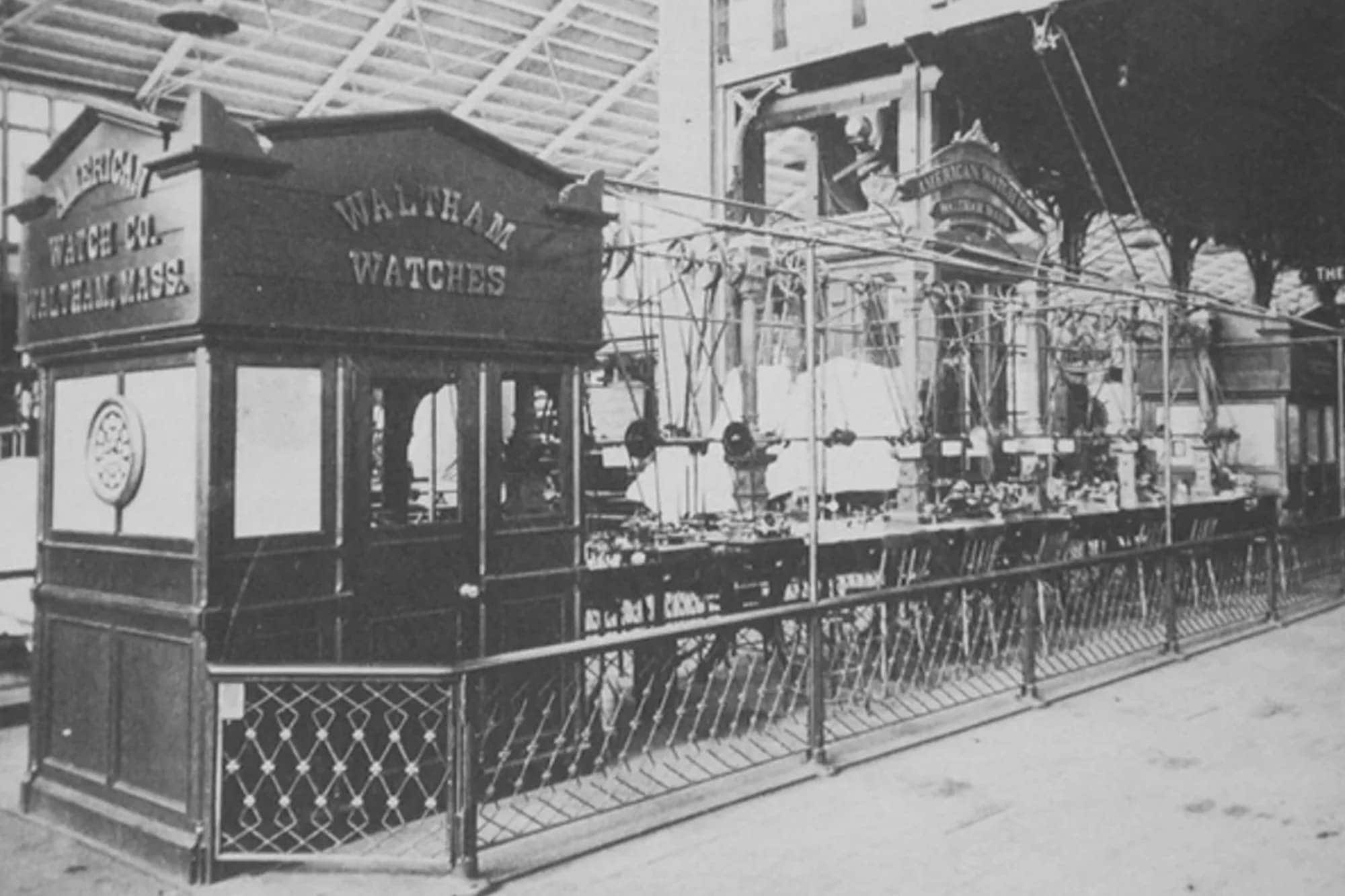
Over the next twenty years, most Swiss watch producers took his advice. After the First World War, they consolidated production into cartels that fixed prices and set production quotas. They used their control over the “Swiss Made” label to turn a national reputation for precision into a mechanism for price collusion.
The second near-death experience came from Japan. On Christmas Day 1969, Seiko launched the first production quartz watch. Quartz watches were cheaper, tougher, and much more accurate. They rendered mechanical movements obsolete and brought Swiss watchmaking to its knees. In 1970, Switzerland had more than 1,600 watch companies; by the mid-eighties, fewer than 600 survived. Watchmaking employment fell from roughly 90,000 to 33,000. Two-thirds of the industry simply vanished.
Those who survived pivoted from function to feeling. Houses like Rolex and Patek Philippe repositioned their watches as luxury goods. A watch became micro-engineered wearable art, an emotional purchase that nobody needed just to tell time anymore.
The pivot worked. According to the Swiss Watch Industry Federation, Swiss watch exports in 2025 totaled about 25.6 billion Swiss francs, or about $28 billion. The industry now ships fewer watches than it has in decades, about 14.6 million in 2025, a multidecade low, and only about 5 million of these were mechanical. The volume keeps shrinking even as revenues remain high, thanks to watches that cost tens of thousands of dollars.
Mechanical watch sales are astonishingly concentrated. Morgan Stanley and LuxeConsult, whose annual report is the closest thing this secretive industry has to an earnings call, estimate that out of roughly 450 active Swiss brands, just four (Rolex, Cartier, Audemars Piguet, and Omega) account for 55% of sales. Rolex alone accounts for roughly a third, with wholesale sales of nearly 11 billion francs and about 1.15 million watches a year. Shockingly to me, the 1.4% of watches priced above $60,000 account for 37% of export value and nearly all of the industry’s growth. The pivot to high-end luxury both devoured mechanical tool watches and saved them from extinction.
The Geography of Timekeeping
Today, mechanical watchmaking clusters in three places: the valleys north of Geneva, the region around Tokyo, and a small German village near Dresden. Each industry was shaped by its own history, and each developed a different idea of what a watch is for.
Switzerland: Calvinist craftsmanship. Swiss watchmaking owes its existence to a religious crackdown that contained an important loophole. In the mid-sixteenth century, Geneva banned jewelry and ostentation. This rule would have ruined the city’s goldsmiths, except that Calvinism prized punctuality and the disciplined use of time, so, under its strict sumptuary laws, a pocket watch was designated a virtuous tool rather than a sinful decoration (four centuries later, the industry would quickly reverse this distinction). Because they could no longer ornament the exterior of watches, jewelers pivoted to refining clock and watch movements.
Earlier Modern Times posts described the rise of Rolex in Switzerland and Seiko in Japan. Another outlined the eerie parallels between Rolex and Apple Computer.
Today, large Swiss watchmakers are more stewards than innovators. This was not always true. During the seventies, the whimsical, artsy, and cheap quartz Swatch generated so much cash that its owners bought up a dozen brands damaged by the quartz crisis. Now, the Swatch Group owns Omega, Glashütte Original, Blancpain, Longines, and several other brands. Richemont, a conglomerate founded by a South African family whose fortune came from diamonds, gold, and tobacco, has been a surprisingly careful custodian of houses like Vacheron Constantin, IWC, Panerai, and A. Lange & Söhne, preserving their distinct identities rather than blending them into a single luxury mush. Adhering to the twisted logic of a true luxury retailer, Richemont destroyed hundreds of millions of dollars’ worth of unsold watches rather than discounting prices and cheapening its brands.
Japan: weaponizing innovation. Swiss watchmaking grew from farmers seeking indoor work during long winters, but Japanese watchmaking grew directly from state policy. The Meiji Restoration prized manufacturing independence, so Japan adopted the Western fixed-hour clock, and Japanese firms quickly moved from importing clocks and watches to making their own.
Seiko became the world’s most relentlessly innovative watch company (thanks in part to Citizen, a serious quartz competitor whose best watches are often overlooked). Seiko built Japan’s first wristwatch and produced a steady drumbeat of world firsts after the war. In 1969, it pioneered the quartz watches that took a wrecking ball to Switzerland’s mechanical watch industry. In 1999, it launched a movement that delivers quartz-grade accuracy from a mechanical caliber (Grand Seiko’s Spring Drive), a feat no Swiss maker has yet to match.
There is a lovely irony here. Japan destroyed two-thirds of the Swiss industry using the very strategy, precise and affordable mass production, that had failed American industrialists a century earlier. The same weapon produced the opposite outcome because the Japanese kept innovating, whereas American watchmakers preferred to collude and try to corner the market.
Germany: surviving catastrophe. German watchmaking lives almost entirely in Glashütte, a small Saxon town that has made watches and trained watchmakers since the 1840s. This picturesque village has a brutal history. The Allies firebombed it (along with civilians in neighboring Dresden) at the end of the Second World War. After the war, Glashütte fell inside communist East Germany, so the Soviets carted off their watchmaking machinery as reparations. They also merged the independent workshops into a single state combine. (Oddly, this protected Glashütte from the quartz crisis, since a planned economy saw little reason to chase cheap battery-powered watches.)
After reunification, watchmaking reemerged quickly from Glashütte’s fertile soil. Walter Lange and the executive Günter Blümlein rebuilt A. Lange & Söhne from nothing. Within four years, watch enthusiasts spoke of Lange as a new Patek Philippe. Glashütte Original emerged from the old state-owned enterprise. Like Lange, it reflected a distinct German watchmaking philosophy: stunning hand-engraved bridges, oversized date mechanisms that snap precisely at midnight, and movements assembled twice so that horologists can test, take apart, clean, and reassemble them for delivery. The Germans take this approach for granted, which is the most German thing about it.
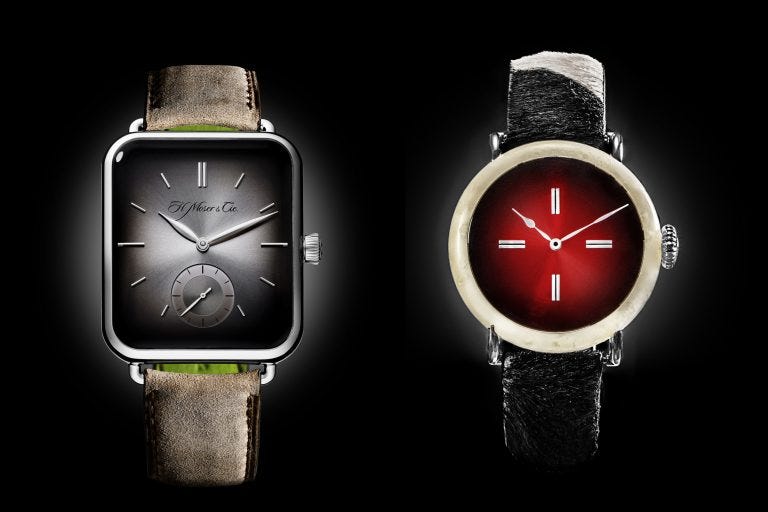
Beneath the industry giants sits a vast and lively world of independent watchmakers organized into three price tiers: insanely expensive, absurdly expensive, and merely expensive. The top tier features museum pieces that cost six figures and up. The fun lives in the more accessible tiers. H. Moser & Cie, a Swiss independent brand, trolls the establishment by making a fully mechanical watch that resembles an Apple Watch. Another Moser features a case made of real Swiss cheese to protest loose “Swiss Made” rules. Sinn, a German watchmaker, builds pilot’s watches proven on space missions. Oris, my first love, issued a watch that displays Kermit the Frog on the first day of each month. Here, instead of a corporate monolith manipulating artificial scarcity, independent artisans use high horology as a canvas for whimsy and cultural critiques. Having been liberated from pure utility, these watches become a space for art, ritual, and even defiance.
The newest indies will not quickly disrupt the staid, conservative Swiss watch industry, but they keep trying. In Glashütte, Nomos has made inroads with Bauhaus-inflected design and an innovative world-timer. Christopher Ward designs in England and builds in Switzerland, and just cracked the industry’s top 50 brands with a direct-to-consumer model, innovative designs, and accessible prices.1 Studio Underd0g injects irreverence, food, and vibrant color into an otherwise serious watch industry. China, which built mechanical clocks five centuries before Europe and then perfected the counterfeiting of Swiss watches, has launched independent brands like Atelier Wen that are the real thing.
Thriving on Obsolescence
So where does this leave a hobby built on obsolescence?
Aesthetically, it’s male, pale, and stale. Its market share is trivial: Apple alone sells roughly twice as many watches as the entire Swiss industry, and Apple is only one slice of a smartwatch market that dwarfs mechanical watchmaking. Simple quartz watches still outsell smartwatches, though the gap is closing. People have many choices for what to put on their wrist, and a mechanical watch is the least practical option.
And yet demand holds. For years, Deloitte’s watch survey asked people what they would do with a financial windfall, and majorities across countries kept choosing a fine mechanical watch over a new smartwatch.2
Mechanical watches are not, of course, the only obsolete technology that continues to thrive. Film photography, vinyl albums, pour-over coffee, lugged steel bike frames, and typewriters for writers who prefer devices that can’t interrupt them. Or candles, fireplaces, fountain pens, and manual transmissions. Even sports like archery, biathlon, and fencing evolved from obsolete military technologies.
To be sure, a watch lover with a well-made mechanical timepiece on his wrist usually has a phone in his pocket, just as a vinyl obsessive keeps a Spotify account. But efficiency can be the enemy of engagement. Those worried about the human future in an age of AI should take heart that obsolescence can liberate objects. Once a thing no longer has work to do, it can take on new and more specialized meanings – as craft, ritual, contest, or signal. It survives as art you love rather than a tool you need.
ICYMI
Ford tried to replace 300 quality inspectors with AI. It just hired them all back.
Although Volvo produces Chinese cars in the US, Trump is blocking its sister, Polestar.
China is launching a factory to produce customized anti-cancer vaccines.
South Korea is investing a trillion dollars in memory fabs.
Alexis de Tocqueville spent only nine months in the new United States, but he hung out with Native Americans around campfires and with Andrew Jackson at the White House. He survived a steamboat wreck, rode with pioneers in Michigan, and watched soldiers drive indigenous Choctaw across the Mississippi. When he got home, he wrote Democracy in America, perhaps the best book on the subject ever. The Economist tells the story well in a new podcast.
Watchmaker Hans Wilsdorf realized that the name “Wilsdorf & Davis” would neither fit on a watch dial nor create a memorable brand. So, thinking of round excellence, he came up with Rolex. Christopher Ward ignored this lesson and insisted on preserving the name of an unworthy co-founder whose name resembles Montgomery Ward. Since the Bel Canto is one of their most exceptional watches, I have long advocated that the company rename itself Aria and give its watches operatic names. Don’t hold your breath.
The picture is shifting: in Deloitte’s most recent study, only about a quarter of respondents prefer a mechanical watch, down from nearly half in 2020 – although interest in buying a mechanical watch is roughly even with interest in smartwatches.
Marty I love this story. there is another chapter. for old people -- and I know this from personal experience and from the population i live with at The Vi -- the case for the Apple watch becomes almost irresistible. My Apple watch asks me if I am OK should I fall -- as I have while bike riding -- volunteers to call for help and in addition can be set up to call anybody I want for help.
Great story. I have a treasured Blancpain from the 70s, when they were making fewer than 40 watches a day. Few understand its significance.