
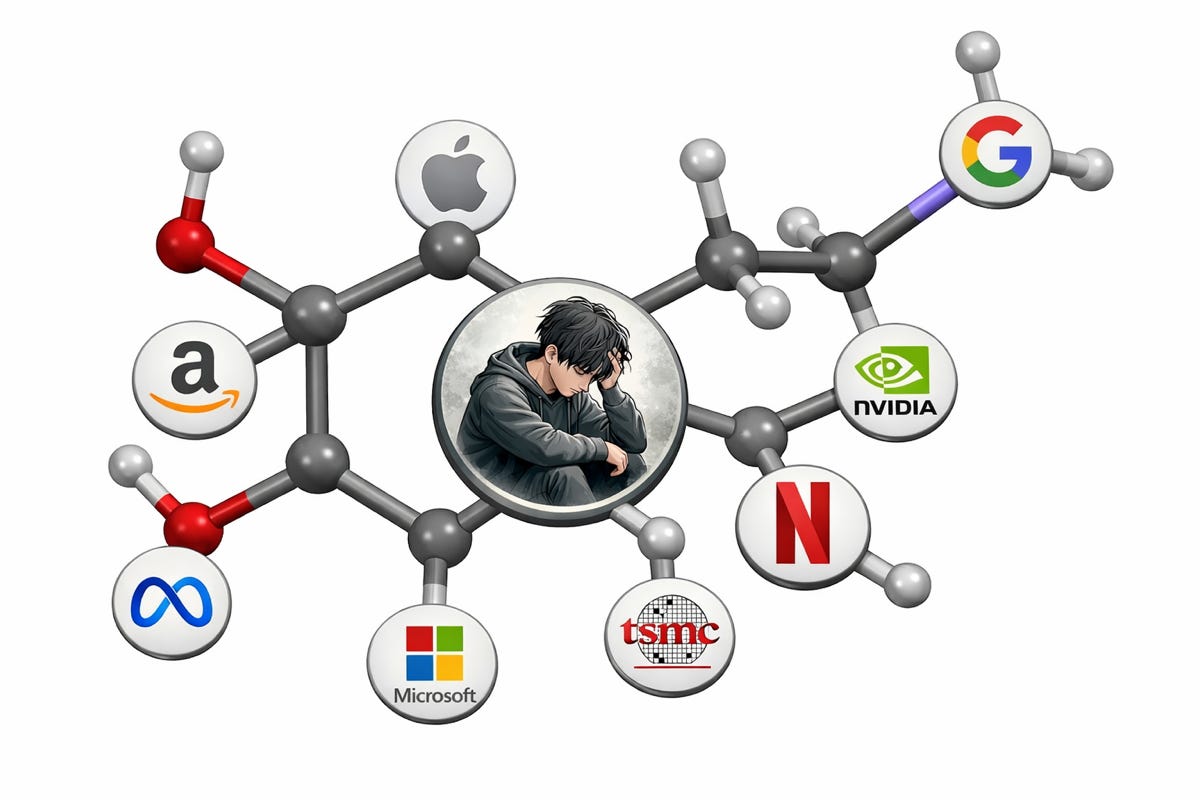
If coal transformed the nineteenth century and oil propelled the twentieth, what critical resource powers today’s economy? Some assert that data is the new oil. Others believe that it’s compute. Or attention.
Now that the first quarter of the century has drawn to a close, I nominate dopamine – the feel-good neurotransmitter that fuels the success of many of our most valuable companies.
Dopamine is associated with both achievement and addiction.1 It provides the kick we get from physical exercise, goal attainment, sex, meditation, music, art, and social connection. It also hooks us on drugs, gambling, ultraprocessed foods, AI chatbots, Instagram, and endless videos.
Dopamine signals the brain, “This is good, do it again,” motivating us to repeat the behavior, whether for survival or pleasure. It’s a powerful hormone. Famously, lab rats wired to stimulate their dopamine receptors immediately become addicted. They will press a lever thousands of times per hour to get a continuous dopamine hit. They neglect food and water to the point of starvation.
Addicts Make Wonderful Customers.
For better and for worse, dopamine is a big part of what makes us human. Every society in history has enjoyed gambling and used psychoactive substances to get high. The ancient Sumerians, Egyptians, Greeks, Chinese, and various Native American communities incorporated opium, cannabis, coca leaves, and other plant-based substances into religious, medicinal, and social practices. By 3000 BCE, gambling with early dice was widespread in Mesopotamia, Egypt, and China. Betting on sports arose very early in ancient Greece and Rome.
Things changed when business strategists in a growing number of sectors began to appreciate the commercial value of dopamine. Of course, drug dealers, coffee shops, and bookies have long relied on addiction to produce repeat customers. Today, however, more companies than ever want to hack your neurotransmitters and make their products addictive. Media companies, sports betting sites, fast-food outlets, AI chatbots, social media platforms, and video games deliberately seek to elicit a sustained dopamine response.
Families and churches have long understood that addiction can be socially contagious, so they try to protect children from drugs, gambling, food, and media they consider harmful. They know that addictive habits do not simply rewire our brains; they induce others to follow. When addiction cascades become large enough, they reshape society and culture.
For this reason, we barely notice addiction cascades that involve sweets, caffeinated beverages, fast food, salty, crispy, cold, or sugary snacks, and sweetened drinks. These foods elicit short-term dopamine spikes and often sidestep satiety signals. GLP medications such as Ozempic or Zepbound work, in part, by interfering with dopamine production and reducing food craving.

It is not only companies that seek to wire us up like lab rats. Increasingly, successful politicians must be able to activate our limbic system. Video natives like Zohran Mamdani and reality TV stars like Donald Trump are instinctively able to elicit a dopamine response. We call it charisma. Leaders who struggle to perform this trick regularly suffer at the polls. Ask Kamala Harris or Tim Walz.
Breaking Bad
As Karl Marx was denouncing religion as “the opiate of the masses,” the British Empire was busy enslaving people to mass-produce addictive tobacco, sugar, tea, rum, and actual opioids. Later in the nineteenth century, a drink that relied on cocaine and high-caffeine kola nuts to trigger dopamine exploded in popularity. Coca-Cola became a global symbol of American freedom and prosperity. Things go better with dope.
Drugs. Cultural norms, rituals, churches, strict laws, and scarcity once helped to control the use of addictive substances. Now we mass-produce highly potent drugs and make them universally available. We argue against infantilizing adults and for letting each person spend their hard-earned money as they see fit. As a result, people today are both freer to choose and much more likely to be addicted to drugs.
About 1.2 billion people are addicted to tobacco worldwide – roughly one in five adults. About half that number, or 600 million people worldwide, depend on alcohol or have an alcohol use disorder. Only about 24 million people have equivalent problems with cannabis (although problems with marijuana are growing rapidly, while tobacco use and heavy drinking have decreased in the US).2
According to the 2025 UN Drug Report, about 316 million people, or 5% of adults, used amphetamine, cocaine, or synthetic opioids during the past year, and about 64 million have drug use disorders. Although they have dropped recently, drug overdose deaths in the US have risen fivefold since the early 2000s. Between 1.5 and 2 million Americans died from a drug overdose between 2000 and 2024 — about 50% more than died of Covid. Synthetic opioids like fentanyl killed more than 100,000 Americans annually from 2021 to 2023. This year, fentanyl overdoses killed more people than gun violence or Covid.
The aggressive marketing of oxycodone and hydrocodone drove the first wave of the opioid crisis. Overdose deaths rose sharply from these prescription painkillers. As controls on prescribing tightened, many people addicted to these meds turned to heroin (the “second wave”). Then came a “third wave” of illicitly manufactured synthetic opioids—especially fentanyl mixed into heroin and counterfeit pills. Fentanyl is dozens of times more potent than heroin by weight, cheap to produce, and easy to ship and mix into street drugs. The result is highly variable potency and a much higher risk of overdose.
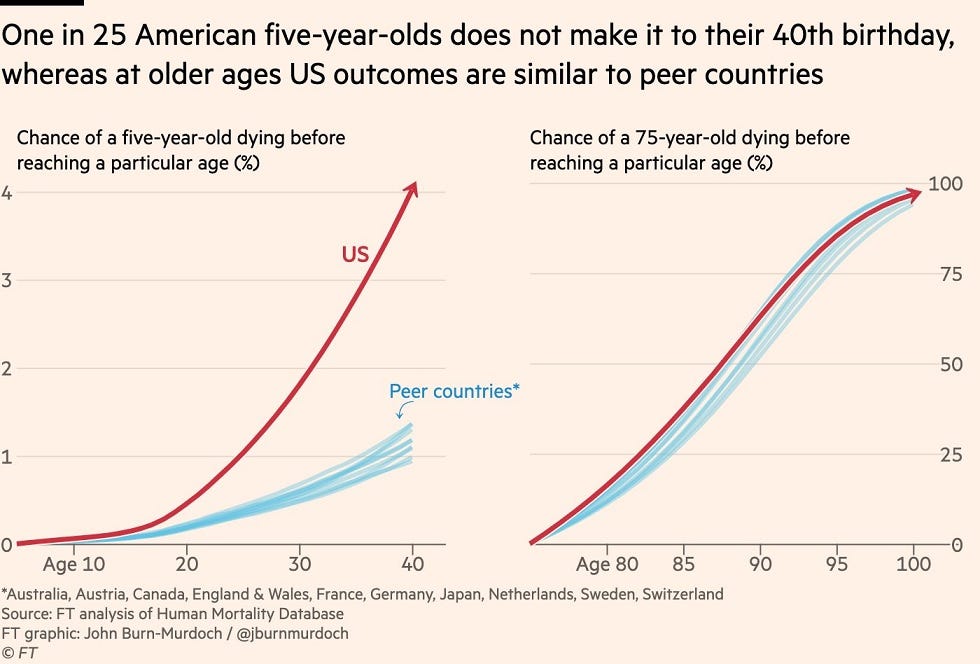
Recently, dopamine entrepreneurs have begun to sell ultra‑potent non‑fentanyl synthetic opioids, such as nitazenes. Some of these analogues are 20 times stronger than fentanyl and hundreds to thousands of times more potent than morphine. Drug addiction, even more than violent crime, has reduced life expectancy among young people in the United States — but our old people live as long as in other modern countries.
Gambling. Gambling addiction is low among the general population, but growing as more Americans become regular gamblers. In 2018, the Supreme Court struck down a federal ban on sports betting. Since then, online gambling has grown about 10% annually. Before the ruling, Americans legally wagered less than $5 billion annually on sports. Today, half of men aged 18-49 have a sports betting account, and they spent $160 billion on sports last year. Men are more susceptible to gambling than women, just as they’re more likely to engage in illicit drug use, drink excessively, or die of opioid-related overdoses.3
Gambling is an expensive dopamine fix. Recent research found that bankruptcies increased 30% in states that legalized gambling. Since 3 percent of bettors account for 82 percent of revenue from bets on NFL games, a few people may be trying to gamble their way out of gambling debt. The tendency of gambling addicts to dig themselves into a deeper and deeper financial hole may help explain why, of all addictions, gambling is most likely to lead to suicide.
Sports gambling has benefited not just from court decisions but from modern digital technologies. Companies like FanDuel and DraftKings exploit the immediacy of bets on your phone. They can target users based on their viewing and betting history and offer dynamic pricing and bespoke bets based on an assessment of how good or bad a gambler you are. Under intense lobbying by the gaming industry, states have created a system that maximizes sportsbook profits at the expense of players' and fans' well-being.
Online gambling goes well beyond televised sports. Buying cryptocurrency is best understood as gambling, as is betting on a wide variety of outcomes on platforms such as Polymarket or Kalshi. The US classifies these markets as financial exchanges that offer “event contracts” – a regulatory distinction, not a functional one. Gaming regulators in many states and several countries, like Singapore, Thailand, and Belgium, have banned Polymarket and its peers, explicitly classifying their activities as unlicensed gambling.4
Digital life. Social media, video gaming, and video scrolling all produce measurable dopamine spikes. The response is smaller than that induced by drugs, but repeated often enough, and users reshape their attention to screens and away from more social activities. These days, questions about video addiction are a rich source of both serious research and moral panic.
Today, eight of the world’s ten most valuable companies help turn dopamine into attention for advertisers. They may sell ads, chips, or phones – but they are in the business of triggering dopamine. It works so well on young people that a quarter of US teenagers believe that they are physically addicted to social media, leading Biden’s Surgeon General to issue a detailed health warning.
Chatbots. We are designing AI chatbots to engage people emotionally by triggering a dopamine response. But there is no need for AI tools to elicit emotional engagement. We do not ask a hammer to give users feedback on the nails it pounds, nor do we ask a search engine refer to itself as “I” when conducting searches. AI does this deliberately by designing bots with social personalities designed to increase engagement. Anthropic was embarrassed recently when its AI Claude disclosed the specs for its “soul.”
Chatbots can even do drugs with you. Users can now pay to get their chatbuddies high using an online marketplace to purchase code modules that simulate the effects of cannabis, ketamine, cocaine, ayahuasca, and alcohol when uploaded to ChatGPT. (I am old enough to remember 2024, when we paid our AIs not to hallucinate.)
Social media. Addictive social media no longer requires a social network. TikTok, for example, neither knows nor cares who your friends are. Its algorithm maximizes users’ dopamine responses by delivering hundreds of videos per hour. Disclosures obtained by the Attorney General of Kentucky revealed that TikTok’s own research showed that users can become addicted within 35 minutes and that “compulsive usage interferes with essential personal responsibilities, including sufficient sleep, work/school, and connecting with loved ones.” TikTok is not unusual. Derek Thompson has pointed out that everything is becoming a TV-like video platform.
Video games are highly addictive by design. As a result, online gaming is now a $180 billion global industry – larger than recorded music, movies, and book publishing combined. The EU estimates that 12% of teens play video games compulsively. Of course, some of these concerns reflect the moral panic of older people worrying about the media habits of a new generation.
But the risk is not trivial. The World Health Organization has officially recognized “gaming disorder” since 2019. In 2021, China imposed the world’s strictest gaming limits for young people. Minors may play online games for only 3 hours per week. Early reports indicate that compliance is high, with more than 75% of gamers under 18 now playing fewer than 3 hours per week. More recent reporting is less optimistic.
In related news, China now produces about half of all AI researchers worldwide.
Porn. Nothing triggers dopamine like real or imagined sex. Porn sites receive enormous traffic. One large site had more traffic in a single month than Netflix, Instagram, or Amazon. Of course, researchers debate how damaging porn is, but survey results suggest that 11% of men and 3% of women in the US consider themselves addicted to porn. These surveys are imperfect, reflecting both underreporting and cultural bias. But if even 3-4% of the population (the low end of global estimates) contend with the consequences of compulsive porn use, hundreds of millions of people may be facing sexual dysfunction, distorted expectations, guilt, and interference with real-life intimacy or responsibilities.
Ultraprocessed food. Unlike drug, gambling, and digital addictions, men and women are equally likely to become addicted to ultraprocessed foods. Food engineers know that salt enhances dopamine release, especially when combined with fat. They add sugars, fats, salt, and sensory intensifiers to various foods. This stimulates neurological reward pathways more than whole foods do. Ultraprocessed foods also use liquids and soft, cold solids like soda and ice cream to short-circuit normal satiety signaling. The resulting salty snacks achieve “vanishing caloric density,” so consumers never feel full. It is no accident that potato chips are among the most addictive foods ever measured.
Part of why GLP-1 drugs seem magical to many people is that they allow users to feel full by reducing dopamine release after eating. Calorie-dense foods typically trigger a dopamine spike, which GLP-1 agonist drugs blunt, particularly for sugar and fat. Food still tastes good, but those who use the meds often find it less compelling. (In my personal experience, wine and coffee actually taste much worse.) The result is to weaken dopamine-driven food motivation, not eliminate pleasure or suppress dopamine globally.
Workable Policies: Add Friction
Obviously, not all addictions are equally damaging. We should not confuse a coffee habit or a nightly dark chocolate fix with a five-hit daily meth obsession. Doomscrolling may be less harmful to a 45-year-old professional than to his 12-year-old daughter (or it may be worse; the research is ongoing).
Moreover, Americans tend to believe that adults have the right to make lousy choices and the obligation to pay full price when they do. As a result, making antisocial choices more difficult is often more effective than banning them outright. Policies that address addiction from different angles – taxes, restrictions, treatment, liability, and education produce greater gains when implemented together. A handful of tools have shown significant benefit across various addictions:
Tax ‘em. One way to reliably reduce the use of an addictive substance is to tax it so that it costs more. Researchers credit a sharp tax increase on tobacco with substantially decreasing smoking. Likewise, alcohol taxes or minimum pricing help reduce heavy drinking. Taxes could help to eliminate free or ultra-cheap bets in gambling. They can prevent exploitative microtransactions in games and can reduce excessive consumption.
There are limits. When taxes become too high, the activity goes underground. At this point, the cost of enforcement often exceeds any plausible benefit. Or (as happened in British Columbia to its famous carbon tax), voters can reject the taxes politically, even if the government rebates them.5
Worse, governments can come to depend on sin taxes for revenue. In 2014, the federal government collected $14 billion in tobacco taxes. Last year, it was $9 billion. Even though public health benefits from lower tobacco sales, budget writers who rely on those dollars must either replace them with higher taxes, cut spending, or borrow more. The problem is worse when, as in New York City, governments borrow against future tobacco revenue or tobacco-settlement-backed bonds. A government that monetizes the proceeds of future tobacco payments ends up fiscally preferring that its revenue not shrink, even if it likes the health outcome.
Ban advertising. Restrictions on advertising, sponsorship, and promotion of addictive products greatly reduce temptation. Comprehensive bans on tobacco advertising under the FCTC helped to denormalize smoking. Several countries ended or will soon end gambling ads to discourage risky play. Some limit ads targeted at teens. Others ban dopamine-triggering features (e.g., by prohibiting social media “like” counts for minors).
Restrict access. Limits on when, where, and to whom vendors can sell addictive products also cut their use. For example, smoke-free public places do not just make smoking harder; they also make it less socially accepted. Limits on the hours of alcohol sales or bar service, caps on the number of gambling venues or machines in a region, and curfews or screen time limits on video games can also reduce overall exposure and impulsive use.
Treat addicts. While prevention is better, it is obviously vital to treat people who are already addicted. Increasing access to treatment programs, counseling, and support hotlines can mitigate harm and aid recovery. Today, only a small fraction of people with addictions receive treatment. Expanding these services and reducing costs saves lives. Publicly supported training for healthcare providers helps them screen for and intervene in risky drinking. Needle exchange for drug users or self-exclusion schemes for gamblers can also reduce immediate dangers and create pathways to help further.
Propaganda. Taxes on addictive products can fund education efforts to change behavior and social norms. These campaigns are especially effective when they are humorous rather than scolding. Graphic warning labels on cigarette packs or calorie counts on alcoholic drinks are additional transparency “nudges” that help consumers make more informed choices.
While education alone doesn’t eliminate addiction, when combined with the above measures, it cultivates a culture of healthy skepticism toward addictive behaviors. Notably, involving communities – for instance, having former addicts share their stories, or engaging youth in peer-to-peer campaigns about social media use – can make these efforts more relatable and compelling.

Sue ‘em. We need to rethink product liability for online platforms. Section 230 of the Communications Act currently shields online platforms from most product-liability suits. The courts have generally held that you cannot sue a platform for third-party content. Section 230 preempts product liability claims from a plaintiff alleging harm from third‑party content.
Recent lawsuits have argued instead that platforms should be held liable for damaging product design. Plaintiffs who argue that rankings, recommendation algorithms, infinite scroll, or UX designed to be addictive are harmful are framing their suit as defective product design, failure to warn, or negligence.
These claims have prompted an active, multi‑circuit debate about how far Section 230 extends to algorithmic recommendations and “optimized for addiction” design. Some judges are more willing than others to treat these as separate from publisher functions, leaving the scope of protection against product‑liability theories in flux.
The direction of these suits seems promising. In that spirit, Congress should retain Section 230 protections for speech, while carving out liability for reckless product design. They should revise the law to hold a platform liable for any feature designed primarily to maximize compulsive engagement, or for any feature that creates a foreseeable and substantial risk of serious harm.
This approach protects individual posts, videos, and comments. It protects neutral ranking, search, and moderation decisions. But it would expose to liability engagement-maximizing design choices that resemble product defects, such as infinite scroll without stopping cues, autoplay chains tuned to maximize session length, variable-reward notification systems, algorithmic escalation toward increasingly extreme content, and the targeting of minors or known vulnerable users.
Holding platforms liable for product defects is hardly radical. It maps cleanly onto existing tort doctrines because courts are familiar with analyzing negligent design, failure to warn, foreseeable misuse, and unreasonable risk. Applying familiar law to digital products does not require a new theory of speech harm. It avoids First Amendment landmines by not punishing viewpoints, topics, political content, or editorial judgment. It regulates behavior-shaping mechanisms that courts routinely permit in statutes concerning drugs, gambling, video games, and consumer finance.
The dopamine economy has always been with us, even if more products take advantage of our neurotransmitters than ever before. Ultimately, we want companies to create addictive products – just not harmful ones. We are entering an era in which it is increasingly important to define which addictions are harmful. There is nobody who can do the job except for us addicts.
Musical CODA
Here, I will refer to dopamine, but human brains are complicated. Several other neurotransmitter systems work with dopamine to reinforce achievement, reward, and addiction, especially in the mesolimbic “reward circuit.” These include glutamate, GABA (Gamma-aminobutyric acid, which is synthesized from glutamate), serotonin, norepinephrine, and several unpronounceable endorphins.
Bespoke alcohol has risen massively: in 2006, the US had 75 bourbon distilleries. By 2023, we had almost 2300.
In general population surveys, about 1–3% of adults meet criteria for problem/pathological gambling, but among people who gamble frequently (weekly or more across several types of gambling), multiple surveys find that a substantial minority show problematic behaviors (roughly on the order of 20–35%, depending on the exact definition and sample) A recent survey of 3,000 Americans found that high-risk behavior is concentrated among frequent gamblers (28-35%, depending on frequency), fantasy sports (24%), traditional sports (17%), young people (15%), and men (10%).
The platforms and their supporters argue that they facilitate trades in financial instruments (e.g., event contracts) for hedging and price discovery, not wagers. They claim to leverage the “wisdom of the crowd” to aggregate information and forecast outcomes more accurately than polls. Critics argue that for the average user, buying a “yes” or “no” contract on a single-game sports outcome is indistinguishable from placing a bet. The critics have the stronger argument, but prediction markets have stronger lawyers and lobbyists. I would not bet money against them.
British Columbia wisely built initial support for a carbon tax by issuing a check for the first year of revenue before it began collecting taxes. Unfortunately, the tax may have grown too high. Despite its effectiveness in reducing emissions, British Columbia eliminated its carbon tax on consumer goods in April 2025, primarily due to rising cost-of-living pressures and increasing political divisiveness. They retained the Output-Based Pricing System, which creates incentives for large industrial emitters to adopt cleaner technologies.