
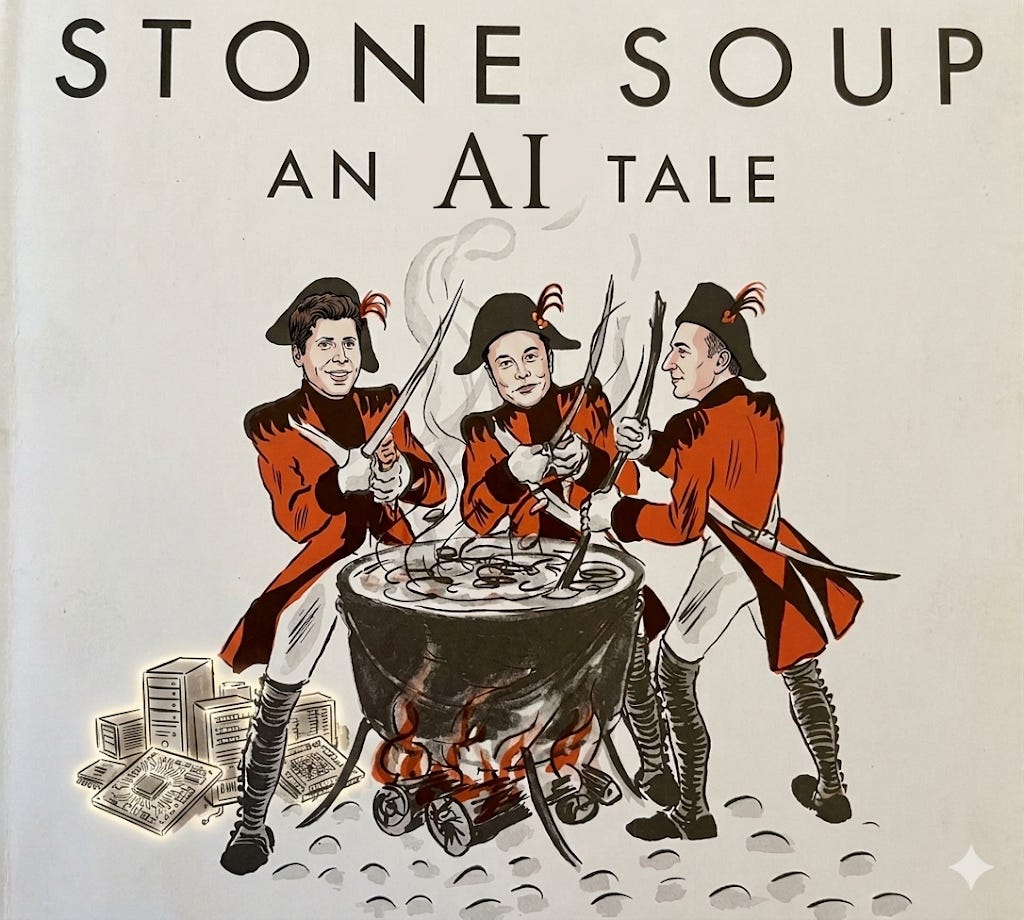
How we govern AI will soon surpass Trump’s corrupt antics, oil wars, immigration, the cost of living, the federal deficit, and collapsing birth rates as the central political issue of our time.
Voters from both parties despise AI. On the left, populists hate tech billionaires and the income inequality they symbolize. Environmentalists dislike data centers. Labor activists fear job losses. Humanists, religious believers, and parents across the political spectrum are finding common cause in their shared distrust of the effects of AI on children and society.
And AI is just getting started. When Americans choose a new president in November 2028, AI will be thousands of times more powerful across many dimensions than it is today.1
The Horror Story and the Fairy Tale
Our public debates about AI swing between a horror story and a fairy tale. Is AI a tragedy of the commons, or is it stone soup?
In 1968, UC Santa Barbara ecologist Garrett Hardin wrote a famous essay in Science titled “The Tragedy of the Commons.” Hardin described how shared resources invite overuse and eventual ruin, as individuals acting rationally overconsume the commons and produce a collective catastrophe. The tragedy is structural. No villain is required. Despite the article’s Malthusian overtones, most economists believed him.
Stone Soup tells the opposite story. A traveler (sometimes three) arrives in a village and boils some water. He adds a stone and announces that he is making a magnificent soup. He explains that his dish needs a few small additions and persuades one villager to contribute carrots, another to donate potatoes, and another to toss in a bit of meat, until a feast emerges that feeds everyone. The traveler then pockets his stone and moves on. (The stone is sometimes a nail or an axe; there are many versions.)
The two stories are symmetric in interesting ways.
Contributions. In the tragedy, individuals extract from a shared pool until it collapses. In stone soup, individuals add to a shared pot until it overflows.
Logic. The tragedy leads each person to reason, “If I don’t take from the commons, someone else will.” In stone soup, each person reasons: “If I add a little, I get back far more.”
Social fiction. The tragedy unfolds without coordination, like a malevolent invisible hand. Stone soup succeeds through a bit of theater and a small social fiction that lowers the barrier to contribution. Religions do this all the time.
Results. The commons turns abundance into scarcity. Stone soup turns apparent scarcity into abundance. The difference between the two outcomes is not just resources or incentives - it’s whether someone can construct a believable focal point for collective action.
AI as a Tragedy of the Commons
Many people see AI as a slow-motion depletion of our shared informational, cultural, and labor patrimony.
AI undermines our cultural commons. Democratic deliberation, science, many laws, and the social trust that enables commerce are collective goods. They emerged from institutions built over generations of struggle to distinguish fact from fiction. Today, every person and organization has a strong incentive to deploy AI-generated content, but the cumulative effect is more noise and less signal in all forms of public and private communication. This is epistemologically corrosive and trust-destroying if it diminishes our shared understanding of reality.
It pollutes our internet commons. The human-generated web is a commons that trained the current generation of AI models. They extracted enormous value from it. Now AI-generated content is flooding back into the same pool, threatening to pollute future training data with synthetic, self-referential output.2 Cory Doctorow described internet platforms like Facebook and Amazon as vulnerable to “enshittification”. Every website with user content is now exposed to enshittification by AI slop.
It threatens our labor commons. I have argued that AI is unlikely to eliminate jobs overnight, but if it steadily reduces nearly all cognitive work, it would devalue human skill and expertise and lead people to invest less in education or mastery. We may end up with less human knowledge, fewer craftspeople, and fewer people who have mastered anything difficult. The accumulated human capacity on which civilization depends would be depleted for individual gain. (This argument can quickly be reduced to the absurd. Most of us no longer add large columns of numbers by hand, but ceding basic arithmetic to calculators and spreadsheets shifted numeracy from rote computational skills towards quantitative literacy and data interpretation. Life did not spiral downward. But AI may not be like spreadsheets.)
AI as Stone Soup
The stone soup reading is more hopeful and equally plausible.
In the tale, the stone gives everyone a reason to contribute what they have. AI tools already play this role for people who were previously locked out of certain kinds of work. Using AI, non-programmers can build working tools. Non-designers can produce something visually coherent. Non-native speakers can write with greater fluency. By lowering the threshold for participation, AI allows more people to add their carrot to the pot. The feast grows as AI recruits new contributors.
Scientific research, medical diagnosis, and legal reasoning are built on knowledge accumulated across generations. No one can master it all. An AI that holds the collective soup allows specialists to add their particular expertise and receive back synthesized insights that none of them could have produced alone. Researchers using AI to discover new drugs or materials are already cooking a richer stew than any prior generation could manage.
AI might also play the role of the traveler himself, arriving with a trick that breaks up artificial scarcity. One structural problem in knowledge economies is that expertise is rationed — not because knowledge is finite, but because credentialing, geography, and cost restrict access to it. AI can dissolve some of those barriers. The best legal reasoning, medical knowledge, and educational scaffolding need not be reserved for those who can afford a lawyer, a specialist, or an elite university. The stone here is AI’s capacity to unlock both the contribution and the benefit of the commons for people who were previously excluded.
This is the insight that earned political scientist Elinor Ostrom a Nobel Prize. She proved that the tragedy of the commons is not inevitable. Contrary to the instincts of most economists, Ostrom showed that real communities protect shared resources such as pastures, fishing waters, and forests by developing their own rules, norms, and governance without top-down mandates or full privatization. Ostrom would read Stone Soup as a fable about a well-governed commons.
Whose Cauldron Is It?
AI presents a twist neither Hardin nor Ostrom anticipated. The political economy of AI today looks less like an open pasture or a communal village pot than like a privately owned cauldron filled with public goods.
A useful comparison is the Inclosure (aka Enclosure) Acts, which roiled 18th- and 19th-century Britain. Enclosure laws privatized common lands, drove peasants into cities, and created the modern working class. Frontier AI models are pulling off something similar: monetizing decades of publicly produced human output — Reddit threads, Wikipedia articles, blogs — without meaningful compensation or consent.
In a classic tragedy of the commons, people stop caring for a resource when they feel excluded from its benefits. That defection has already begun. Some creators are using the University of Chicago’s Glaze or Nightshade to poison their own images so AI scrapers cannot use them cleanly. Users are abandoning Google Search as it enshittifies with AI-generated content and retreating to Reddit, Discord, and other human-curated spaces.3 An underground economy of data hoarding and algorithmic evasion is emerging as high-quality human-generated data becomes a closely guarded commodity.4
The political backlash against AI appears technophobic or Luddite, but it may simply be an inchoate resistance to a massive enclosure movement. Billions of people contributed their carrots and potatoes to the pot through training data, and a handful of tech executives showed up to the feast claiming to own and control the pot itself.
America is about to decide what institutional guardrails we want to ensure that AI serves public needs. Many of the barons of Silicon Valley will favor no regulation at all. Others will be tempted to treat all foundational language models as public utilities, with public auditors monitoring their inputs and outputs for safety and social value. Others will want to construct a public, non-commercial computing infrastructure to ensure that the benefits of synthetic intelligence are distributed broadly. Many of these measures would not only slow AI down but also strangle it in its crib - as their proponents know.
Which story wins and what governance we adopt depends on whether we can create a credible focal point for collective action to manage the risks and socialize the benefits of AI before it depletes our human commons. Stone Soup speaks to us because the traveler fed the village with ingredients the residents themselves provided. The AI stone possesses real, transformative magic. But it only delivers a feast if the community that supplied the ingredients gets to sit down and eat.
ICYMI
What could go wrong? Trump has finalized plans to invade Cuba.
Farm bankruptcies doubled last year, median farm income is falling, and some 90% of family-owned farms and ranches rely on alternative sources of income.
Thanks to Hormuz and El Niño, grocery bills are set to rise just before the midterms.
Zuckerberg’s Biohub just documented more than one billion predicted protein structures and billions more protein sequences, surpassing Google/DeepMind’s AlphaFold3. There’s a pony in there somewhere.
What else could go wrong? Trump wants 2 million federal employees to sign an NDA. (Note that NDAs that conceal illegal activities are rarely enforceable.)
Are most new songs on Apple and Spotify composed by AI?
Grok weighs in on the Pope’s view of AI. Reminds me of the person who asked ChatGPT, “Is there a God? The response: “There is now.”
Leading predictive models estimate that by the November 2028 US election, AI will cross the threshold of full human-level reasoning. This means AI agents are capable of autonomous research, high-level persuasion, and highly accurate political forecasts that routinely outperform human experts.
Consider the following credible estimates of specific 2028 AI capabilities:
Forecasting Communities: The Metaculus AI Forecasting Dashboard tracks real-time expert predictions regarding AI capabilities. Their aggregate models indicate a high likelihood of human-like AI arriving well before the 2028 election, with expectations that agentic AI could manage entire 40-hour work weeks autonomously.
Political Forecasting Metrics: Platforms like Metaculus’s FutureEval track how AI models perform in predicting global geopolitics and elections. Leading algorithms are already projected to match or beat human forecasters in accurately modeling election outcomes, voter behaviors, and political campaigns.
Betting and Prediction Markets: Sites like Kalshi’s 2028 Election Markets provide live, crowd-sourced probability data on how AI might reshape the political landscape, including odds on likely 2028 presidential candidates and AI-driven voter shifts.
Academic and Institutional Models: Analysis from organizations like the Centre for Future Generations projects that advanced AI by 2028 will feature unprecedented autonomous capabilities, shifting the focus of the election toward economic disruption, labor displacement, and the AI regulatory framework.
AI-generated content is flooding back into the training data pool at scale, a phenomenon sometimes called “model collapse” — where future models trained on synthetic output gradually degrade in quality.
Platforms like Reddit and Discord are seeing sharp traffic growth as users prioritize human-curated, conversational environments over traditional web search. This trend has accelerated what observers call the “Dead Internet Theory” — the perception that most online content is now bot- or AI-generated, eroding trust in standard digital information sources.
As high-quality human-generated datasets migrate behind corporate paywalls, smaller AI developers and independent researchers are retreating to private networks and encrypted communities to share uncontaminated data. The focus of large AI companies has shifted from open web scraping toward exclusive data-licensing deals and synthetic data generation. Clean human data is becoming the ultimate scarce commodity.