
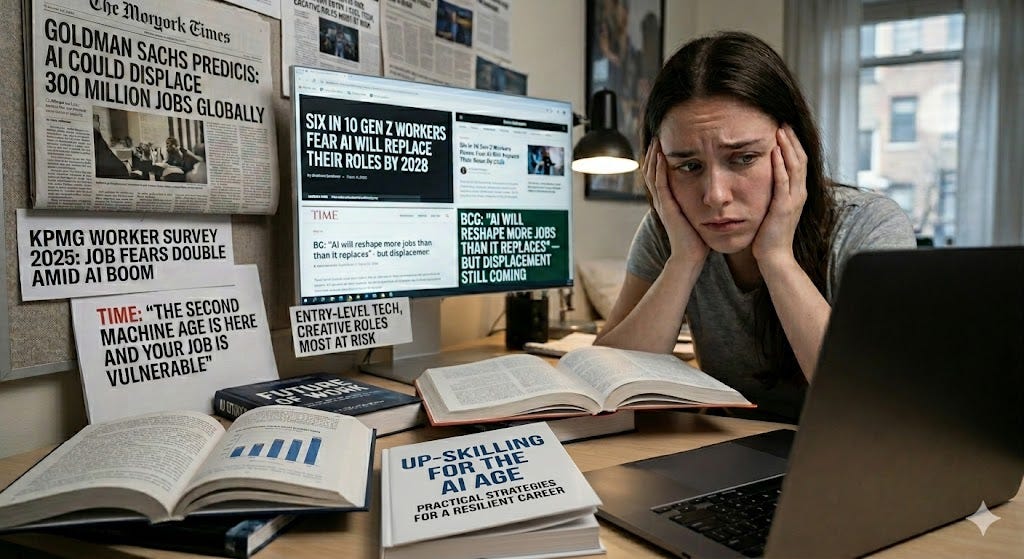
CEOs of artificial intelligence companies are warning of a jobs apocalypse. This is the wrong alarm. Advanced AI is unlikely to throw tens of millions of people out of work, but it can easily be used to attack critical infrastructure, launch a lethal virus, or concentrate income and wealth.
Policymakers and the press are obsessed with the possibility that advanced AI will throw millions of people out of work. This is unlikely, but the risk of AI killing people, draining their savings, or hollowing out the economy deserves more public attention and policy debate.
AI CEOs are sounding the wrong alarm.
The leaders of our biggest AI labs are right to warn that their technology is powerful and that we need to take steps to prevent it from being weaponized. But they are wrong to predict a job market meltdown.
Anthropic CEO Dario Amodei has warned that 50% of entry-level jobs in tech, legal, consulting, and finance will be wiped out within five years. Last year, he told Axios the “white-collar bloodbath“ could spike unemployment to 20% -- Great Depression territory.
x.AI CEO Elon Musk declared in 2023, “There will come a point where no job is needed -- AI will be able to do everything.”
ChatGPT founder Sam Altman wrote that “the price of many kinds of labor will fall toward zero once sufficiently powerful AI joins the workforce.”
Cyber and biological risks are real. Frontier safety teams at the major AI labs, along with the World Economic Forum’s Global Cybersecurity Outlook 2026, all document the same risks. Advanced AI systems now generate working exploits, plan multi-step attacks, and lower the expertise threshold for things that used to require a trained team. Armed with advanced agentic models like Anthropic’s Mythos, a garden-variety basement nerd can now discover previously unknown vulnerabilities and launch a cyberattack on your power grid, bank account, or water system. Hackers who route around the porous “refusal systems” AI tools so they can tinker with lethal viruses are risking catastrophe.
The risk of freaks or terrorists weaponizing AI led me to argue last month that national governments will soon need to subject frontier AI models to much more technical and political oversight and licensing. Trump floated this idea recently, and he should try to remember it long enough to pursue it.
The jobs apocalypse is mostly a distraction. Our labor markets are enormous, dynamic, and have proven resilient to exactly the kind of shock people now fear. That doesn’t mean that AI won’t inflict pain – but it does suggest that CEOs of AI companies aren’t framing the questions well.
Repeated warnings from AI CEOs can shape events, even when they are dead wrong. Nobel Prize-winning economist Robert Shiller described how apocalyptic memes matter in Narrative Economics: How Stories Go Viral and Drive Major Economic Events. He shows how popular fears of machines displacing workers contributed to 19th-century economic downturns, reinforced the false belief that automation caused the Great Depression, and exacerbated the double-dip recession of the early 1980s. The danger isn’t just labor disruption — it’s that popular narratives create a negative feedback loop. Economic hardship caused by recession gets misattributed to machines, creating pessimism that deepens the downturn.
We may be watching this dynamic play out now. AI-washing is masking the real sources of today’s labor market anxiety: inflation, tariff shocks, and a hangover from pandemic-era over-hiring at big tech firms.
Employment data tell a different story than these warnings suggest. Consider the supposed canaries in the coal mine—tech workers. Net US technology employment grew from 8.7 million in 2020 to 9.6 million in 2023 and has been roughly flat since then. Tech is a low-hire, low-fire labor market where unemployment for tech workers and everyone else is converging around the Fed’s target rate of 4%. Not great, but hardly apocalyptic.
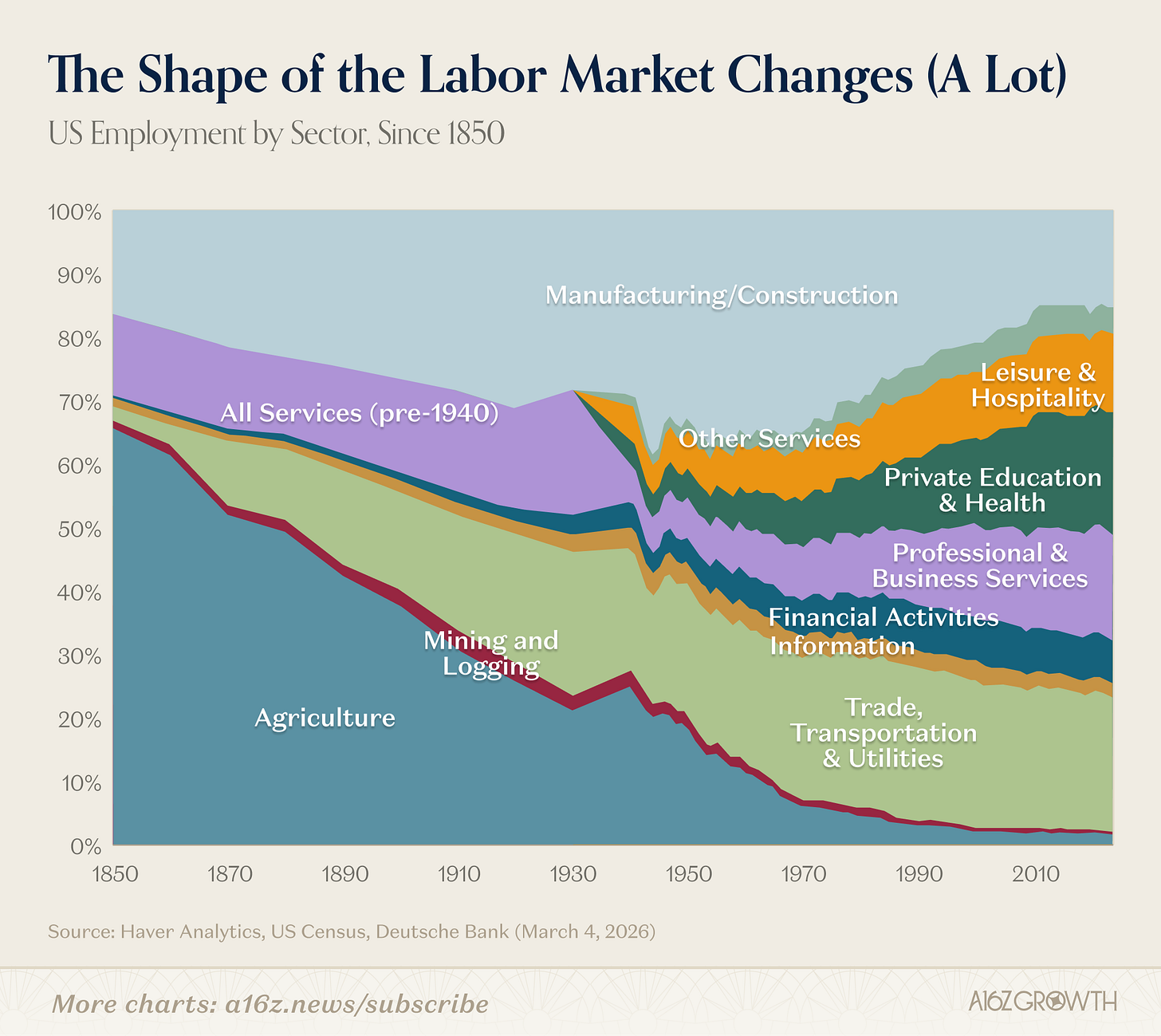
Over time, the US labor market has evolved a lot. Take a look.
Academic and government economists are skeptical that a job apocalypse is approaching.
A recent NBER working paper found that “AI adoption has not yet led to meaningful changes in total employment,” though it is reshaping which tasks workers perform.1
The Federal Reserve Bank of Atlanta surveyed firms and found that more than 90% estimate no employment impact over the last three years.
The Census Bureau’s Center for Economic Studies found that only about 5% of AI-using firms reported any headcount change -- and those changes were split almost evenly between increases and decreases.
The Yale Budget Lab concluded in April 2026 that “the picture of AI’s impact on the labor market that emerges from our data is one that largely reflects stability, not major disruption at an economy-wide level.”
Even though we should expect AI to create and eliminate both tasks and jobs, there is still no statistically significant relationship between AI and unemployment or employment growth.
Why the job apocalypse story is (mostly) wrong
Look more closely at the kind of report that drives reporters to sound the alarm. Goldman Sachs recently estimated that generative AI could automate tasks equivalent to about 25 percent of US work hours, and that roughly 300 million jobs globally are at risk of some level of automation.
Read quickly, that sounds like mass unemployment. Read carefully, it isn’t. Goldman’s own base case is that 6 to 7 percent of US workers will be displaced over roughly a decade of adoption, raising the unemployment rate by about half a percentage point during the transition. If companies deployed only current AI use cases across the economy, Goldman estimates that just 2.5 percent of US employment would be at near-term risk.2 That’s economic adjustment, not labor-market collapse.
There are five reasons that the deeper story is more reassuring than the headline.
The US economy does not create a fixed number of jobs. This is the “lump-of-labor” fallacy, and economists have been refuting it for two centuries. Human wants and needs are essentially infinite. When automation lowers the cost of existing goods, freed-up wealth and labor flow into new sectors — healthcare, education, software, hospitality, pet care, fitness, mental health services, and niche entertainment. David Autor and his colleagues used census data to show that roughly 60 percent of US workers in 2022 worked in occupations that didn’t exist in 1940. Most of the jobs your grandchildren will hold don’t yet have names.
Technology that cuts costs can grow jobs. The clearest case is the one that should haunt every AI doomer: spreadsheets. When VisiCalc and then Excel arrived, the prediction was carnage among bookkeepers and accounting clerks.
The carnage was real for the clerks. But the number of accountants rose, because cheaper calculation made it worth asking more questions — what if I borrow more, hire more, or change prices?3 Accountants stopped being mere calculators and became advisors. The Bureau of Labor Statistics still projects positive growth for accountants; only the narrow data-entry slice of bookkeeping is shrinking. Software ate part of one job and grew many others. (Counterexample: farming. When we automated agriculture, we did not eat a lot more food, so we needed fewer farmers.)
People often prefer people. As AI commodities get cheaper, the things AI can’t fully replicate become more valuable: human attention, human judgment, human warmth, the social fact of having been served or taught or treated well by another person. Therapists, teachers, health care providers, hospitality workers, performing artists, and coaches are protected because the value they deliver depends as much on relationships as intelligence. In a richer, more automated economy, the premium on human connection rises rather than falls. (Counterexample: in San Francisco, people pay more to ride in driverless cars. The driver adds negative value.)
AI kills more tasks than jobs. A job is a set of tasks. You get paid to complete all of the tasks associated with your job. If an AI automates much of your rote work and it frees up time for you to generate better ideas, your productivity goes up, you become more valuable to your employer, and, ideally, you earn more. But if AI automates all of your tasks, then yes — you are out of work.
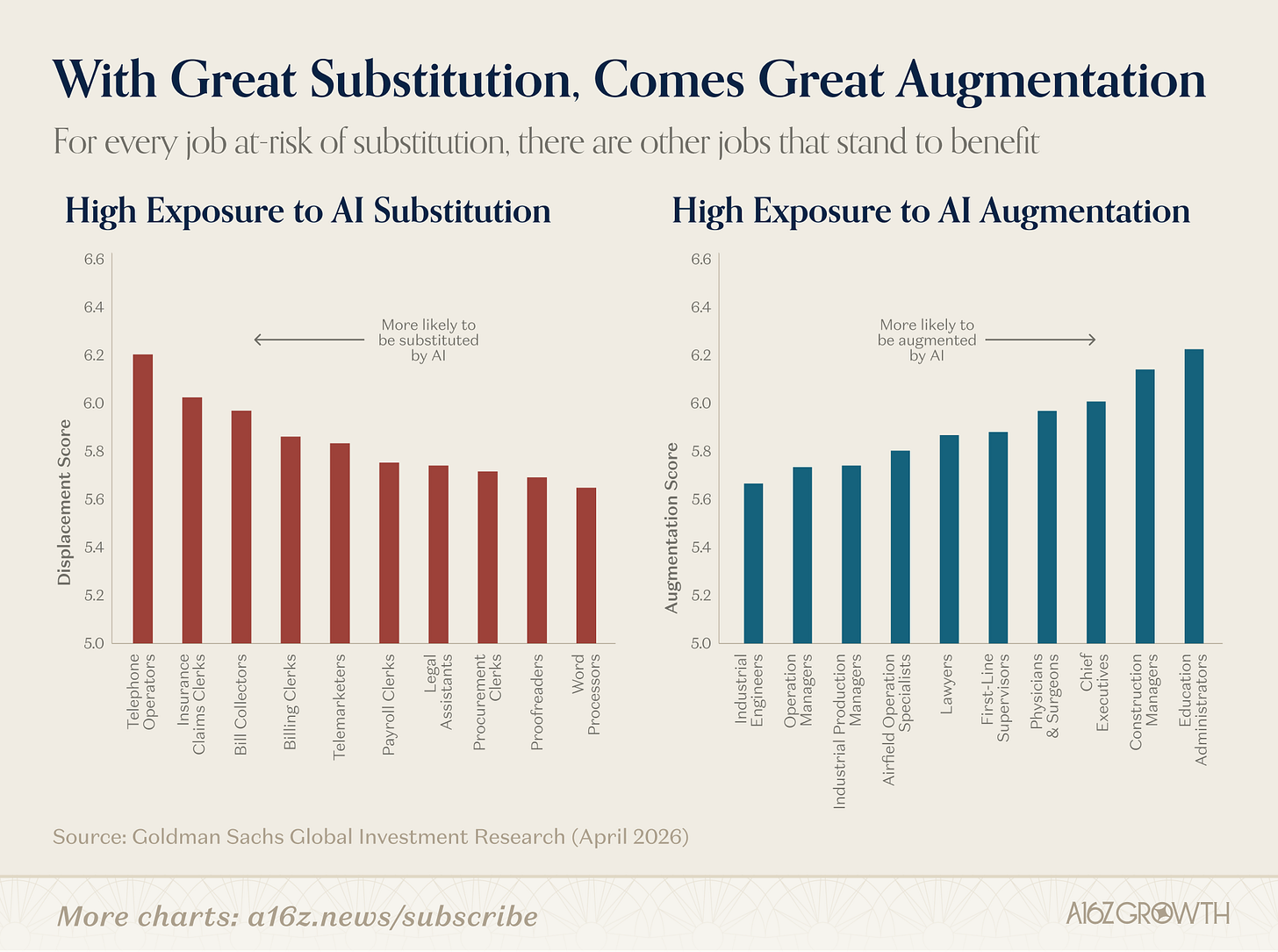
Goldman Sachs broke down the tasks for a series of jobs. They concluded that education workers, judges, and construction managers are the jobs with tasks most likely to be augmented. But the “substitution versus augmentation” distinction is artificial. In most knowledge work, AI handles many tasks while a human handles the last few — and those last few are often the ones that determine whether the work succeeds at all.
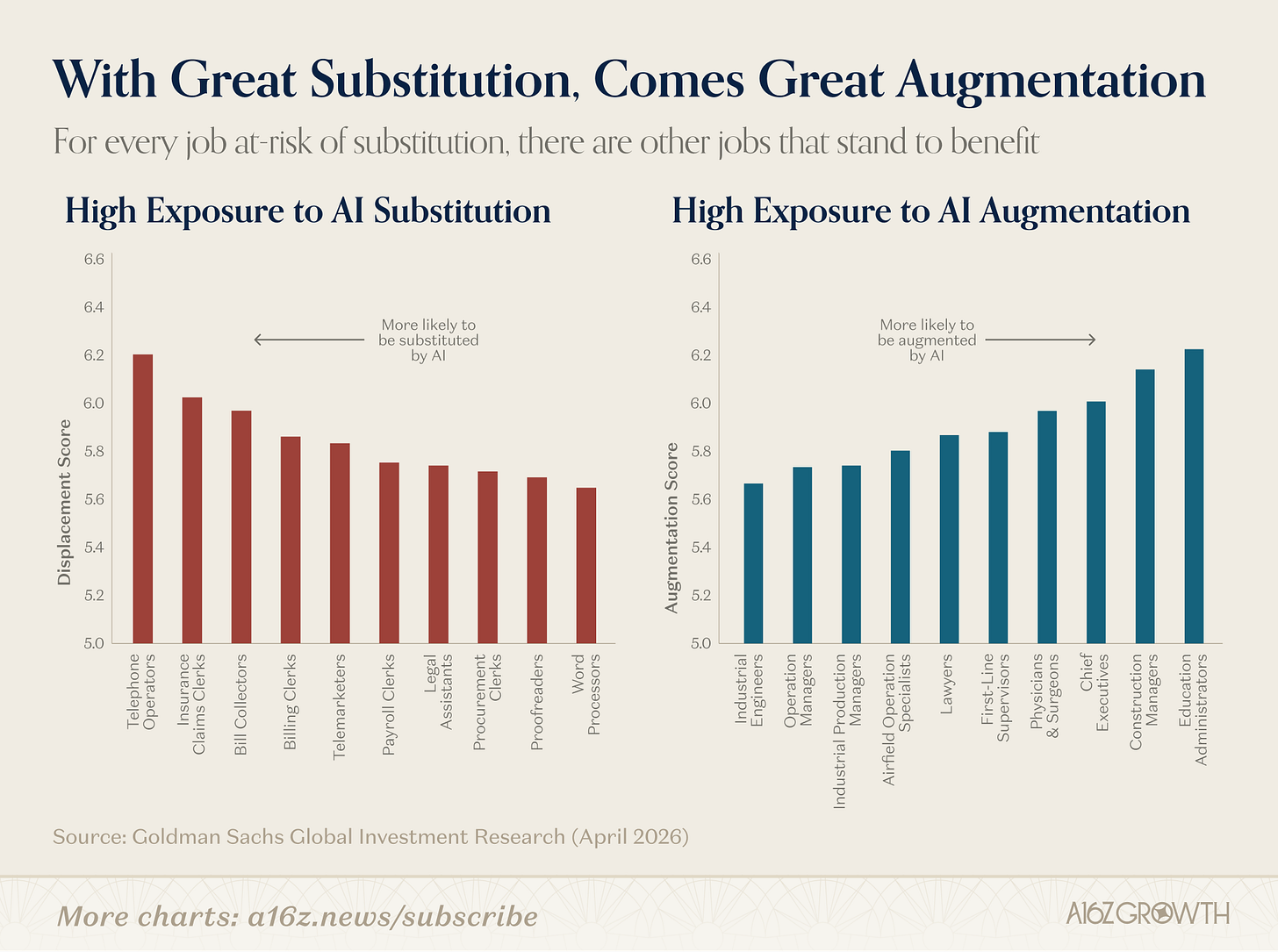
Labor economist Alex Imas calls these O-ring jobs, after the small component whose failure destroyed the space shuttle, Challenger. If AI does 98 percent of the work but a human is required to catch the 2 percent that would otherwise produce a catastrophic failure, the human stays and is highly paid. Radiologists and software engineers are the canonical examples; they’re also two of the professions most often predicted to vanish, and have so far done roughly the opposite. (Counterexample: Goldman identified telephone operators, insurance claims clerks, and bill collectors as among the occupations where AI will substitute for enough tasks to threaten jobs.)
We should worry less about direction and more about timing. Historically, labor market transitions were slow enough that they could adapt across generations. Children trained for jobs their parents couldn’t do. But if AI diffuses in years, not decades, displacement could outrun retraining, and wages in exposed occupations could fall sharply before new high-wage roles absorb the workers.
That is a transition problem, not an apocalypse. Still, it’s the scenario that deserves real policy attention, because the US has never learned to effectively help workers navigate major labor-market transitions.
Productivity gains tend to lift wages across sectors, not only within the productive ones. This is the so-called Baumol effect, named after the economist who first described it. When tech and manufacturing workers become more efficient, they earn more. Service-based, labor-intensive roles — nurses, teachers, live musicians, hairdressers — can’t easily become more productive without degrading the service. Still, employers in these sectors have to compete for workers with high productivity. To retain talent, wages rise across the board, even in places where output per worker isn’t moving.
Whether productivity gains flow to wages depends more on bargaining power and timing than on the technology itself. Wage growth from productivity has historically depended on workers accumulating bargaining power through labor unions, taking advantage of tight labor markets, or possessing scarce skills. If the competitive dynamics that surround AI companies were to disrupt this, income inequality could grow.
Let’s look closer at that possibility.
Taking inequality risk seriously
If the CEOs of AI companies overstate the risks to jobs, they understate the risk of growing income and wealth inequality. Four forces drive this – and like fish that cannot notice water, AI companies are so saturated in these dynamics that they barely observe them.
Winner-take-all competitive dynamics. Historically, the benefits of technology have flowed heavily to those who own or control it. AI accelerates this through network effects and data moats. The wage gains that do materialize may flow disproportionately to a relatively small technical and managerial class employed by or immediately adjacent to frontier AI companies, widening the gap with everyone else.
For example, a garden-variety software engineer who joined Anthropic three years ago might have received a stock grant valued at $200,000 at that time, which would be worth $ 400,000 after four years. With Anthropic now valued at $900 billion, that engineer now owns stock worth about $30 million – and more if the company goes public at a higher valuation, as seems likely. (Arguably, engineers should be willing to pay Anthropic for these jobs.) This will not improve Bay Area housing prices for anyone who is not working on a frontier AI model.
Winner-take-all regional dynamics. Tech-driven wage gains have historically clustered in specific cities and industries, leaving many regions and workers behind. AI development is even more concentrated than past waves, suggesting the same dynamic could play out more sharply. Add the success of Google and OpenAI to Anthropic, and you can see why the Bay Area is now home to the world’s highest concentration of billionaires and the largest share of high-paying jobs in the nation. You can also see why housing is expensive and why housing activists here have such a steep mountain to climb.
Winners-stay-private capital markets. AI investments have effectively become the US economy. They account for 92% of national GDP growth and 75% of S&P 500 returns since the launch of ChatGPT. But the hottest AI startups create a lot of value, but do not sell shares to the general public. SpaceX/X.ai, OpenAI, and Anthropic have enormous valuations, but venture investors, founders, and employees have captured the value of their explosive growth. The general public. has been shut out, which concentrates wealth far more than in earlier industrial eras.
Winners-take-most labor market dynamics. Labor markets are full of countervailing forces. On the one hand, productivity gains from capital-intensive technology often benefit owners more than workers. AI infrastructure (compute, data, models) is very capital-intensive and controlled by a small number of entities. To the extent they can capture the value of increased productivity, the capital share of income will rise, and workers' wages will advance more slowly.
Each of these four forces could, by itself, widen income inequality. Working together, they could expand it a lot. On the other hand, skilled workers may use AI to become more productive and earn higher wages. Past technology waves — mechanization, electrification, computing — tended to complement workers who could use the new tools and substitute for those who couldn’t. AI is already doing something similar: a skilled analyst, lawyer, or programmer using AI can produce far more per hour, and labor markets tend to reward that productivity with higher wages. The person using AI becomes worth more than the person alone.
Well-designed tools can benefit low-skilled workers. A widely-publicized study from MIT found evidence that AI helps less experienced and lower-skilled workers more than highly skilled ones. Moreover, to the extent that AI lowers the cost of legal advice, medical guidance, tutoring, and financial planning — forms of expertise that used to be out of reach for most people — the consumption side of inequality narrows even if the wage side widens. A family that couldn’t previously afford a lawyer or a competent tutor may be able to get a credible version of both for almost nothing. That doesn’t show up in wage statistics. It does show up in living standards, and it can matter over time.
In 1942, economist Joseph Schumpeter outlined his theory of “creative destruction”, declaring that “economic progress, in a capitalist society, means turmoil.” The risk that AI will leave large numbers of people unemployed is small. The risk that it will be used to attack critical infrastructure, lower barriers to bioterrorism, and concentrate gains in fewer hands is much larger — and is much more affected by the choices about AI we are making right now.
ICYMI
The US needs about 5,000 miles of high-voltage transmission per year to keep pace with electricity demand. In 2024, we completed just 888 miles.
The world is awash in bourbon.
Are smartphones causing the global fertility collapse? No.
Bachelors Without Bachelor’s: college-educated women are forced to seek non-college men.
Grade inflation produces 21 valedictorians at one high school.
Is science too risk-averse? Yes.
As a companion paper put it: “GPTs are GPTs”, meaning that what engineers call a Generative Pre-trained Transformer like ChatGPT is what economists call a General Purpose Technology that behaves in powerful, disruptive, but historically predictable ways.
It is hard to grasp the churn in US labor markets. The monthly BLS JOLTS Survey documents job turnover in terrific detail.
The median American worker now spends fewer than 4 years with their employer. Each month, between 3.5 and 4 million workers quit their jobs – about three times as many as are laid off or fired. But there is a lot of variation. If you are over 55 or work in the public sector, median tenure is about twice as long. If you work in hospitality or other high-turnover service jobs, it can be half as long.
All of this is predicated on the assumption that this technology actually works. It does not. The models are trained to the benchmarks, and the benchmarks are themselves biased.
Evidence? The promised productivity gains have not materialised, despite the largest injection of capital in human history. When the bubble — and it is a bubble — bursts, the economic disaster that results will be epic.
Oh, the AI reckoning is coming. But it won't have much to do with jobs, cyber attacks, or biological risks.