
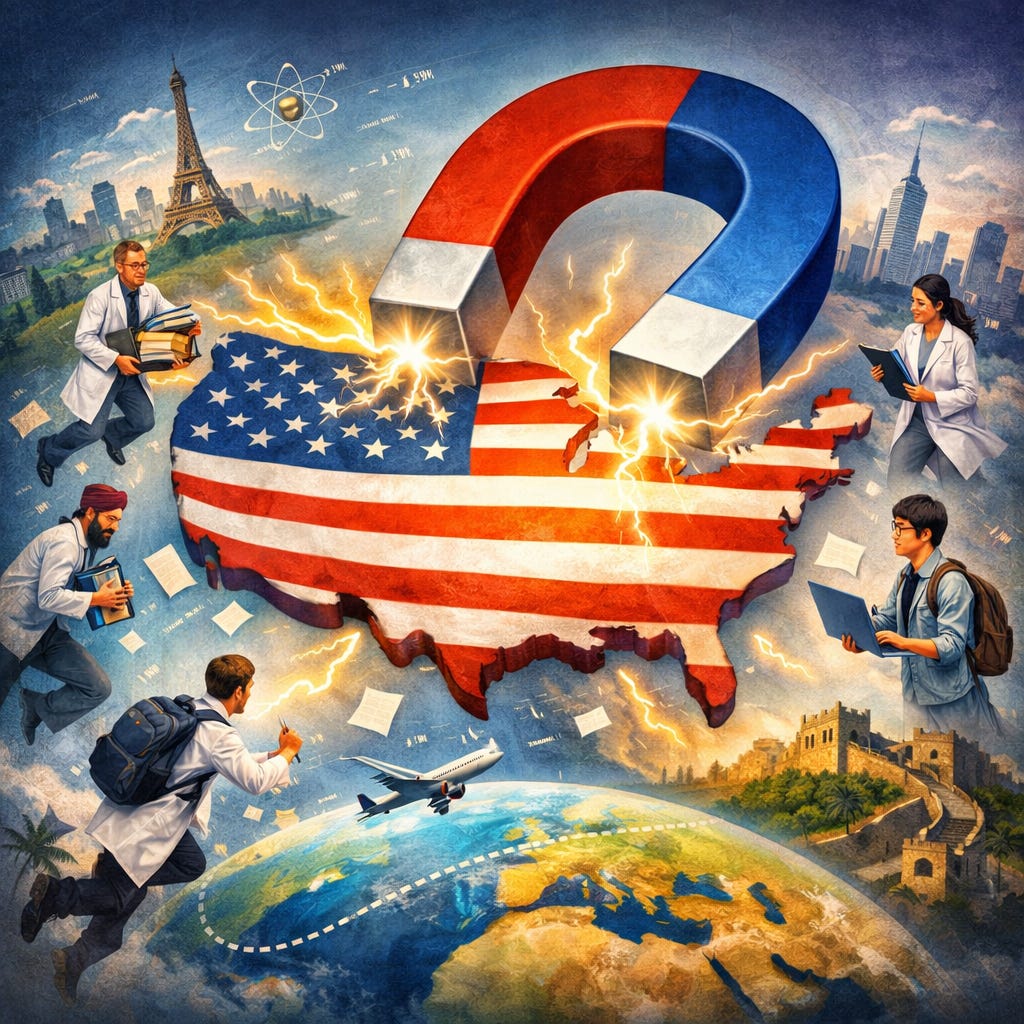
For the past century, the United States has operated the most successful talent-attraction system in history. It does not appear to be a coherent system, as it depends on a shambolic and loosely coordinated mix of research universities, federal funding agencies, immigration policies, thousands of technology companies, and unfathomably complex labor markets.
The combined effect of these institutions attracted talent to America’s shores for several generations until the Trump administration deliberately began to weaken them. The damage so far has been minor, but, as with Hemingway’s description of bankruptcy, the impact of Trump’s actions may well be gradual, then sudden.
As the U.S. has weakened the policy scaffolding that made it the default destination for the world’s leading researchers, other countries have begun to aggressively compete for high-skill talent. The result is not a cinematic “brain drain” that empties American laboratories overnight. This would be a crisis, and America might respond. Instead, we face the slow corrosion of a thousand small decisions. A postdoc chooses Toronto over Boston. An AI researcher joins a lab in Paris rather than a company in San Francisco. A doctoral student decides not to apply to a U.S. program.
As these individual decisions accumulate, they compound, and the United States loses something that money alone cannot rebuild: its position as the world’s central node of scientific discovery.
The Competitive Advantage We Barely Noticed
Day-to-day, few Americans recognize the powerful U.S. system for attracting talent, which consists of several elements.
Generosity. Until recently, researchers could reasonably assume that generous federal science funding through the National Institutes of Health and the National Science Foundation would continue year after year. Universities planned hiring and graduate admissions on the assumption of steady funding.
Predictability. Scientific research is a long-horizon enterprise, so predictability mattered as much as generous funding. A doctoral program is five to seven years. A biomedical research agenda can span decades. When uncertainty rises, participation falls. Scientists are unusually sensitive to the risk of cuts because their careers are unusually path-dependent. Miss one grant cycle, one visa window, one cohort of graduate students, and the damage can persist for years. Increasing risk leads researchers to seek a more stable environment. Foreign students can only invest a decade of their lives training in the U.S. if they are confident that their visas will not suddenly disappear.
Talent clusters. In many fields, talented people seek one another out because they know that interactions with skilled colleagues improve their work.
The effect of proximity on scientific research productivity is surprisingly strong. When MIT analyzed papers and patents, they found that even in the digital age, researchers in the same workspace were significantly more likely to collaborate than those farther apart. Research from Harvard Medical School found papers with co-authors in the same building received far more citations, and the impact increased as the physical distance between the first and last authors decreased.
As returns to talent have increased, both stable scientific research funding and a coherent immigration policy have become cornerstones of industrial policy. Every modern government understands this.
The High Cost of Immigration Uncertainty
Despite its many flaws, the H-1B visa system functioned as a pipeline that connected global talent to American institutions. Universities used it to recruit scientists. Companies used it to staff cutting-edge research teams. Startups used it to hire specialists. However, the Trump administration’s immigration policies have sharply increased both the costs and the risks associated with visas.
Funding cuts. Trump entered office determined to slash university research funding. The National Institute of Health and the National Science Foundation bore the brunt of these cuts. Some funding has been recovered through ongoing lawsuits, and additional amounts may yet be recovered through congressional action. But the uncertainty has slowed and damaged research projects and frozen hiring.
Visa fees. Trump’s crackdown on immigrant researchers has led many researchers to question whether they can count on visa renewals. His $100,000 fee for each H-1B visa is damaging to research universities, which cannot absorb a six-figure fee for each researcher as readily as large firms can.
Visa barriers. The new policy has made it more difficult for businesses—and especially universities—to use visas to recruit scientists from abroad. A recent report from the nonpartisan Niskanen Center notes that immigration policy has become a central instrument of labor and economic strategy. Yet, while countries worldwide are competing to attract top talent, the United States has moved in the opposite direction by imposing new hurdles on the legal immigration of high-skilled workers.
The damage this causes doesn’t show up immediately. In the U.S. system of knowledge production, universities are upstream of everything else. They train the researchers who populate firms, labs, and startups. A policy that starves the upstream development of critical talent inevitably weakens downstream organizations. But it takes a while.
Hidden costs. Defenders of these restrictions often argue that they protect American workers. But this framing misunderstands the labor market for frontier science. The relevant comparison is less “a foreign scientist versus an American scientist” than “a U.S. lab versus a foreign lab.” When a quantum physicist or AI researcher cannot enter the United States, the work relocates. And so do the spillovers: graduate students, startups, supplier networks, and tacit knowledge. These are not paper losses – they are the economic substance of innovation.
The World Responds to U.S. Carelessness
The United States enjoyed an advantage in scientific research that has accumulated since the Second World War. Even when other countries funded research, they rarely matched the U.S. ecosystem’s scale, prestige, or openness. The world’s most talented scientists, managers, and investors came here as a result.
That world is ending.
The European Union has announced a Choose Europe for Science initiative to enable U.S. researchers to “explore national and regional funding and support schemes available across 27 EU Member States.”
France is recruiting “30 outstanding U.S. students for one year of master’s-level study at one of 15 top French institutions…(in) Science, Technology, Engineering, Mathematics, the Humanities, Social Sciences, and the Arts. The French government recently hosted a “Choose Europe for Science” conference to help EU countries target U.S. scientists.
Canada recently announced it will spend $1.7 billion to “attract top global talent.”
Tiny Norway is targeting $10 million at US scientists. On April 26, the Chamber of Commerce of equally tiny Denmark made an offer on Instagram to U.S. researchers: “To all the brilliant researchers in the U.S. feeling uncertain right now: Denmark is open – and we need you! Across the Atlantic, we’re watching with concern as politics begins to overshadow science.” The Danish Society of Engineers will create a “fast-track initiative to welcome up to 200 American researchers over the next three years.”
Spain is expanding its program to attract international scientists, specifically “researchers who are in the United States and are being scorned by the current administration.” In addition to awarding $1 million to each researcher, Spain offered scientists from the United States an additional $200,000 for their research projects.
The Australian Academy of Science has launched a Global Talent Attraction Program aimed at U.S. scientists, asserting that “Australia has an urgent and unparalleled opportunity to attract the smartest minds leaving the United States to seed capability here and nurture the next generation of scientists and innovators.”
The United Kingdom has launched a new program to disperse money to enable 10 of its research organizations to attract international scientific talent.
China, which is already outpacing the U.S. in scientific research, is surely laughing at headlines in The Economist declaring that “America is foolishly waving goodbye to thousands of Chinese boffins.”

By making U.S. immigration policy more hostile and scientific funding less predictable, Trump has narrowed the gap between the U.S. and other countries. Visa uncertainties that once seemed tolerable become decisive. Funding delays that once felt annoying become disqualifying. The U.S. no longer wins by default.
The early results are troubling. A survey by Nature Magazine found that 75% of scientists surveyed are considering leaving the U.S. and announced a 32% increase in applications from U.S. scientists for overseas positions.1 This fall, the number of international students enrolling in U.S. universities fell for the first time. It declined by 17 percent compared with last year.
Leading Technology Sectors Depend on Research Scientists
All scientific fields matter, but some matter more than others. It is especially valuable for the U.S. to continue to lead advances in medical research, artificial intelligence, and quantum computing because these are general-purpose technologies. Advances in these fields spill over into sectors such as manufacturing, defense, health care, logistics, and energy. They raise productivity broadly.
The United States’ advantage in these areas has always depended on dense research networks. Informal conversations matter. So do graduate seminars, shared datasets, and labor mobility between academia and industry. When that density thins, progress slows—not linearly, but exponentially. Networks fracture. Feedback loops weaken. The invisible infrastructure of innovation erodes.
This is why even small outflows matter. Losing a few senior researchers is bad. But it is even worse to lose the graduate students and postdocs who would have built the next generation of labs around them.
It is tempting to dismiss concerns about brain drain by pointing out that American universities remain world-class. This is true—and misleading. Infrastructure takes decades to build; it does not vanish overnight. But that is the danger. Advantages that took decades to build can be dismantled slowly enough as to trigger no political alarms.
The United States is still benefiting from investments in research after World War II, the expansion of graduate education, and the openness of Cold War-era immigration policy. These are sunk costs that continue to pay dividends.
But sunk costs are no guarantee of future returns. The U.S. remains strong today, but whether the next cohort of scientists will anchor their careers here is far less certain. Once they decide to look elsewhere, this becomes an extraordinarily expensive problem to solve.
An Economic and Political Challenge, Not a Cultural One
Debates over immigration and science policy are often proxies for culture wars about cosmopolitanism versus nationalism. That framing obscures the stakes.
Economists refer to scientific talent as a “non-rival input.” Attracting more of it doesn’t reduce opportunities for domestic researchers; it expands them by increasing funding, collaboration, and institutional scale. The historical evidence is overwhelming that regions with higher concentrations of skilled immigrants produce more innovation and higher wages for native workers.
When the United States restricts high-skill immigration or destabilizes research funding, it shrinks the pie, which does nothing to protect workers. Other countries understand this. That is why they are spending real money to attract talent. They view scientists as productive assets rather than cultural symbols.
Moreover, Trump has a coherence problem. He wants the U.S. to lead global AI, quantum computing, and biomedical research, but he deliberately undermines the institutions that produce that leadership. Trump is skeptical of international expertise even as his goals depend on it. He aspires to global dominance but chokes off access to the talent the U.S. needs to compete globally.
This incoherence is itself a competitive disadvantage. Scientists value clarity. They choose environments in which rules are stable, and futures legible. When policy sends mixed signals, researchers with choices—the top talent that drives innovation—inevitably move first.
Recharging the Magnet
None of this is inevitable. The United States still has extraordinary universities. It still has deep capital markets. It still has a culture of scientific ambition. The losses to date appear marginal rather than catastrophic. But marginal losses are how great powers decline.
Fixing this requires that U.S. immigration policy align with economic reality. It requires stabilizing research funding to enable universities to plan. It requires recognizing that global talent competition is a foundation of American prosperity – not a threat to native-born workers.
Bipartisan solutions are well-understood. The U.S. can fast-track visas for advanced STEM graduates and reduce funding uncertainty for research institutions. The barrier is political will.
History offers a cautionary lesson against any country treating scientific supremacy as an inheritance to which it is entitled. Germany’s pre-war dominance evaporated when it closed its doors to intellectual openness, driving many scientists to the U.S. Britain lost scientific preeminence in the 1950s and 60s when its talent followed opportunity elsewhere. Countries that wish to lead scientific advances must cultivate and sustain the institutions that enable them to do so.
America’s advantage was earned by institutions that welcomed talent, funded curiosity, and tolerated risk. We can choose to weaken or strengthen those institutions. The question is whether policymakers recognize what is at stake before erosion becomes collapse.
Because once the world’s best scientists stop seeing the United States as the obvious place to build their lives, no amount of rhetoric will bring them back.
Musical Coda
Treat these findings as indicative, not scientific. Nature asked its readers to take a survey, and 1650 people responded. There is no reason to believe that this sample is representative, but the sentiment was nonetheless overwhelming. Nature also analyzed its jobs board and found “that US scientists submitted 32% more applications for jobs abroad between January and March 2025 than during the same period in 2024.” Again, indicative, not comprehensive.
A related topic for future discussion is the change in the criteria for funding research projects that has accompanied the Trump science-related immigration policies. A recent conversation with a family member who is tenured faculty member in geophyiscs added another layer to the concern about reduced science funding. Pre-Trump, many, if not all ,research proposals contained some references to achieving DEI objectives as a standard proposal element. Trump has moved aggressively to eliminate all such considerations, but at the same time the assessment of proposals is likely to have shifted in another politically motivated direction.