
At first, I thought it was my imagination. Had Chinese cities really become quieter? A quick check revealed the story: cities were calmer because the Communist Party now treats noise as pollution and suppresses it like an unwelcome dissident.
The Quiet War
China’s battle to quiet its cities has several fronts. Even the famous “dancing grandmothers” in public parks are required to dance to directional speakers.
More EVs. The shift to ghostly-quiet electric vehicles and scooters has significantly reduced street noise. EVs use silent regenerative braking. Traffic studies also show that Chinese EV drivers accelerate more smoothly than combustion-engine drivers, further reducing engine noise.
Quieter roads. China is resurfacing streets to make them quieter. It laid more than 32 million square meters of noise-reducing surfaces last year alone. Many new arterials use porous asphalt whose tiny voids “swallow” the air trapped between the tire and the road, muting the small pop that is the dominant source of highway noise. Some districts mix in recycled tire rubber and get a further 3–5 decibel reduction.
No-honking zones. In the 1990s and early 2000s, Chinese cities were like Bangkok or Mexico City. Drivers honked aggressively and pointlessly. Most seemed stressed, as though their cortisol levels were through the roof. Today, no-honking zones cover the bulk of the urban core in cities like Guangzhou and Beijing. Honk in a restricted zone and acoustic cameras triangulate your position, read your plate, mail you a fine, and dock your social credit score.1 In less than a decade, this system has trained drivers to stay off their horns. There are still plenty of aggressive drivers, but they don’t honk.
Less construction. The construction slowdown has helped quiet things down. For two decades, the “sound of China” was the round-the-clock throb of pile drivers and cement mixers. Since the residential property market crashed in 2021, there are fewer cranes on urban skylines, and in many neighborhoods, the background hum of heavy machinery has simply vanished. (Infrastructure construction — rail, highway, industrial — has not slowed nearly as much; what you notice in cities is the absence of high-rise residential work.)
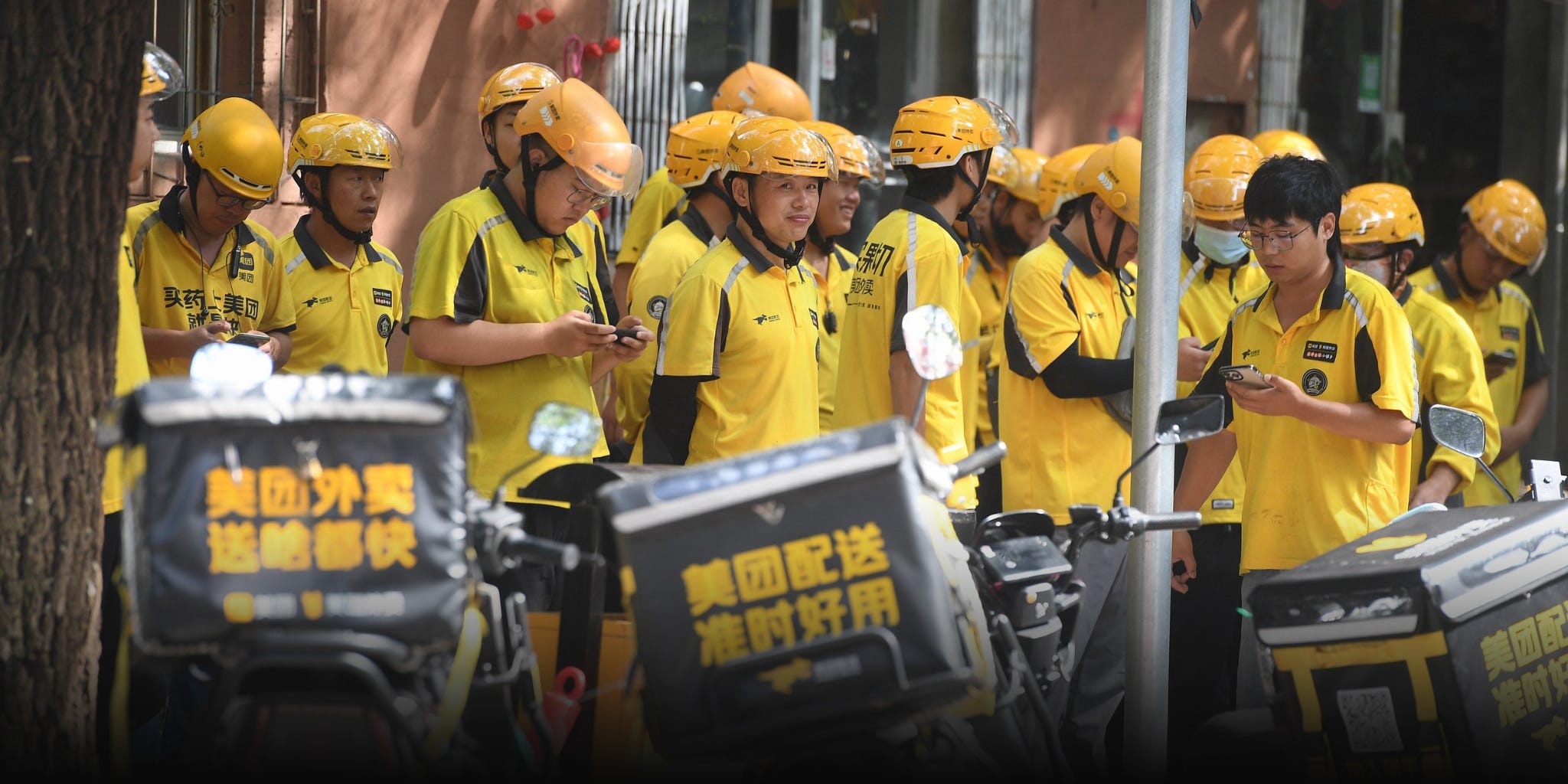
The war on noise has changed the sound of Chinese cities. Nonetheless, every day starting around 11 a.m., a new sound rises on Chinese streets. It’s too quiet to be an EV, too steady to be a bicycle. It is a high, insectile hum, layered dozens of times, approaching and receding from every direction at once. If you’re standing at a crosswalk, the sound flows by like water around a midstream rock.
Riders on electric scooters — dressed in yellow, orange, or blue — materialize from the gaps between cars. They mount and dismount the sidewalk. They surge ahead of traffic to make left turns. One might thread the needle between a delivery truck and a baby stroller, then vanish into a residential compound whose gate they somehow know how to open. The rider parks and heads inside. It turns out that thirty minutes earlier, a resident of the compound had opened an app and tapped on a picture of a bowl of noodles.
The Machine Behind the Hum
Delivery riders on fast scooters now make up China’s urban circulatory system. Something like 12 million people, nearly all of them young men and a quarter of them with recent college degrees, make their living moving objects on two-wheeled electric vehicles.
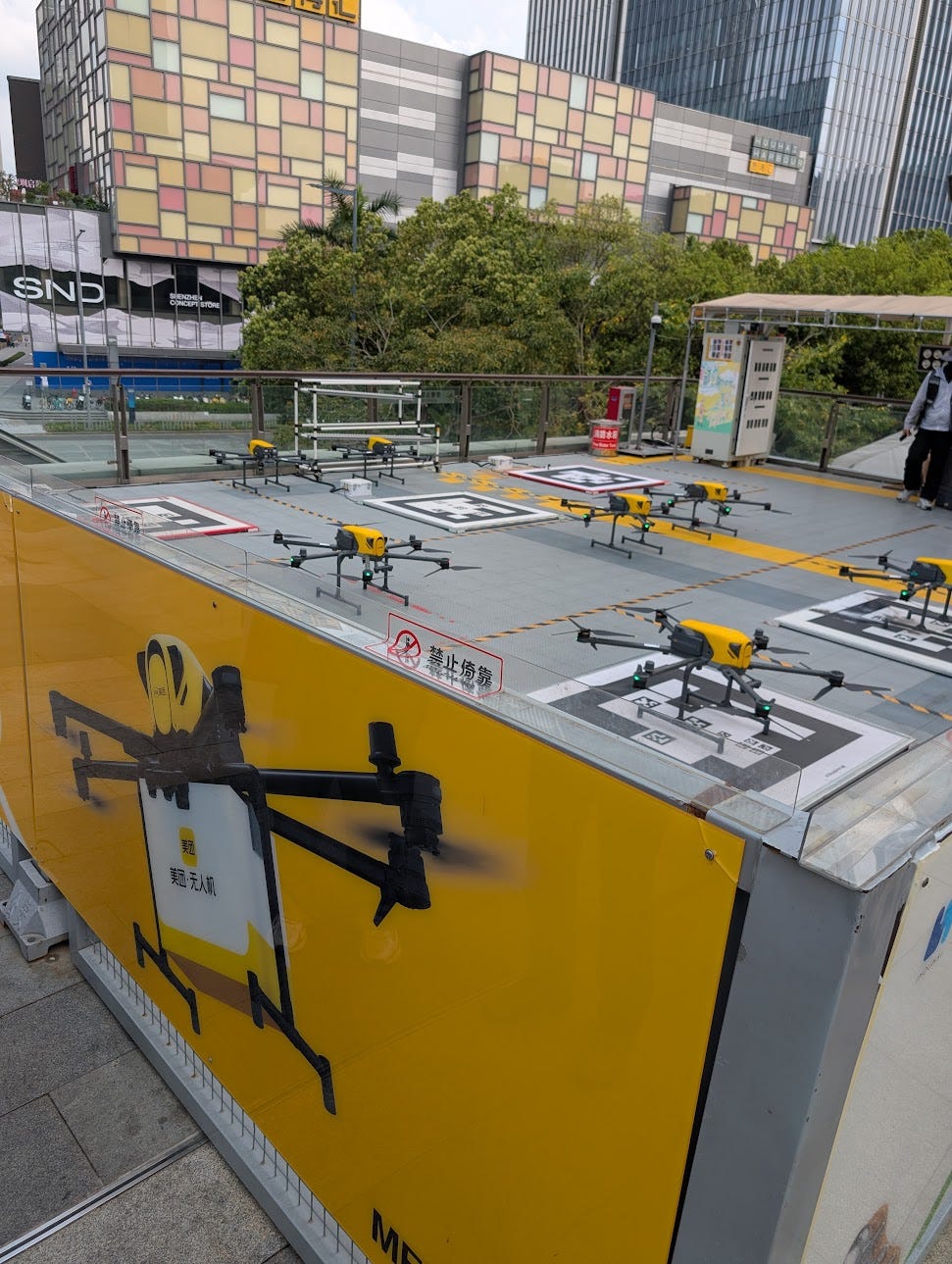
The platforms that coordinate them — Meituan above all, with Ele.me a distant second — have built the most sophisticated last-mile infrastructure ever assembled. A cup of bubble tea in Hangzhou moves from shop to hand in about 22 minutes. A forgotten phone charger in Shenzhen can be fetched from an apartment and delivered to an office in under an hour. Groceries, prescription medicine, a single lightbulb, a live crab in a plastic bag — the system does not care. It routes. It dispatches. It delivers. Instant delivery is now a trillion-yuan market — roughly $138 billion. In Shenzhen, we watched Meituan’s prototype drone delivery and, for fun, had a lemon tea flown to us from a mile away.
The ubiquitous bright-yellow Meituan scooters are much more than Chinese DoorDash. Yes, food delivery pays the bills — the way search pays Google’s. But Meituan’s actual business is a real-time dispatching engine that continuously solves one of the nastiest combinatorial problems in applied computer science. Given N couriers in motion, M restaurants with variable prep times, and K customers with soft deadlines, it must find an assignment that minimizes total cost, subject to hard constraints on food temperature, rider load, and promised delivery times. This is classically NP-hard.2 Meituan solves approximations of this problem a hundred million times each day.
The noise comes from e-scooters, the bastard offspring of a bicycle and an electric motorcycle. Scooters feature squat step-through frames with lead-acid or lithium batteries tucked under the seat. Manufacturers claim the bikes have a top speed of 15 mph (25 km/h), but delivery riders can easily modify their bikes to go twice that fast. They carry saddlebags or an insulated rear box large enough for four bowls of soup that the rider nurses over potholes so nothing spills. The scooter costs about as much as a new phone.
These things are ubiquitous to a degree that is hard to convey until you’ve stood on a Chinese street corner at rush hour and watched the river flow by. There are more than 350 million e-scooters in China. They outnumber cars. They outnumber, by something like five to one, the entire global stock of e-bikes sold in the West. You can rent one off the street in seconds — just scan a QR code and hop on.
The real instant-delivery sorcery lies in the software layer. When you place an order, an algorithm (what Meituan sinisterly calls its “super brain”) estimates the restaurant’s prep time, predicts traffic on every candidate route, calculates how many other orders each nearby courier is already carrying and in what sequence they’re stacked, and produces a delivery estimate before you’ve finished typing your address.
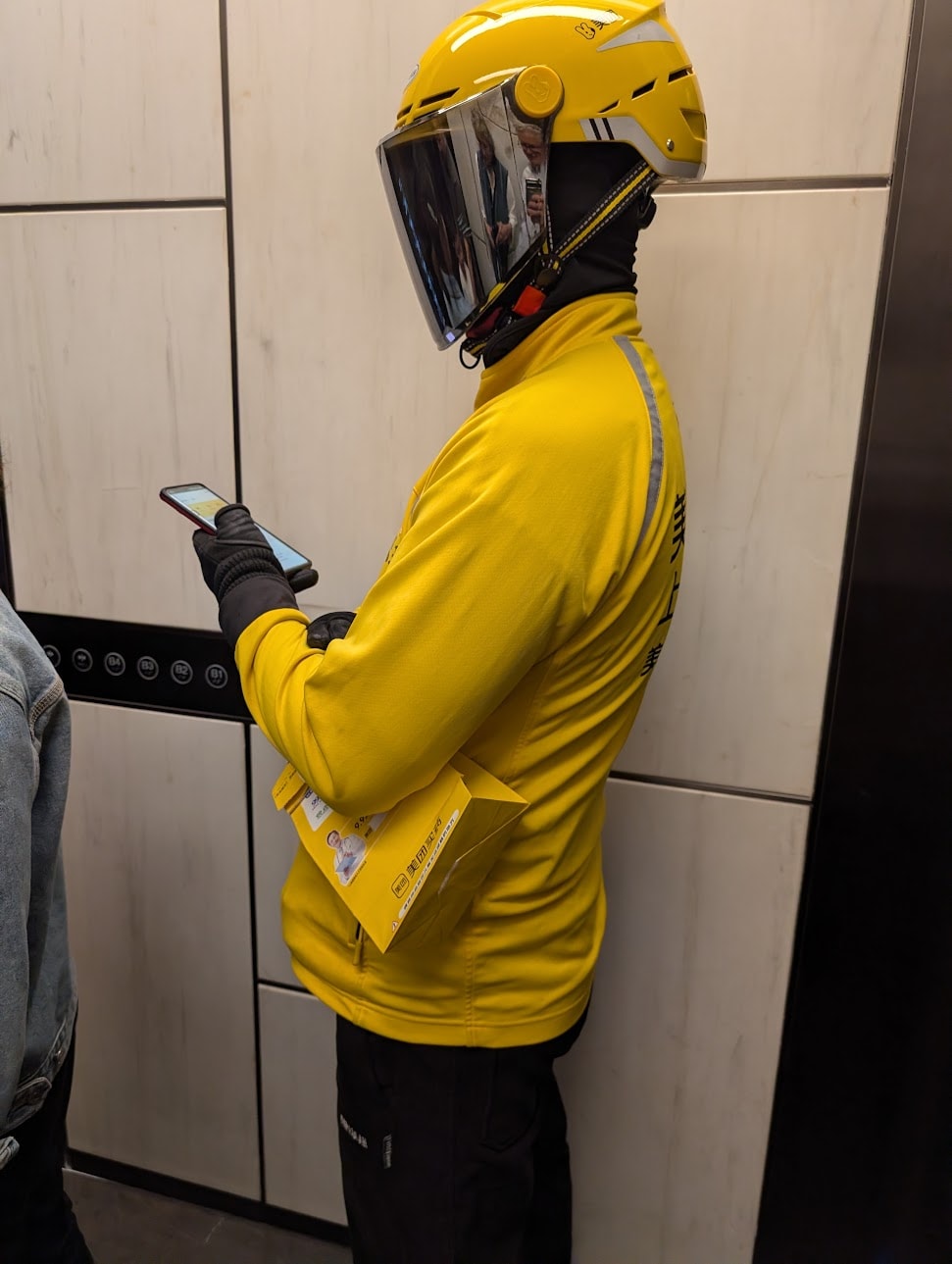
The app then promises each customer a delivery time. If the rider misses the deadline, the app docks their already meager pay. A rider who misses badly is electronically fired, or “deactivated.” The system is what control theorists call a tightly coupled feedback loop: the algorithm learns from every delivery how fast this particular route can be completed under these conditions, and then demands that future deliveries complete it at least that fast.
The Chinese magazine Renwu detailed what this does to drivers in a now-famous 2020 investigation titled Delivery Riders, Trapped in the System. Couriers run red lights, drive the wrong way down one-way streets, and sprint up stairs because the thirty seconds they save by jaywalking are the ones the algorithm learned to shave off their allotted time. For a new perspective on what this work is like, I recommend Hu Anyan’s grim but funny memoir, I Deliver Parcels in Beijing.
As in many modern industries, hell for workers produces magic for consumers. A Beijing office worker orders a single egg tart from a bakery four blocks away and receives it, still warm, for a delivery fee of about three RMB — forty cents. The system is so cheap and so fast that it has reshaped urban life.
Nobody cooks. Not in the way Americans mean it. Why would you? A prepared meal delivered in 20 minutes for 8 RMB is competitive with — often cheaper than — the groceries and the time it would take to make the same thing at home, especially once you price in cooking time. Kitchens in new apartments have become vestigial, like the human appendix — present because tradition demands them, shrinking because nobody uses them.
Empty restaurants. Why eat out? Tourists do, and groups still do. But for the solo diner or the weekday lunch, most urban Chinese now eat in. Hotels accept food deliveries as a matter of course, usually at the entrance or the front desk, so the driver doesn’t have to negotiate elevators and hallways.
The New Sound of the City
No traffic system can gracefully absorb tens of millions of new vehicles weaving through traffic, many of them straining to meet an algorithmic deadline. The results are not great for riders, pedestrians, or delivery workers.
Riders. Start with the risks to riders themselves. The Chinese government does not publish regular statistics on delivery-related crashes. Still, the figures that leak out — from Shanghai traffic police in 2017, from journalist reports in 2020, from various municipal campaigns that periodically announce crackdowns and then just as periodically go quiet — suggest that delivery couriers are involved in something like a quarter of all two-wheeler crashes in major Chinese cities, despite being a much smaller share of the two-wheeler population.
They run red lights because the algorithm demands it. They ride on sidewalks because the road is slower. They carry loads that destabilize their scooters. They ride in thunderstorms and in the 400-ppm smog of a north China winter, because surge pricing during bad weather is the only way the platform can hit its monthly income target.3
Pedestrians. A sidewalk in a Chinese city is not pedestrian-only. It is a contested zone that pedestrians share, grudgingly, with e-scooters that have mounted the curb to skip a congested intersection. Older residents, in particular, have learned to walk with a vigilant shuffle and head swivel because the scooters are fast and nearly silent. The consequences of a collision fall entirely on the slower, softer party. Understandably, e-scooters are among the top grievances at neighborhood committee meetings across urban China.
Transferring risk from the strong to the weak. Meituan and Ele.me classify the overwhelming majority of their riders as independent contractors, or as employees of labor-dispatch agencies two or three corporate layers removed from the platform. As with Uber and DoorDash in the U.S., Chinese delivery platforms are built on this legal foundation.
This means that when a rider runs a red light to meet a tighter delivery window, the platform has no legal liability if the rider is hit by a car. Investigative reports and a handful of high-profile incidents — a rider who set himself on fire outside a Meituan office in 2021 over unpaid wages; another who died of a stroke mid-shift, and whose family was offered 2,000 RMB (about $300) in “humanitarian assistance” — have periodically produced promises of reform. The algorithms have been tweaked to add buffer time. The underlying arrangement has not changed: the platform transfers the risk of too much, too little, or too demanding work to young, low-paid, and frequently desperate drivers.
The Sound of Pigeons Flying: What Scooters Replaced
To understand how 12 million young men ended up on scooters running red lights for an app, it helps to remember what they replaced.
Chinese cities once moved on bicycles. In the 1980s and early 1990s, China had the world's best cycling infrastructure. This was the result of policy, not accident: China declared bicycles the workers’ vehicle, and built cities around them as a socialist virtue. This led to rivers of heavy black Flying Pigeon bikes flowing through cities on dedicated lanes. Riders rode five or six abreast, protected from car traffic by raised medians.
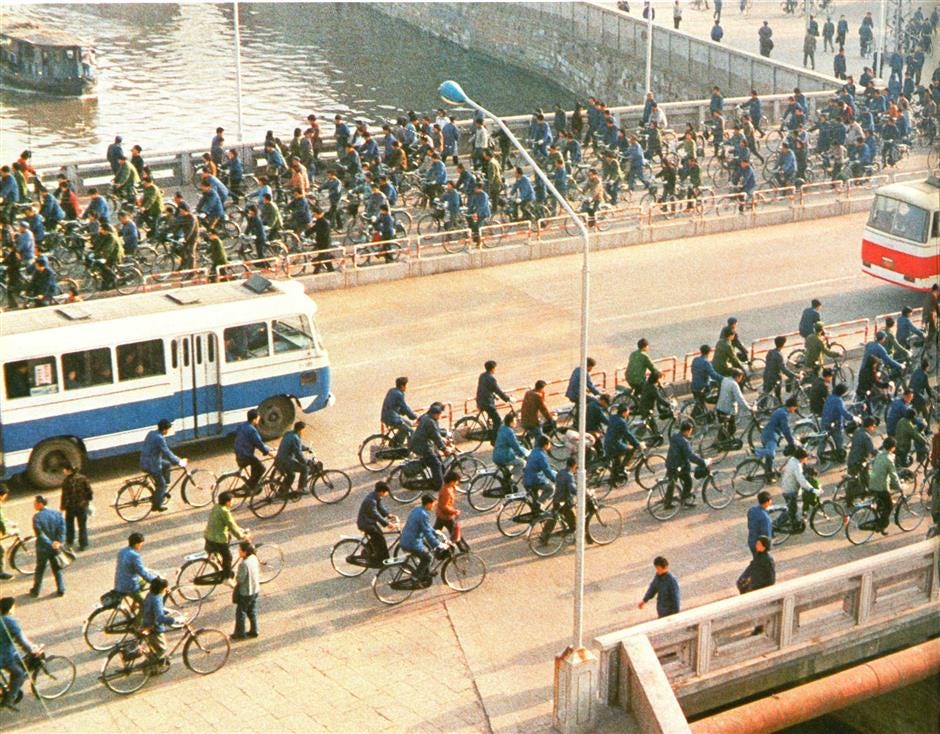
That world is now gone. As commuter vehicles, human-scale bicycles have been displaced by e-scooters designed for urban flow. For the price of two decent bikes, you can buy a scooter that goes three times faster, carries your groceries, and gets you to work unsweaty. It handles the kind of sprawl that Chinese cities, in their explosive growth, now demand. If you’re a working-class commuter in a second-tier city who has to cover eight kilometers to the factory, it isn’t really a choice. E-scooters displaced bikes for good reasons.
As a committed urban cyclist, I’ve biked through more than fifty global cities. In Guangzhou, I tried riding the back alleys and bike lanes with a local guide. Both were full of stealthy e-scooters — the most aggressive of them ridden by delivery drivers threading bike lanes like fighter pilots in an air corridor. I was repeatedly passed at forty kilometers an hour by riders on desperate deadlines whose vehicles outweighed mine by a hundred kilos.
Plenty of people still ride bicycles in Chinese cities, but they do it as a hobby, a workout, or perhaps as a political statement. Outside a few suburban college campuses, it is rare to see a mass of bicycle commuters.
The last gasp of bikes was the dockless bike-share boom of the late 2010s, when companies like Ofo and Mobike raised venture money on the hallucination that the bicycle could be made viable again at scale. It couldn’t. By 2017, mountains of blue, yellow, and orange frames lay rusting in huge municipal lots. Even though there are still some 20 million shared bicycles available in China, the game was over. Electric scooters had won.
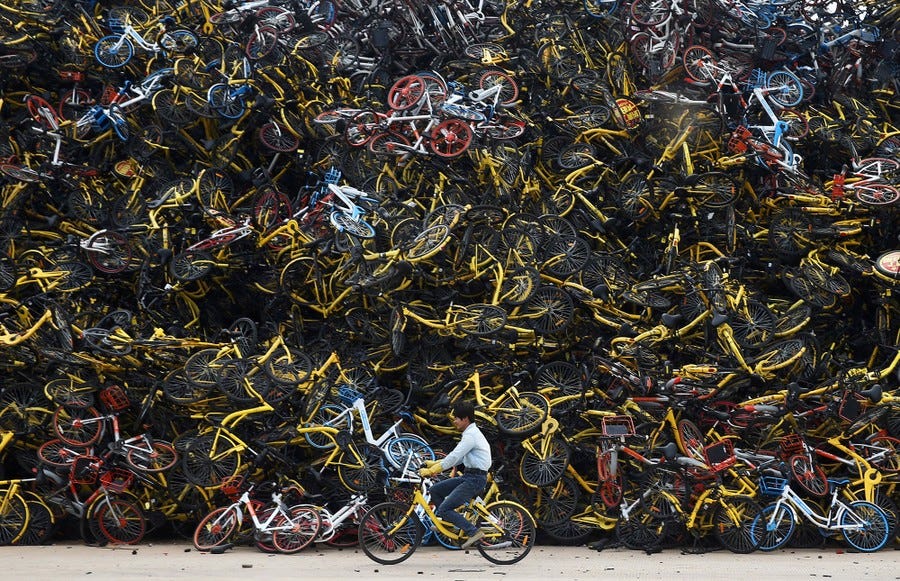
But the scooters didn’t just win as commuter vehicles. They became the substrate for something much larger: the world’s largest urban delivery platform.
The Silent, Invisible Trap
China’s urban delivery platforms are both an achievement and a cage. The cage is hard to see because it consists of logistics that China can no longer easily build.
An efficient delivery system is “many to many” — it enables millions of dispersed retailers to serve billions of dispersed consumers. This requires consolidation points where shipments can be pooled into trucks, airplanes, and local delivery vans. A well-designed delivery system is so productive that it can pay above-median wages in most countries. Ask UPS or FedEx.
“Point-to-point” delivery is very different. It’s a courier service that moves goods from a single retailer to a single customer. China’s world-class instant-delivery network depends on cheap labor willing to do point-to-point deliveries. But this system makes it much harder for China to build a world-class many-to-many delivery network that rationalizes shipments and is productive enough to pay well.
This sounds counterintuitive. Surely, if you can deliver a bowl of noodles in 22 minutes, you can deliver a box of shoes in 22 hours? But the two systems operate very differently. Paying millions of riders for point-to-point instant delivery is only sustainable at very high density and very high velocity. Moreover, it absorbs the resources needed to modernize into a high-productivity system.
Customer expectations. To start, instant delivery shapes a broad range of consumer expectations. Customers who expect shoes to arrive within an hour can only buy from local merchants, which apps like Alibaba facilitate. This effectively shrinks the consumer market or requires retailers like Temu to maintain far more local distribution centers throughout China.
Resources. A modern delivery service needs to compete for the same talent pool, the same vehicle fleet, and the same last-mile access arrangements with residential compounds. Labor that could staff parcel routes is on scooters, making instant deliveries at piece rates. The vehicle fleet that could be consolidated into efficient vans is fragmented across tens of millions of individually owned two-wheelers.
Regulations. The regulatory regime that could have encouraged standardized addressing and universal service is a patchwork that assumes every delivery is coordinated through a platform app. The residential compounds that could have been required to install uniform mailbox or locker infrastructure have instead been allowed to wave through individual riders, compound by compound, app by app.
Opportunity cost. The economics of a 22-minute point-to-point delivery of bubble tea are fundamentally different from those of high-volume, many-to-many, two-day parcel delivery intermediated by cross-dock warehouses. China has ruthlessly optimized for the former at the expense of the latter.
The result is a system that is extraordinary at instant delivery, but mediocre at everything else. Moreover, it is now large enough to be buried in path dependencies that will be very hard to overcome.
Building a Japanese-quality parcel network in urban China — with its dense web of neighborhood of koban equivalents, its universal addressing, its seamless integration of postal, private, and municipal services — would require resources and policy attention that are instead flowing into the instant-delivery machine.
Moreover, the machine is too successful and too important to redirect. Meituan alone processes enough daily transactions that disrupting its logistics would register as a minor macroeconomic event. Ele.me is owned by Alibaba, which means disrupting it would be a minor political event.
Will drones replace drivers? It’s tempting to imagine Meituan’s drone prototypes as the next wave — quieter, faster, cleaner, and less exploitative of workers. Don’t hold your breath. After several years of operation, Meituan’s drone program runs a few hundred thousand deliveries per year, compared to its scooter network, which handles tens of millions of deliveries every day. Drones require dedicated takeoff-and-landing infrastructure (Meituan has built rooftop stations at malls and office towers), while scooters require a rider with an app. Payload limits of around 2.3 kilograms rule out highly profitable grocery orders. Only a few major cities have opened their low-altitude commercial airspace to designated pilot zones.
And — the quiet truth of the whole system — the scooter network’s cost advantage is its ability to arbitrage labor. Until drone deliveries are cheaper than a rider's 5 RMB per run, drones cannot compete on cost. The drones are cute, but they are a rounding error, not the future of China’s urban circulatory system.
Behind China’s New Hum.
American and European commentators look at Chinese urban logistics and usually conclude one of two things: either China is the future and we should copy it, or China is a dystopia and we should be grateful to live somewhere else. Both of these views miss the more interesting lesson: China’s technological trajectory is emergent and path-dependent, as it is in most places.
China’s e-scooter delivery system is not a glimpse of the future. It is an unplanned, contingent response to a specific set of conditions: cheap labor, dense cities, lax vehicle regulation, a regulatory environment willing to tolerate enormous algorithmic wage pressure, and a population that — for reasons of income distribution and urban form — found the service irresistible.
The country has built something that works so well at its intended purpose that it cannot easily build the other things it might want. The infrastructure isn’t neutral. It isn’t a platform in the Silicon Valley sense — something you build more things on top of. It is a structure that grew to fit its market so completely that it reshaped the market around itself. Now the market can support this structure, and not much else.
When we talk about “advanced logistics” as a civilizational capability, we should specify what we mean by it. A network that moves a hot bowl of noodles four kilometers in 22 minutes is not the same thing as a network that reliably delivers a package from any address to any other address within two business days. They are different achievements. China has one of them, to an astounding degree. It does not really have the other. And it is not obvious that it ever will.
Somewhere in China right now, the urgent mosquito-whine is out there. Riders are moving, algorithms are routing, and someone is about to get their hot noodles. It is a marvel. It is also the sound of choices whose alternatives are receding fast.
ICYMI
Congress reports that at least ten individuals who “had a connection to US nuclear secrets or rocket technology,” have “died or mysteriously vanished in recent years”.
Salmon on cocaine are more confident. And as a result, far more likely to be eaten by predators.
Some bankers are warning that AI will be massively deflationary.
Nate Cohn thinks Democrats might retake the Senate. The biggest lifts: Iowa and Alaska.
The Chinese Communist Party is increasingly led by top scientists, not just engineers. Lawyers need not apply.
Russian forces are struggling to defend themselves against Ukrainian strikes. Slava Ukraini.
Students use AI tools to get a four-year online degree in three months.
China’s Social Credit System is a fragmented, government-led initiative aimed at building what officials call a “culture of sincerity” by rating the trustworthiness of citizens and entities. Rather than a single nationwide score, it operates through local pilots, industry-specific ratings, and national blacklists — most prominently the Supreme People’s Court’s list of “dishonest persons,” which is what actually bars a debtor from booking high-speed trains, flights, or premium hotels. Local pilots add their own rewards and punishments, ranging from priority access to public services and lower energy bills to deposit waivers on rental bikes.
NP-hard problems are a class of computational problems for which no known algorithm can produce an exact optimal answer in time that scales polynomially with input size. For practical purposes, at the scale Meituan operates, exact solutions are infeasible, so they must build systems that rely on heuristics and approximations that get close enough, fast enough. This is technically nontrivial.
If delivery riders are 12 out of 350 million e-scooters, they are 3-4% of the total. If delivery riders average 8 hours a day and commuters average only an hour, delivery scooters could be involved in a quarter of all accidents simply because they represent a quarter of all miles driven. Algorithms could have nothing to do with it. I’d be surprised, but we don’t really know.