

During the 1940s, British biochemist and historian Joseph Needham visited archives throughout China under wartime conditions to document the country’s extraordinary history of technological inventions. His 27-volume history convinced the West that China developed printing, the compass, gunpowder, advanced mathematics, engineering, astronomy, state bureaucracy, and hydraulic engineering centuries earlier than Western countries did.
Needham’s discoveries led him to wonder why modern science and industry developed in Europe after the Renaissance, when China had established clear technological superiority more than a millennium earlier (roughly from the 1st century BC to the 15th century AD). It is a dilemma still widely debated by scholars who refer to it simply as “the Needham question”.1

Since the 1980s, China has fully confronted the Needham Question by building institutions and incentives that have enabled it to once again flourish technologically. The result is the most impressive economic achievement in my lifetime: the lifting of a billion Chinese people from grinding poverty to a level of economic well-being approaching middle-income status.
Until recently, most Americans regarded China as another Asian country that churned out cheap stuff, much as Japan and Korea had once done. This China still exists, although it is fading fast. Since 2013, China has shed tens of millions of factory jobs. As it automates manufacturing or sends production to poorer countries, China is no longer content to serve only as “the world’s factory”. It is morphing into a global research and development laboratory that can outbuild, outinnovate, and outengineer the rest of the world.
When the Financial Times recently summarized how they are doing this, they described how China now designs, builds, and deploys semi-autonomous EVs in as little as 18 months — compared to four or five years for similar projects in Europe. That kind of velocity is the product of a national apparatus that fuses industrial policy, engineering capacity, supply-chain density, and a deep talent pool into a formidable machine.
Capital, Coordination, and the “Innovation Flywheel”
Behind this transformation is a sustained, nationwide strategic investment in research and development and a governance model able and willing to take a decades-long view of strategic technologies. This view has created a series of interlocking industrial clusters in which supply chains, manufacturing, and research reinforce one another. As the US defunds federal science programs, the Chinese are enabling success in one field to feed progress in others.
This week, the Australian Strategic Policy Institute released research on 74 high-tech sectors and found that China now leads 66 of them, with the US ahead in the other eight. The report described how persistent Chinese investment in research helped them overcome the initial US lead in most of these technologies.
China is investing massively in scientific research. Two decades ago, China published six percent of the world’s most highly cited research papers. This year, it was 48 percent. The US went from 43 percent to nine percent during the same time period.
The most recent Nature ranking of global research universities lists nine of the top ten research universities in China, with Harvard University the only top-tier US university.
At a time when the US is defunding many federal science programmes, China is doing the opposite by “building the whole technology ecosystem”, says Jenny Wong-Leung, one of the report’s authors. ASPI’s findings align with Nature’s latest ranking of research institutions, which tracks articles across 145 science journals. In terms of research output, nine of the world’s top 10 research institutions are Chinese, with only Harvard University in the top tier.
Europe has demonstrated that published research alone does not create technological capability, but China has done an exceptional job of commercializing its research. This is in part because Chinese leaders are technology-obsessed. Under programs like Made in China 2025, Beijing fused industrial policy, advanced supply chains, robust engineering, and a STEM-heavy talent pipeline into a single formidable machine. China targeted a suite of technologies that they believed would power future innovations. These include the electric stack – photovoltaics, batteries, and electric motors that power everything from e-bikes and EVs to drones. It included robotics, 5G, and high-speed rail. Even where China didn’t achieve its most ambitious goals, it nonetheless built globally competitive capabilities across many of these sectors.
The results are not merely dynamic sectors that are globally competitive. China has cultivated a vast and dense ecosystem that links universities, researchers, engineers, factories, capital, and regulatory support. This system can achieve accelerating returns. A breakthrough in battery chemistry, for instance, doesn’t just benefit EVs; it ripples across energy storage, industrial automation, and maybe even robotics.
China has taken the Needham question to heart and is determined to both outperform the West and not treat innovation as a sprint with a single winner. It has integrated hundreds of foreign firms into its ecosystem and attracted hundreds of foreign-owned labs into cities like Shanghai. It has consciously promoted talent clusters in major cities. This reflects not just a competitive push, but a pull — a magnet for ideas, capital, skills, and cross-pollination. It’s a model closer to a sprawling, collaborative R&D commune than a zero-sum war over supremacy.
The FT documented the extent of these ties.
In Shanghai, long the country’s preferred hub for foreign companies, the number of foreign-owned R&D centres has increased to 631, as of September, from 441 in 2018. French automaker Renault does not even sell cars in China, but it is among those companies to have opened an R&D centre in Shanghai this year to learn from the local market.
Beijing also saw 58 new R&D centres established by foreign groups in the first 10 months of the year, expanding the total number of foreign R&D centres in the city to 279, according to local officials.
The West Becomes Nervous
Chinese success has produced a growing wariness in the West of geopolitical dependence in critical fields such as AI, drones, ships, clean energy, EVs, high-speed rail, and robotics. As Patrick McGee documents in his masterful book Apple in China, straightforward business decisions by Western companies ultimately strengthened China as a powerful commercial and military rival. He describes how Apple deployed thousands of industrial engineers to Chinese factories, trained millions of workers, and invested hundreds of billions of dollars to build the world’s most advanced supply chain in China. In doing this, Apple also unwittingly laid the foundation for a powerful, state-supported Chinese electronics industry.
The Beijing machine has weaknesses, of course. At least half of the Chinese economy is a mess (as is some large fraction of the US economy). China suffers from heavy-handed governance, the real estate collapse, opaque political and industrial incentives, systemic corruption, and growing youth unemployment. Chinese investment in R&D is massive, but without the checks and balances provided by decentralized institutions and independent oversight, it is less likely to yield breakthrough innovations.
This may not matter. Chinese R&D is both more strategic and less technologically aspirational than in much of the West. There is less “blue-sky” or “moonshot” science, and more emphasis on developing scalable infrastructure and industrial efficiencies. These dry but consequential investments build the infrastructure that transforms inventions into everyday reality. It also shifts the competitive landscape from whether America and Europe can out-innovate China to whether we can out-build, out-deploy, and out-scale them. China is not just building more – they are adopting new technologies more rapidly, operating at a much larger scale, and dominating supply chains in many sectors thanks to the feedback loops that turn labs into wealthy economies.
A Talent for Talent
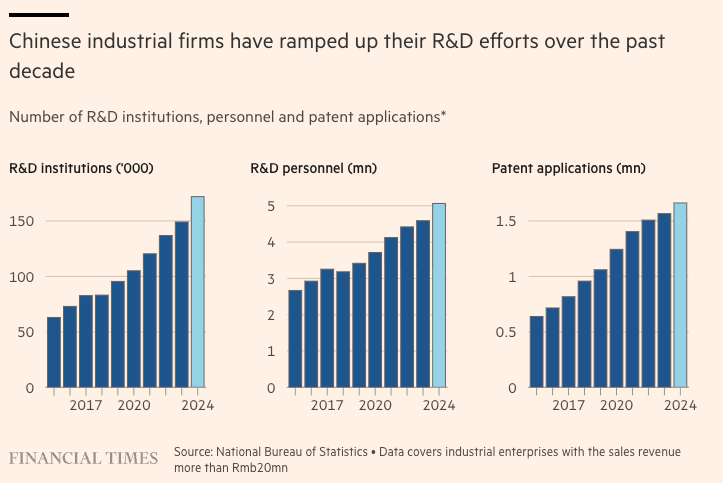
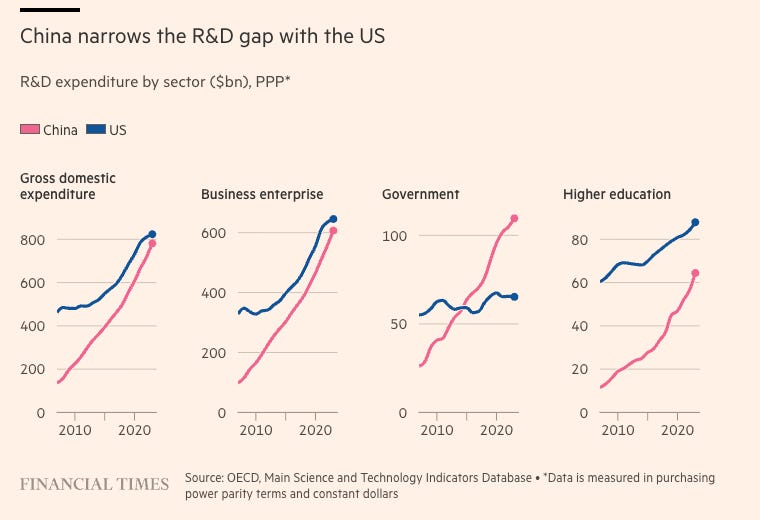
The Chinese government has spent more on R&D than the US every year since 2015 and has tripled the number of corporate R&D institutions to more than 150,000 during this period. This demands legions of trained researchers, as China has doubled the number of corporate R&D personnel to over five million.
This has required China to design and build a talent pipeline. The country now produces around 50,000 PhD graduates in science, technology, engineering, and mathematics each year, compared to about 34,000 from US universities. (And about 16% of US STEM graduate students come from China.)
Small wonder that China filed three times as many patent applications last year as the United States and accounted for almost half of all global patent applications.2
Zero or Positive Sum Competition?
The ascent of China, not just as a factory leader but as a knowledge leader, may or may not herald a single global winner, depending on whether the US treats innovation as a complex ecosystem or a two-player duel. Growth industries from EVs, clean energy, robotics, and manufacturing can benefit globally if Chinese capabilities strengthen local supply chains. For example, American researchers and managers would learn a great deal if China were to build EVs in the United States and source essential components locally. BYD, China’s largest car company, already builds electric buses in Lancaster, California. Unlike most transplants, they recognized a union, sought to hire local military veterans, and invested heavily in civic projects.

Integrating Chinese supply chains raises obvious economic, geopolitical, and ethical questions. Dependence on a potential military adversary, strategic bottlenecks, technology-transfer concerns, and the opaque and occasionally brutal nature of Chinese state-backed development all raise serious questions. China does not respect property or human rights, or the rule of law more generally. They are overly reliant on state-owned enterprises and impose onerous restrictions on foreign investors. To note their success is not to minimize these concerns.
But if history has taught us anything, it’s that technologies rarely stay local. Chinese EVs are already for sale in the US.3 The printing press spread, the transistor diffused, the smartphone proliferated. It increasingly matters less who creates the breakthrough than who has the infrastructure to build and deploy innovations at scale.
China is no longer simply a supplier to the United States. Competition between the two countries will become more complex as it shifts from bilateral to multilateral. It will continue to be both overt and covert, involving both partnerships and direct competition, investments as well as sanctions. But increasingly, China is not just racing to catch up – it is building, learning, and accelerating faster than the West.
CODA
Like many guitar heroes, Mary Spender is a fellow watch nerd. Last week I followed her visit to the semi-secret Nomos boutique in NYC.
Most concluded that although China’s early achievements were real and extraordinary, Europe developed the institutions and incentives that turned natural philosophy into experimental, law-seeking, mathematized modern science. By historical accident, Europe possessed a combination of politically fragmented competing states, market incentives, and intellectual traditions that favored mathematization, autonomous universities and scientific societies, and global economic conditions that did not exist in China.
Note that more than half of US patent applications were filed by researchers who were born outside the US. Discouraging these researchers from immigrating to the US or ejecting them once they arrive is incredibly shortsighted.
They are sold as Volvo EX series cars. Volvo is owned by the Zhejiang Geely Holding Group, a Chinese multinational car company, and assembles EVs in both China and Ghent, Belgium, using components from China.
This story is why we opened an office in Hong Kong in 1984 and were among the first to enter the "mainland," as it was known at the time. The scale and history of China made its future economic role in the world inevitable. So long as productivity gains from innovation continue to propagate, the world wins in the long run regardless of their source.