
Two things struck me when I arrived in Costa Rica last week. The first was “pura vida” — the country’s iconic national phrase that can sound like a collective speech tic. It translates to “pure life” (something like “all good”), but serves as a catch-all greeting, farewell, and expression of gratitude. “Pura vida” is a laid-back reminder to appreciate life’s simple joys, stay optimistic, and prioritize family, nature, pacifism, and well-being. You hear it everywhere from everybody.
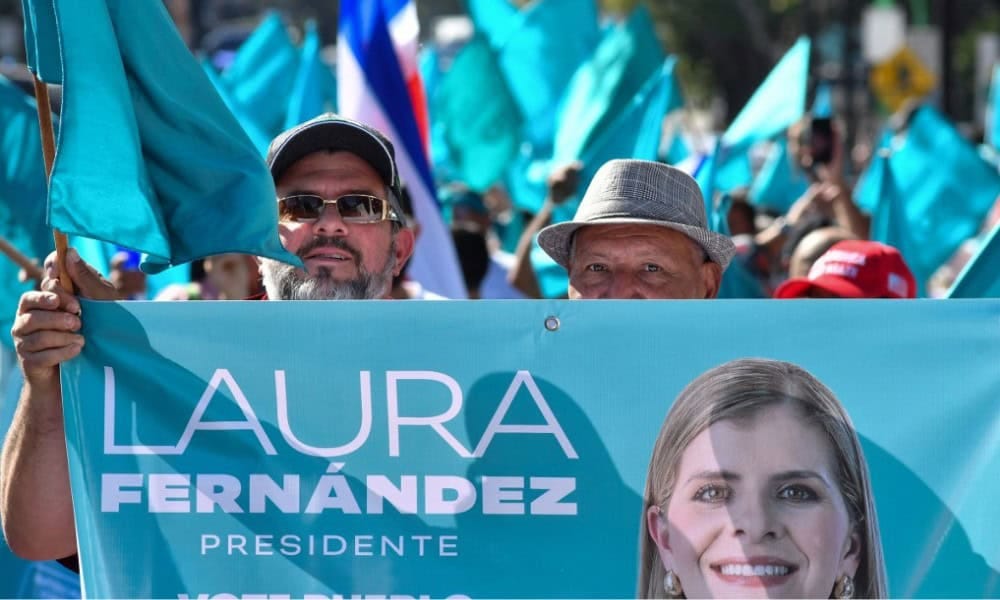
The second surprise was the pervasiveness of the campaign by a young woman named Laura Fernández, whom voters elected the next President of Costa Rica shortly after we arrived. Her bright turquoise-colored signs were on T-shirts, cars, and small-town billboards. Fernández ended up with almost half the vote in a field of 20 candidates. Since 40% wins the Presidency in Costa Rica, she won on the first ballot.
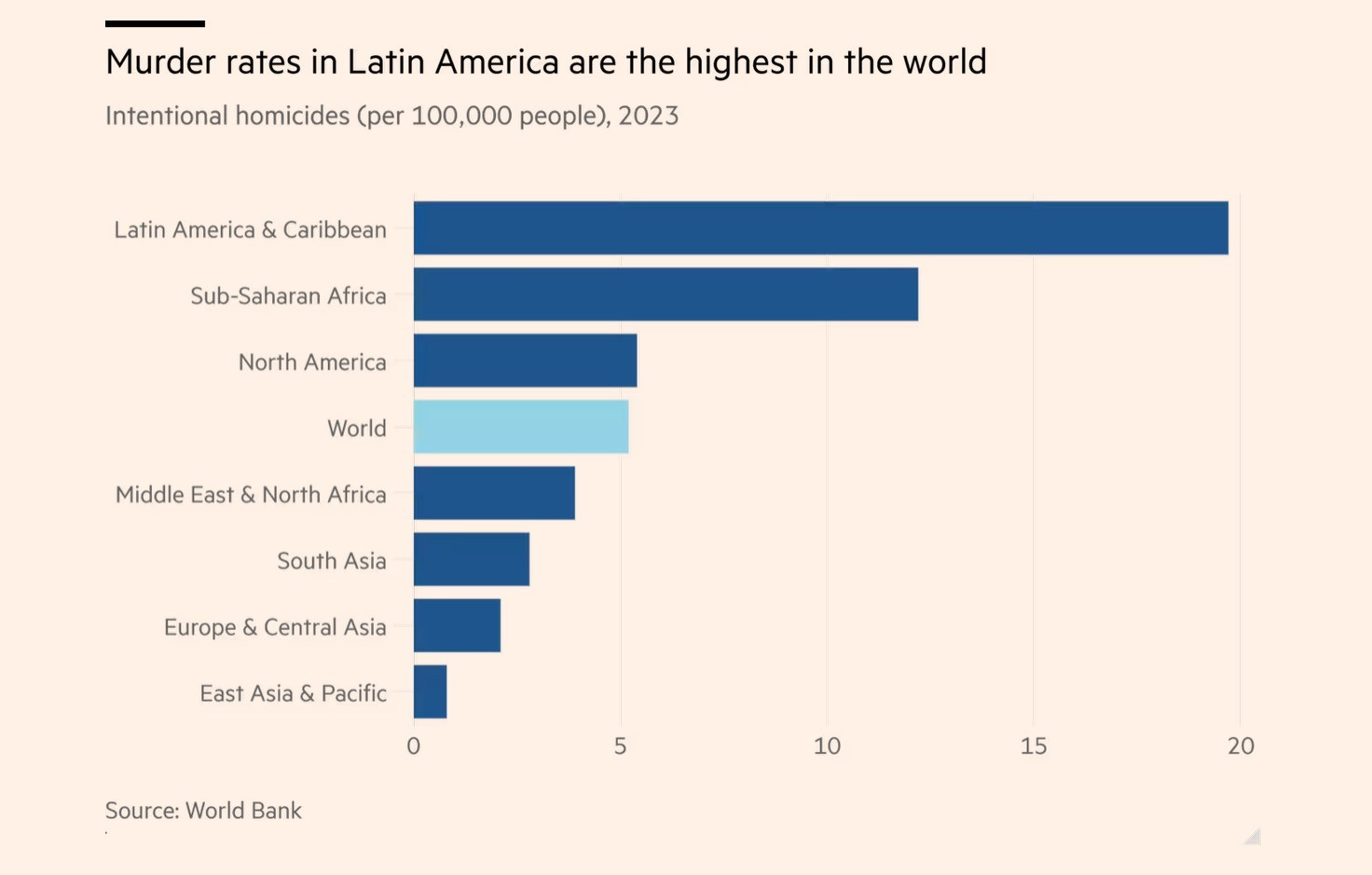
Fernández campaigned on “mano dura” (iron fist), not “pura vida”. She pledged to continue the policies of her current boss, the popular President Rodrigo Chaves, who was ineligible to run again. Fernández and Chaves are right-wing populists whose rise is due less to illegal immigration and more to surging murder rates brought to Costa Rica by drug cartels.
Things Go Worse With Coke
Murderous gun thugs sit especially poorly with Costa Ricans, who pride themselves on not being Guatemaltecos, Nicas (Nicaraguan), Salvadoreños, or Catrachos (Honduran). The country abolished its army in 1948, invested massively in schools, and embraced eco-tourism with a boost from four American Quaker pacifist families who objected to the Korean War. (They founded the cloud forest town of Monteverde and pioneered the use of private land trusts to create biological reserves.) Costa Rica has a strong middle class. It sees itself as richer, greener, more modern, and just plain cooler than the rest of the region. It struggles to reconcile pura vida with being just another center for narcotics-driven murder and mayhem.
Nonetheless, murder rates in Costa Rica have risen sharply. Homicides jumped from 6.3 per 100,000 people in 2000 to almost 17 last year. This is nearly three times the U.S. rate, which ranges from 6 to 7 per 100,000.
Voters elected Fernández to not only continue the policies of the Chaves administration, but at least in part to imitate El Salvador’s Nayib Bukele, who has resorted to authoritarian tactics to smash criminal gangs and drug cartels. He jailed many men for sporting gang-related tattoos. Crime plummeted. Chaves liked the results and launched construction of a mega-prison modeled on the notorious CECOT in El Salvador. Fernández, who says she will keep Chaves in her administration, has promised to complete and quickly fill the prison.1
Costa Rica has become the latest Latin American country, after Argentina, Chile, and El Salvador, to elect an anti-establishment conservative sympathetic to Donald Trump. Up next are Peru and Colombia. But for a shambolic opposition, Brazil would follow suit. And although Trump has removed the pathetic Nicolás Maduro from Venezuela, its democratic future remains in doubt.
How to Supply Drugs to the U.S.
A drug cartel depends on three things: weak or corrupt political leadership in the places it produces and distributes drugs, well-embedded supply chains, and a market that cannot effectively control demand for narcotics. Happily for the cartels, Central America provides the first two, and the United States furnishes the third.
Weak and Corrupt Leadership. Central America has more than 50 million people spread across seven countries. Guatemala is the largest, roughly the size of the New York City metropolitan area. Belize is the smallest – think Omaha. In between are Honduras (~Florida), Nicaragua (~Massachusetts), El Salvador (~Indiana), Costa Rica (~Philadelphia), and Panama (~Miami).
As a single federated, Spanish-speaking, Catholic nation, Central America would be a mid-sized country comparable in population to South Korea or Colombia. Two centuries ago, the region attempted to unite. In 1823, Guatemala, Honduras, El Salvador, Nicaragua, Costa Rica, and a bit of Southern Mexico formed the United Provinces of Central America. Inspired by liberal ideas and the U.S. example, they adopted a federal constitution in 1824.
The project failed almost immediately. Much like the Articles of Confederation in the U.S., the federation lacked stable revenue, a strong executive, and a shared vision for nation-building that could overcome local loyalties. Local caudillos defended their provincial interests instead of building a fiscally and militarily strong central state. Soon enough, states wrote their own constitutions and regional strongmen built local power bases. The result was repeated civil wars in the late 1820s and again from 1838 to 1840, driven as much by rural-urban and indigenous-elite conflict as by disputes over federalism. By 1838–39, the federation collapsed, and each state declared its sovereignty.
The legacy of fragmentation that began two centuries ago continues to shape regional security arrangements. The mechanisms that Central American countries use to coordinate their fight against cartels are weak and primarily defensive. The Central American Integration System (SICA) tries to establish common priorities, coordinate training, and share intelligence on traffickers. But it does not command joint forces, run operations, or enforce common standards. Uneven police capacity and pervasive corruption limit cross-border efforts.
Cartels naturally exploit the weakest link—and most links are weak. Many states, especially pacifist Costa Rica, lack the naval or coast guard capacity to defend their coasts and ports. Governments have learned that pushing too hard can trigger prison riots, municipal assassinations, or port shutdowns, so many try to contain cartels instead of defeating them.
Embedding Narcotics Supply Chains. As drug cartels came under pressure in Mexico and the Caribbean, they turned to Costa Rica for several reasons.
Geography. Costa Rica sits at a perfect mid-point between Colombia, Peru, and Bolivia, which produce cocaine, and the U.S. and Canada, which consume it. It has both Pacific and Caribbean ports, which give traffickers routing flexibility to make short hops by fast boats, fishing vessels, or semi-submersibles from Colombia to Costa Rican waters.
Legitimate trade creates camouflage. Costa Rica exports containers full of bananas, pineapples, coffee, and medical devices to the U.S. and Europe. Because this cargo is often perishable, attempting to scan even a small fraction of it thoroughly would paralyze trade. Drugs are a small illegal needle in a large and legitimate haystack.
Strict rule of law — but limited hard power. Costa Rica abolished its army in 1948. That’s central to its identity—and its vulnerability. Its policing is civilian and comparatively professional, but it has no navy or coast guard and minimal maritime interdiction capability.
A stable institutional environment. Traffickers prefer predictable institutions. They like functional courts, enforceable contracts, and well-developed banking and real estate systems. Costa Rica offered this and historically offered low murder rates and political stability, making it a good place to store, repackage, and finance narcotics.
Homicide in Costa Rica rose after 2008 because changing transshipment dynamics and the country’s poor preparedness pulled it into the drug economy.
Costa Rica became a warehouse, not just a transhipment corridor. The amount of time that narcotics spend in a country is a powerful predictor of drug-related violence. Before 2008, drugs moved through Costa Rica quickly, with minimal local handling and very little violence. By 2015, Costa Rica had become a storage, consolidation, and redistribution point. Cocaine sat longer on Costa Rican soil, involving more people and places and giving rise to more disputes.
Payment shifted from cash to cocaine. Changing from cash to drug payments has huge downstream effects. Not only did traffickers need to pay local collaborators to store, repackage, and trans-ship drugs, but they began to pay them in product, not money. To turn that cocaine into cash, local groups had to sell it or trade it onward. Local gangs with inventory meant expanded retail markets and the inevitable territorial violence that followed.
Cartels remained fragmented. Costa Rica didn’t get one dominant cartel; it got many small, unstable ones with weak hierarchies and constant competition over corners, ports, and stash houses. Paradoxically, big cartels stabilize violence, whereas fragmented ones cause it to explode.
Supply chains bred violence. Ports, especially on the Caribbean side, became choke points for violence as gangs realized that perishable export containers of bananas and pineapples were ideal for drug concealment. Murders clustered around port cities, logistical workers, and transport routes. Costa Rica is fighting supply-chain violence, not random urban crime.
“Pura Vida” is a lousy security model. Costa Rica had long assumed low homicide, limited organized crime, and few violent disputes. After all, the country had no standing army, limited maritime patrols, and limited capacity to investigate or prevent homicides. It can barely protect its fisheries from poachers.
Feedback loops. Once homicide rose past a threshold, feedback kicked in. As guns became more common, demand for weapons rose. Gangs recruited young people, and gang membership became cool. As states sent more young men to prison, prison gangs became stronger. As gangs grew, witness cooperation collapsed — and with it, effective prosecution. As corruption became more common, many officials felt both stupid and frightened if they did not cooperate with local drug gangs. Soon, homicide became a self-reinforcing part of the culture, even if the original cause was external.
Costa Rica does not suffer from mass unemployment. It is not facing political collapse or a massive cultural change. Costa Ricans did not suddenly become violent. The homicide spike after 2008 came from a structural shift in global cocaine logistics as the country went from being a drug corridor to a drug warehouse, from a cash-based drug trade to a cocaine-based one, and from one with few truckers to a terrain contested by many fragmented groups fighting to control key ports.
U.S. Demand for Cocaine. The demand for cocaine in the United States drives much of the Central American drug trade and the associated violence and political blowback. The CIA dryly characterizes the U.S. as the
“world’s largest consumer of cocaine (shipped from Colombia through Mexico and the Caribbean), Colombian heroin, and Mexican heroin and marijuana; major consumer of ecstasy and Mexican methamphetamine; minor consumer of high-quality Southeast Asian heroin; illicit producer of cannabis, marijuana, depressants, stimulants, hallucinogens, and methamphetamine; (and the world’s leading) money-laundering center”
Unfortunately, since Richard Nixon first declared a “war on drugs” in 1971, the U.S. has treated drug demand as a morality play. Nancy Reagan summarized the prevailing view with her “Just Say No” campaign. We imprison our junkies victims of opioid use disorder, which almost everyone involved quietly acknowledges does not work.
In contrast, countries that have successfully reduced demand for drugs treat it as a fairly pedestrian health, price, and availability problem. Their goal is to have fewer compulsive users, fewer overdoses, and fewer people trapped in drug-centered lives. They treat drugs like a chronic public-health risk — more like diabetes than crime. It’s a social problem, not a police problem — much less a populist rallying cry.2
Specifically, these countries:
Make treatment easy, fast, and routine. Countries that normalize treatment access see lower heavy use and far fewer deaths. Switzerland, Portugal, and France integrate treatment into primary care, often offering same-day access to opioid substitution therapy (methadone, buprenorphine), with no abstinence preconditions. They design treatment to lower compulsive demand—the part that drives overdoses, street dealing, and violence.
Keep prices high by focusing on distribution, not users. Since demand for drugs is relatively “inelastic” (not price-sensitive), it is tempting to ignore drug prices. But prices matter because stable, predictable pricing strongly correlates with fewer deaths. Effective policies try to reduce the volatility of drug purity (which causes overdoses) by keeping prices high and stable. These policies do not try to “win the war”; they try to prevent supply shocks that lead to a surge of cheap, potent, lethal narcotics.
Criminalize exploitation, not use. Countries such as Portugal, Germany, and the Netherlands that experience less drug violence and fewer overdoses do not impose criminal penalties or jail users for possession or use of banned substances. But they impose extreme penalties for coercive dealing, trafficking near schools, or any form of organized distribution. These countries have found that sending users to prison increases future drug use by destroying employment prospects and increasing social isolation. In their experience, punishing users increases demand; punishing exploiters reduces it.
Recognize that housing-first beats rehab-first. Countries like Finland and Canada have found that stable housing consistently reduces heavy drug use. They find it far cheaper to provide unconditional housing for high-risk users alongside on-site health and addiction services. The finding that housing lowers use even when abstinence is not required is one of the most widely replicated in social policy. Addiction thrives on instability.
Treat drugs as a mental-health problem. Countries like Norway or Denmark offer robust mental-health systems: early treatment of depression, trauma, and schizophrenia, and access to counseling without stigma for young people. These countries work to treat the underlying condition. They lead with crisis intervention and a robust mental health care system. They still have criminal penalties and coercive psychiatric intervention, but jail is a last resort.
Regulate intelligently. Overall, the evidence on drug legalization is at best mixed, depending on how markets are designed and regulated. To mitigate harm, governments need to heavily control advertising, product potency, retail density, and pricing. In some settings, cannabis availability may modestly displace alcohol or opioid use, but results are still not definitive and seem to vary across populations and time.
Avoid obvious mistakes. In a half-century of fighting to reduce demand for illegal drugs, some things fail consistently. Advanced countries agree on this more than they admit. Mass incarceration fails, as does zero-tolerance policing. Militarizing local police to step up enforcement does not reduce drug use, nor do long prison sentences for possession. These steps tend to raise overdose risk and increase long-run demand.
Europe is not “soft” on drugs. It combines broad access to treatment, including medications for opioid use disorder with harm reduction (naloxone, syringe services), and far less criminalization of users relative to the U.S. This not only achieves vastly better outcomes, but it costs much less money.3
Mano Dura o Pura Vida?
Costa Rica seems likely to compromise civil rights and theatrically imprison drug dealers and gang members. Doing this will likely be as popular as the extreme measures taken in El Salvador have been.
Progressives and independents who value human and civil rights risk ceding the political field to authoritarian leaders unless they respond effectively to the scourge of drug cartels and drug-related violence. Just as progressives in North America and Europe need to embrace realistic policies to confront illegal immigration, those in Central and South America need to commit to destroying drug cartels. But mopping the floor is pointless if the sink is still overflowing. Those who care about the political stability of Central and South America need to insist that the United States reduce its spiraling consumption of cocaine by learning from countries that have reduced their demand for illegal drugs.
Musical Coda
Fernández did not win the 38-seat legislative supermajority she campaigned for to enact sweeping legal and judicial reforms to allow her to declare a state of emergency and limit civil liberties to fight crime. Also, unlike Bukele, she has no army to mobilize. Nonetheless, the President of El Salvador swiftly congratulated Fernández on her victory.
Most cross-country evidence is most substantial on opioids/overdose. Still, the broader lesson is about making heavy-use treatment routine and shrinking the number of compulsive users, regardless of the drug.
The experience of European countries varies, of course. Nonetheless, in 2024, the United States experienced 23.1 drug overdose deaths per 100,000 people. The EU (2023) suffered 2.47 — almost ten times less. A big part of this is fentanyl and other synthetic opioids, which are more lethal and more common in the U.S. Also, the data are not perfectly comparable: the EU headline rate is for ages 15–64, while the U.S. figure above is all-ages age-adjusted. Nonetheless, the magnitude of this gap is so large that this story is about much more than definitions.