
Global capital markets are unfathomably large – on the order of $250-$300 trillion by most measures. These markets for equity (stock or investments) and fixed income (bonds or loans) fund most businesses. They shape the cost of rents and mortgages, the value of retirement savings, the quality of companies, and the jobs they create. Most Americans don’t think about Wall St. and don’t much like it when they do – but the capital markets directly affect their savings, jobs, and purchasing power.
Investors have struggled to profit from season two of The Donald Trump Show. Markets routinely spike, wobble, then snap back. Plainly, they have “priced in” the so-called TACO trades (“Trump Always Chickens Out”). TACO is now the base case, an embedded assumption conditioned by Trump’s reversals and walk-backs. Markets treat political shocks as temporary volatility rather than structural change. And so far, that’s been right -- for investors.
Even though markets have returned to square one, the world has not. Canadian Prime Minister Mark Carney described the current moment as a “rupture” in the global order. When the sober, analytic, former head of the Bank of England uses language like that, traders would be wise to treat it as more than a passing headline.
From TACO to TOFU
Markets need to move from the certainty that Trump will chicken out to the realization that he is causing sustained, long-lasting damage to vital domestic and international institutions. They need to recalibrate from TACO to TOFU – Trump Often Fucks Up.
The past week is a clear example. Talk of U.S. military action against Greenland briefly entered the conversation, then receded just as quickly. Markets sold off—the S&P 500 dropped roughly 2 percent in its worst day since October—and then recovered to end the week almost exactly where they began. For short-term investors, the right move was simple: do nothing.
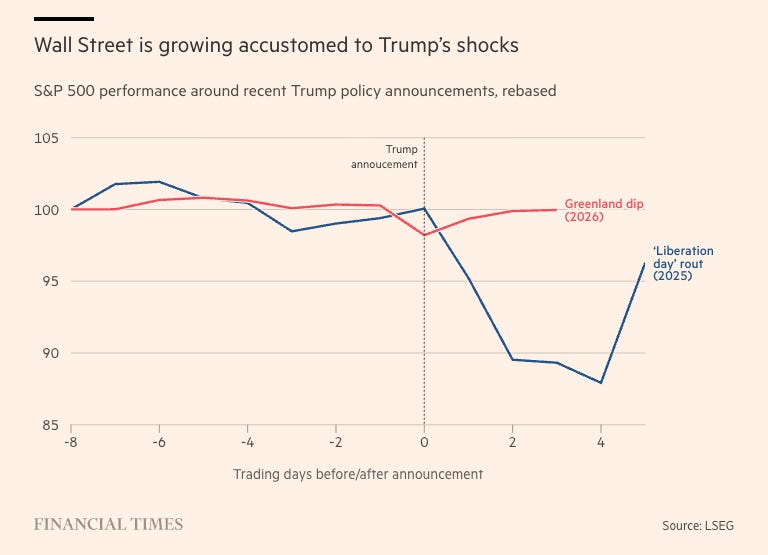
But political systems don’t always resolve according to market timelines. Sometimes the noise is the signal—not because every threat is real, but because the guardrails that once filtered them are eroding. The paradox remains: investors and businesses benefit from complacency in the short run, even as long-run risks quietly compound.
Markets have been known to outsmart themselves. This shows up in technical measurements of the TACO trade on market performance.
Markets fail to fully price in a Trump risk premium. If investors believed tariff threats, debt-limit brinkmanship, or executive overreach were likely to persist or escalate, they would charge for the added risk. Term premia, equity risk premia, and foreign exchange (FX) volatility would increase. Instead, long rates have remained anchored, equities have shrugged off headline risk, and implied volatility has spiked briefly, then collapsed. This is classic “headline discounting.” Markets price the announcement, then discount it because the expected policy path hasn’t changed.
Investors expect Trump-induced volatility to be temporary. Every major Trump-era scare—tariffs, shutdown threats, NATO posturing—has followed the same arc: a short-lived volatility pop followed by rapid mean reversion. Traders expect the confrontation to be walked back, delayed, or diluted. They bet on TACO.
Multiple assets remain unstressed. In a durable break, prices across multiple assets would fall. But fiscal chaos and inflationary tariffs do not cause rates to rise. Credit spreads remain tight, suggesting the market is not pricing in policy-induced recession risk. The dollar doesn’t weaken structurally on trade-war fears. Indeed, it often strengthens, implying global investors expect continuity, not rupture. Cyclical and multinational stocks recover quickly after tariff headlines, which only makes sense if markets assume that Trump will issue exemptions to supplicant CEOs, delay implementation, or negotiate an exit from the tariff schedule.
In short, TACO has provided good short-term guidance. If the market expected Trump to follow through, stock prices would reflect higher expected inflation from tariffs, weaker global growth, and greater long-term volatility. We don’t see those. What we see is skepticism embedded everywhere.
Are Silver and Gold TOFU Trades?
Under Trump, precious metals, led by silver and gold, have experienced a massive, record-setting rally. Silver prices surged past $100 per ounce for the first time in history, reflecting an annual gain exceeding 200%. Gold has also hit record highs, approaching $5,000 per ounce, with gains of over 60% in 2025 and continued, rapid increases so far this year.
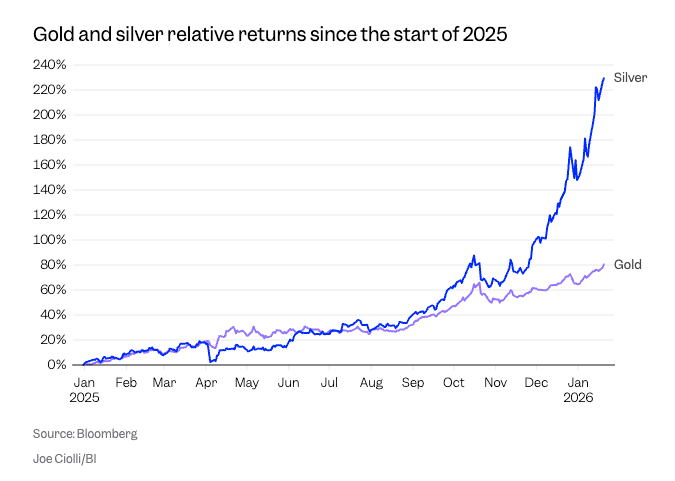
Gold and silver prices answer different questions than equities or credit. Stock markets price earnings, liquidity, growth, and reactions to near-term policy changes. Gold and silver are priced on trust, regime risk, and the long-run reliability of the system in which those earnings sit.
Equity prices reflect what investors expect to happen next. Precious metals are pricing what kind of system this is becoming. The S&P 500 is asking: Will this affect next quarter’s earnings? Gold is asking: What happens if the rules become less predictable over the next decade?
Investors can fully believe in the TACO trade—that every specific escalation will be delayed, diluted, or reversed—and still believe that the process of constant threat and retreat corrodes credibility over time. Gold prices reflect that erosion, which is why gold prices shot up when Jerome Powell denounced Trump’s appalling decision to prosecute him. It’s not reacting to whether a tariff sticks; it’s responding to the growing sense that constraints are weakening. It reflects TOFU.
That’s why gold can rally even as equity volatility collapses. One market is saying TACO: “The bridge will hold today”. The other is saying TOFU: “the system is becoming less trustworthy and the bridge might not be here in ten years.” A large share of recent gold demand comes from central banks, especially in countries that are not U.S. allies and do not want their dollar exposure weaponized. They’re not trading week-to-week volatility; they’re reallocating reserves away from dollars because they know that TOFU.
TOFU Reflects the Long-Term Damage That Trump is Inflicting
Equity investors need to recognize the long-term damage Trump is causing to the institutions they rely on. Investors don’t expect politicians to be calm – but they do count on the machinery that politicians operate being stable: credible data, predictable rules, independent referees, and a bureaucracy that can execute policy without fear. Trump is steadily weakening that machinery.
He threatens an independent Federal Reserve. When markets believe the central bank can be leaned on to cut rates for political reasons, investors bake in a higher “institutional risk premium” into interest rates and FX. That’s a tax on every American.
He undermines credible government statistics. Investors use payrolls, inflation, and GDP to measure valuation, risk, and Fed policy. The firing of the Bureau of Labor Statistics commissioner after a weak jobs report, and broader moves affecting statistical capacity/advisory infrastructure, have eroded trust in core data that markets rely on.
He neutered strong oversight and watchdogs. Inspectors general exist to deter waste, fraud, and abuse—and to make government contracts and procurement less corrupt and more legible. Large-scale removal of inspectors general is widely framed as reducing accountability and raising governance risk. 
He degrades reliable state capacity. If agencies are hollowed out or staffed on loyalty lines, you don’t just get “smaller government”—you get less reliable government: slower permitting, weaker enforcement consistency, noisier contracting, more litigation, and more policy whiplash. Analyses of personnel cuts and fear of retaliation inside oversight functions point to that capacity loss. 
His trade policy is chaotic. Even when the TACO-trained market learns to fade it, tariff brinkmanship still does damage: it raises the option value of waiting on investment, complicates supply chains, and injects event risk into FX and equities. Reuters and others have documented volatility spikes tied to tariff threats and reversals, even when the end state is a walkback. 
He has no use for the rule of law. Investors can live with partisan policy. What they can’t price cleanly is a world where investigations, enforcement, and regulatory pressure are perceived (fairly or not) as tools of political retribution—because that raises the tail risk of arbitrary outcomes for firms, financiers, and individuals.
Even if markets often trade Trump’s outbursts as transient (TACO), the long-run effect is to make the U.S. feel less like a rules-based system and more like a personality-driven one. Investors need to price this risk. They need to move from TACO, which has become a consensus trade rather than a contrarian one, to TOFU.
TOFU reflects the real risk to markets: not that Trump often backs down, but that his erratic, autocratic, and narcissistic style is continually eroding market foundations. A TOFU trade recognizes that the current complacent consensus is making our long-term risks more dangerous, not less.
Thanks Marty, I’ll never look at tofu the same . . .
Good post! I think this is why investors need to keep calm and unite NATO style 😎