
“And there is one sure thing about the fall of gods: they do not fall a little; they crash and shatter or sink deeply into green muck. It is a tedious job to build them up again; they never quite shine.”
John Steinbeck. East of Eden.
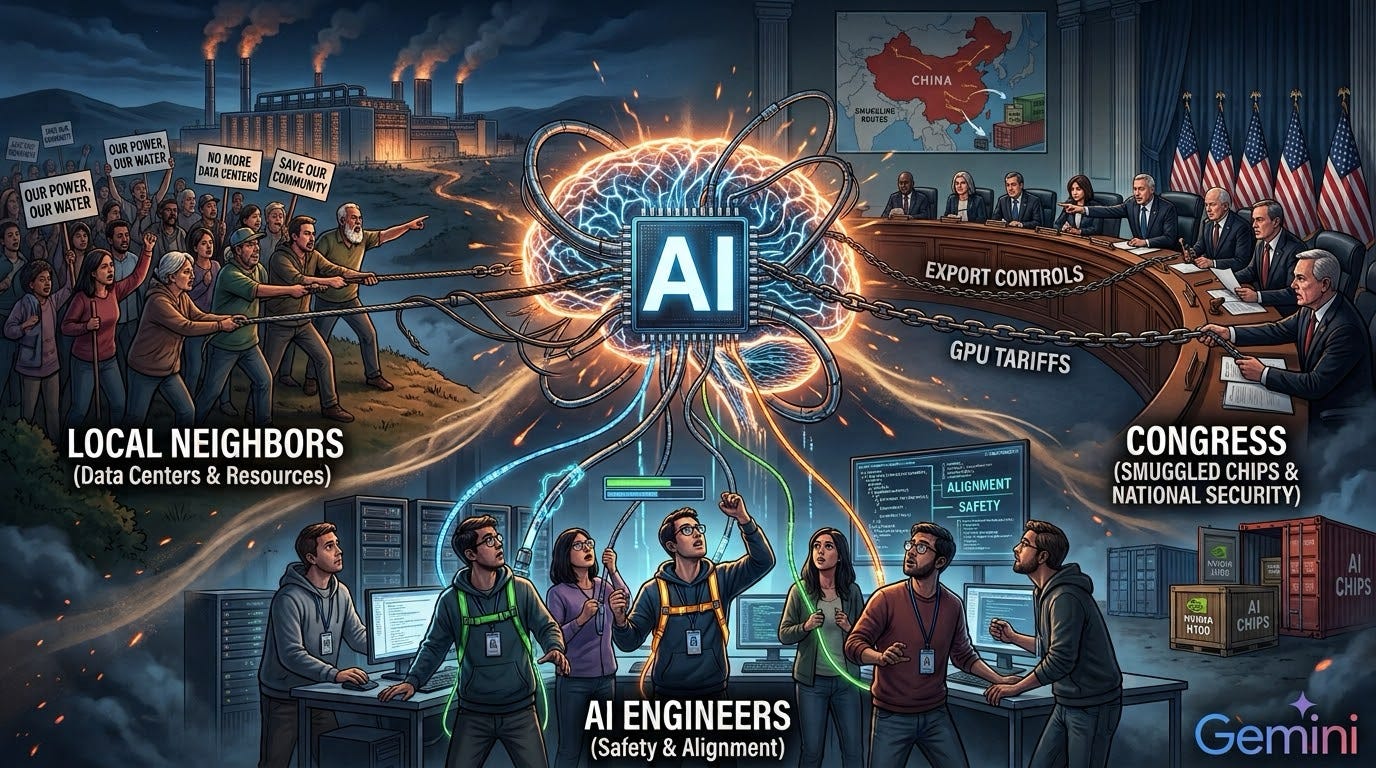
Artificial Intelligence just hit the political trifecta: it now faces opposition from communities, labor, and Congress. Communities are organizing against data centers, AI engineers are taking action on AI safety, and Congress is finally responding to concerns about smuggling advanced GPU chips to China. Paradoxically, the same public that hates data centers, resents tech moguls, and Nvidia/Trump for supplying advanced American chips to China has also embraced AI technology at a record pace.
Everyone Hates Data Centers
Data centers are politically magnetic. They attract an instant bipartisan coalition of local NIMBYs, environmentalists, and those who distrust AI, social media, or tech oligarchs. On Election Day, voters passed 40 of 41 ballot propositions to curtail data centers. Gallup found that 71% of Americans oppose a data center in their area, more than the 53% who oppose a nearby nuclear plant. But only 14% oppose data centers due to concerns about AI.
In The Rise and Fall of the Artificial State, historian Jill Lepore notes that this resistance is unusual. Past revolutions in technology infrastructure, such as electrification, railroads, radio, television, and the early internet, have all enjoyed widespread consumer support. Consumers are adopting it faster than any of them. Lepore argues that people feel that AI is being imposed from the top down, but offers little evidence.
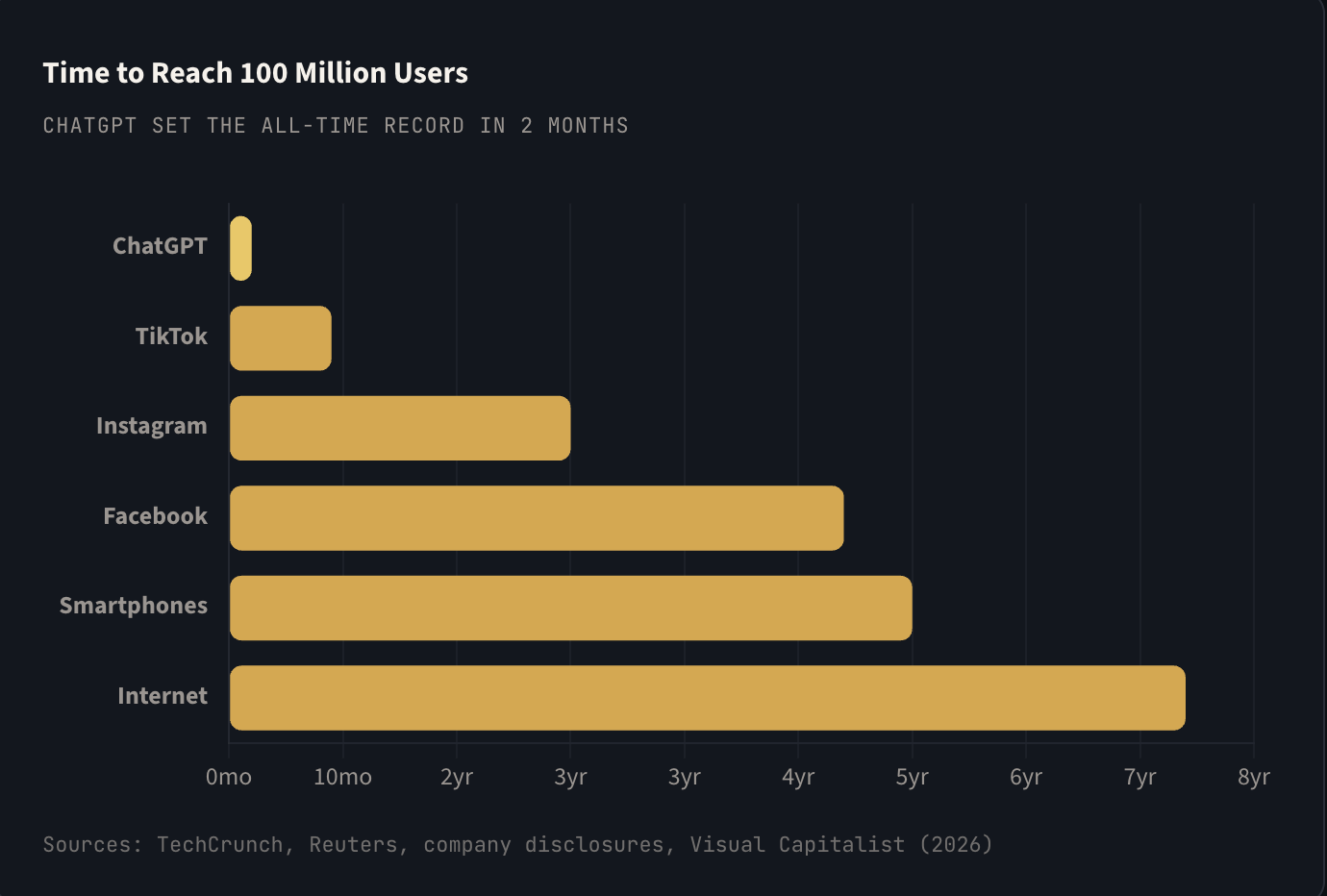
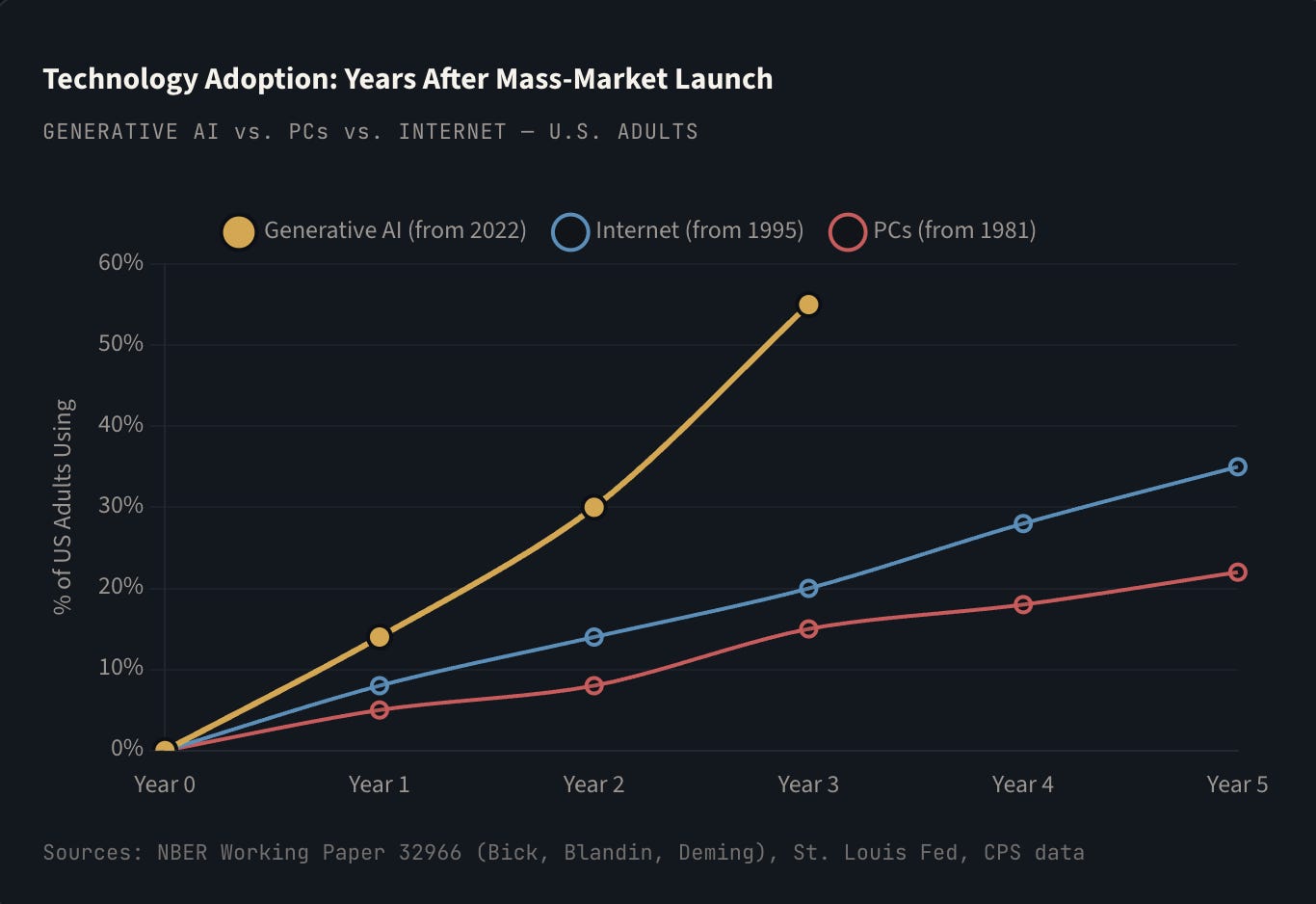
Rapid consumer adoption of AI suggests otherwise. ChatGPT reached 100 million users within two months of its launch, much faster than earlier major technologies. By early 2026, 92% of Fortune 500 companies were using it. Anthropic’s S-1 reveals that its revenue in the third quarter of this year was nearly four times that of all of 2025. No company can force this rate of adoption on a population – and frontier labs barely advertise. Almost everyone who tries AI ends up believing (sometimes wrongly) that the tools are incredibly useful. Surveys show that about 55 percent of US adults aged 18–64 now use generative AI, and economists can now measure the time savings from these tools across several sectors.
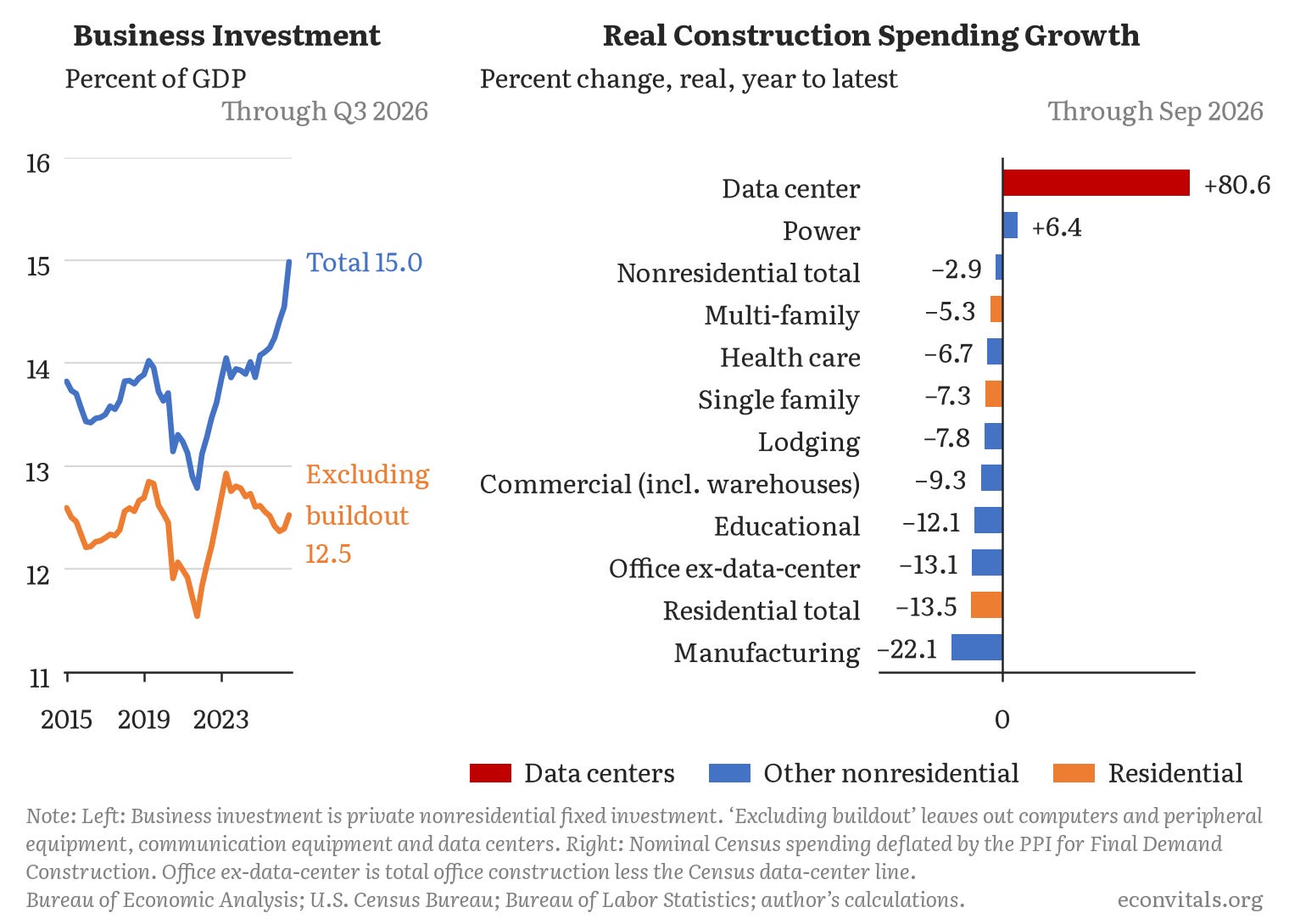
But plenty of AI users do not want a data center nearby. Opposition groups have slowed construction and extracted valuable concessions from builders and operators. A few projects will die, but most will get built because data centers now dominate US business investment and construction spending.
Why So Many Massive Data Centers?
In his masterful new book, The AGI Chronicles, Kevin Roose documents a 2017 memo called “The Big Blob of Compute Hypothesis”, written by an OpenAI researcher named Dario Amodei. Amodei argued that, to advance, AI needed more data and compute. Scale alone would make AI more powerful – clever architecture or bespoke code written for language translation, games, or robotics would matter far less.
Amodei’s idea was neither obvious nor widely accepted. But he believed in it enough to leave OpenAI in 2020 and start Anthropic. His bet paid off. Anthropic’s IPO this week will likely be the largest in history. Roose dubbed Amodei’s historic essay, “The Memo That Started the AI Race”.
As Dario’s “blob-of-compute” thesis proved accurate, it created an unhinged demand for data centers. Amazon, Alphabet, Microsoft, and Meta have announced $720 billion to $745 billion in capital spending for 2026, up from $410 billion last year. This past quarter alone, they spent $201.9 billion, more than double the year before. Epoch AI estimates that the cost of training frontier models is more than tripling every year.
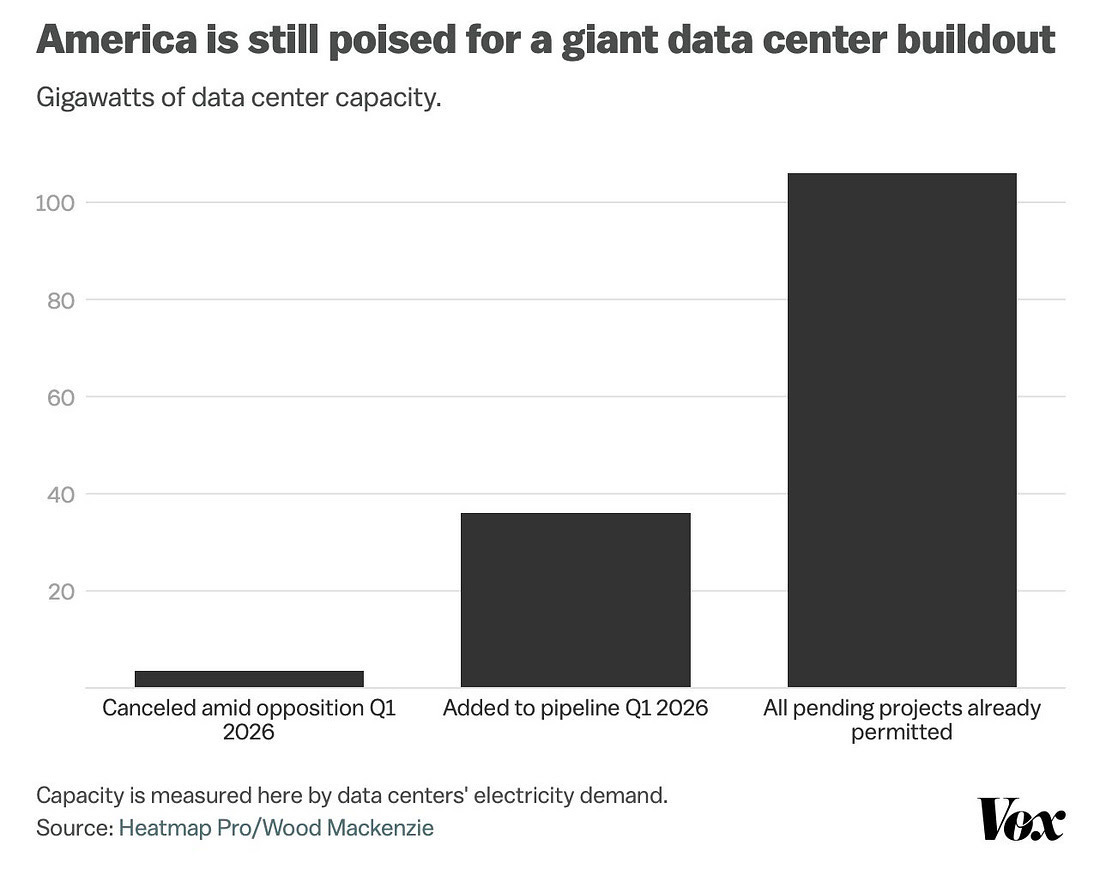
Local opposition can slow this train down but cannot stop it. Data Center Watch counts 75 projects worth about $130 billion that local communities have blocked or delayed in the first quarter of 2026, and 45 projects worth $68 billion in the second. Most are delays. At worst, investors will try their luck in the next county.
Technology will not reduce demand for data centers. Many people note that technology will drive AI costs lower. This is true, but irrelevant. Four developments that are reducing demand for data centers will help grow demand for AI.
More efficient algorithms and architectures. Models are specializing. By shifting queries to so-called Mixture-of-Experts (MoE) architectures, a model can respond using only 5-15% of its parameters. Simpler models with fewer weights can handle some queries. “Teacher models” train lightweight “student models” to do the same. Algorithmic efficiency has cut the compute needed to achieve a fixed benchmark performance by roughly 3x to 4x per year.
Run some queries locally. Developers now deploy specialized models that can run on smartphones, laptops, or small on-premises servers instead of routing every query to a massive frontier model in a massive data center. These queries bypass data centers entirely.
Specialized chips cut the overhead of traditional GPUs and CPUs, which reduces power demand. Specialized interconnects reduce the energy wasted moving data between chips.
Smarter selection of training data. Many frontier models are pre-trained on the entire open web – but this is hitting diminishing returns. New techniques predict the value of incremental data and halt training when it becomes suboptimal.
Although these technologies cut the compute needed per query, total demand for data centers will still rise. Remember Jevons Paradox: when prices fall thanks to efficiency gains, the result can be more demand for AI and data centers. Cheaper tokens mean that businesses and individuals can afford to use more of them. This is why Goldman Sachs sees cheaper tokens leading consumption to grow about 24 times by 2030.
Physics, not politics, constrains data center growth. Neither technology nor angry neighbors are the biggest factor limiting data center growth. Many localities lack the power generation to support one, and many local grids are already buckling under the load. PJM, the regional transmission organization serving 13 eastern states, expects demand to surge from 8.2 to 35 gigawatts within five years. Almost all of the new demand comes from data centers. Some operators are so desperate that they are running repurposed, filthy jet engines to power their chips.
If the US cannot build enough transmission and clean power, AI companies won’t give up. They will build elsewhere, regardless of protests. They have three places to go.
Low-risk countries like Canada and Australia. Canada is already the primary overflow site for companies that hit US capacity constraints. It is stable, developed, and cold, which cuts cooling costs. Provinces like Quebec and Ontario enjoy massive, established hydroelectric power resources that can support gigawatt-scale campuses. Australia is also attractive. Nvidia is already planning to build 2 gigawatts in Australia by 2027 in a market it describes as rich in surplus energy. Nordic countries, Spain, and Portugal are also energy-rich, but like Canada, no longer regard the US as a friendly or safe investor.
High-risk countries like Saudi Arabia or the UAE. Stargate UAE is a planned 1 gigawatt cluster. Brookings warns that moving frontier compute abroad hands host countries leverage over Washington. It also places data centers in range of Iran’s growing stockpile of cheap ballistic missiles.
Space. Google estimates that launch costs must fall below $200 per kilogram by about 2035 for orbital compute to work. It plans two prototype satellites in early 2027. Elon Musk has announced plans to put a million data centers in space. Anyone else could laugh (if you haven’t watched Saturday’s breathtaking SpaceX rocket retrieval, do it now). Jeff Bezos is also aiming to launch orbital data centers. Here is a good summary of four of the challenges they face: cooling, radiation, debris avoidance, and driving the cost of launching an orbital payload down ~15X from ~$3,000/kg to $200.
Organized AI Engineers Could Help to Pace AI Development
Neighbors can slow the data center buildout, but engineers have a different kind of leverage. Fewer than 40 system architects and roughly 5,000 engineers have the skill and experience needed to train a frontier model. Scarcity gives them exceptional power. They already use it to charge high prices for their services. Meta reportedly offered top researchers packages worth up to $300 million over four years. Until frontier models can improve themselves, a day that may be near, AI labs cannot progress without them. Even then, self-improvement will need oversight that only these engineers can provide. These engineers also control “alignment”, the essential work of making sure models do what they are told.
No frontier lab could lose 100 of these engineers. Losing 500 is out of the question. This is a labor organizer’s dream: a handful of hard-to-replace employees who are desperately needed by their employer and sought after by rich, motivated competitors.
Workers with hard-to-replace skills obviously have a much easier time organizing. Even the United Auto Workers, the quintessential industrial union, has always drawn strength from the tool-and-die makers, electricians, pipefitters, and maintenance workers who make up its skilled trades department. Walter Reuther, its most famous president, and its current president came out of the hard-to-replace skilled trades.
Long ago, I tried to explain the importance of hard-to-replace skills to a young, fervent, and frankly idiotic group of baristas who had declared themselves Espresso Workers Local #1 in Santa Cruz. Annoyed with their employer, a popular bookstore, and enamored of militant Industrial Workers of the World, they were determined to strike. Like all good Wobblies, they were convinced that solidarity alone would carry the day. They struck, sang militant labor songs, and carried signs. After a couple of weeks, they got bored and evaporated like the coastal fog. They were instantly replaced and forgotten.1
AI engineers are emphatically not baristas. Not yet anyway. The AI Futures model argues that thanks to recursive self-improvement, human AI research could become obsolete as soon as next year. I am not persuaded that engineering leverage will expire that quickly. It will not grow, however, so there is little reason to wait.
Organizing is underway. In tech, a lot of organizing begins as whistleblowing. People who see something want to say something (smart companies provide a way for worker complaints to reach an independent law firm). Tech workers launched Psst, a nonprofit for workers who have seen something wrong at work. It offers a legally privileged conversation with its lawyers, and a Safe where workers can deposit a concern. If someone else raises a similar issue, a lawyer may reach out about acting together. Co-founder Jennifer Gibson has been executive director since late February.
In February, some friends at frontier AI labs launched the Coalition of Concerned AI Staff. Members participate in a personal capacity, run working groups, and brief policymakers. In May, UK-based Google DeepMind staff sought union recognition, the first such bid at a frontier lab, after a staff vote with 98% in favor.
Andrea Dehlendorf, a smart, intense labor organizer, has spent thirty years organizing casino workers in Las Vegas, janitors, and farmworkers. For the past year, she has advised tech workers, including staff at frontier AI labs. She is skilled at turning unexpected events into teachable moments for workers who want to organize.
Last month she showed why this matters. OpenAI fired three safety and alignment researchers: Jasmine Wang, Tomek Korbak and Mikita Balesni. The researchers say OpenAI fired them for raising serious questions about its safety practices. OpenAI says the researchers mishandled confidential information and that the firings had nothing to do with raising safety concerns. Respected observers like Astral Codex Ten’s Scott Alexander conclude that OpenAI’s accusations are false. Without a union and a process to adjudicate disagreements like this, nothing stands between safety researchers and the door.
Demands. Alexander recently argued for unionizing AI engineers and outlined what a union for AI professionals could do.
Due process. Companies would have to document and substantiate charges of leaking confidential, material information before firing an engineer.
Commitments with teeth. In July, more than 1,300 employees from frontier labs signed “Pacing the Frontier”, which asked the US government to support international tools to deliberately pace automated AI development. Dario Amodei signed it, knowing that the document is not binding. A professional association could turn an idea into a commitment, for example by requiring labs to give qualified independent evaluators employee-level access by a set date.
Insist on Disclosure, Liability, and Monitoring. In October, I argued for disclosure, liability, and monitoring as a pragmatic first step toward holding frontier labs accountable. Today, S-1 statements obscure critical metrics like compute allocation, token costs, circular financial exposure, and the pace of recursive self-improvement. A strong union or professional association can join with policy groups to force needed transparency, product liability, and on-site monitoring.
Safety coordination. A strong union or professional association of AI engineers could help coordinate safety restraints across labs. Engineers could agree to hold back on a dangerous design, such as the looped transformer, if rivals did the same. Failing that, they can mobilize public opinion.

The Fall of Jensen Huang Has Changed the Politics of AI
Nvidia has made Congress the third front. AI labs are not the only companies that have profited from Amodei’s thesis. Nvidia, which makes the powerful GPUs needed for AI training and inference along with the software to run them, is one of the most valuable companies ever built. Until a few days ago, its founder and CEO Jensen Huang was widely regarded as one of the finest CEOs in American history.
Huang believed strongly that Nvidia would serve American interests by selling its advanced chips to China. Despite licensing requirements backed by criminal penalties, advanced Nvidia chips ended up in China in very large quantities. Evidence now suggests that all four of China’s most advanced AI models run on restricted Nvidia Blackwell chips. Federal investigators are examining Megaspeed, a Singapore-based Nvidia customer, and prosecutors have charged other smugglers. Huang resigned on November 12 after admitting to an affair with Alice Huang, a former Megaspeed executive. The New York Times reported that China’s Ministry of State Security had recruited her. Whether she was a spy or not, Alice Huang spent years building interconnected companies designed to supply chips to China.
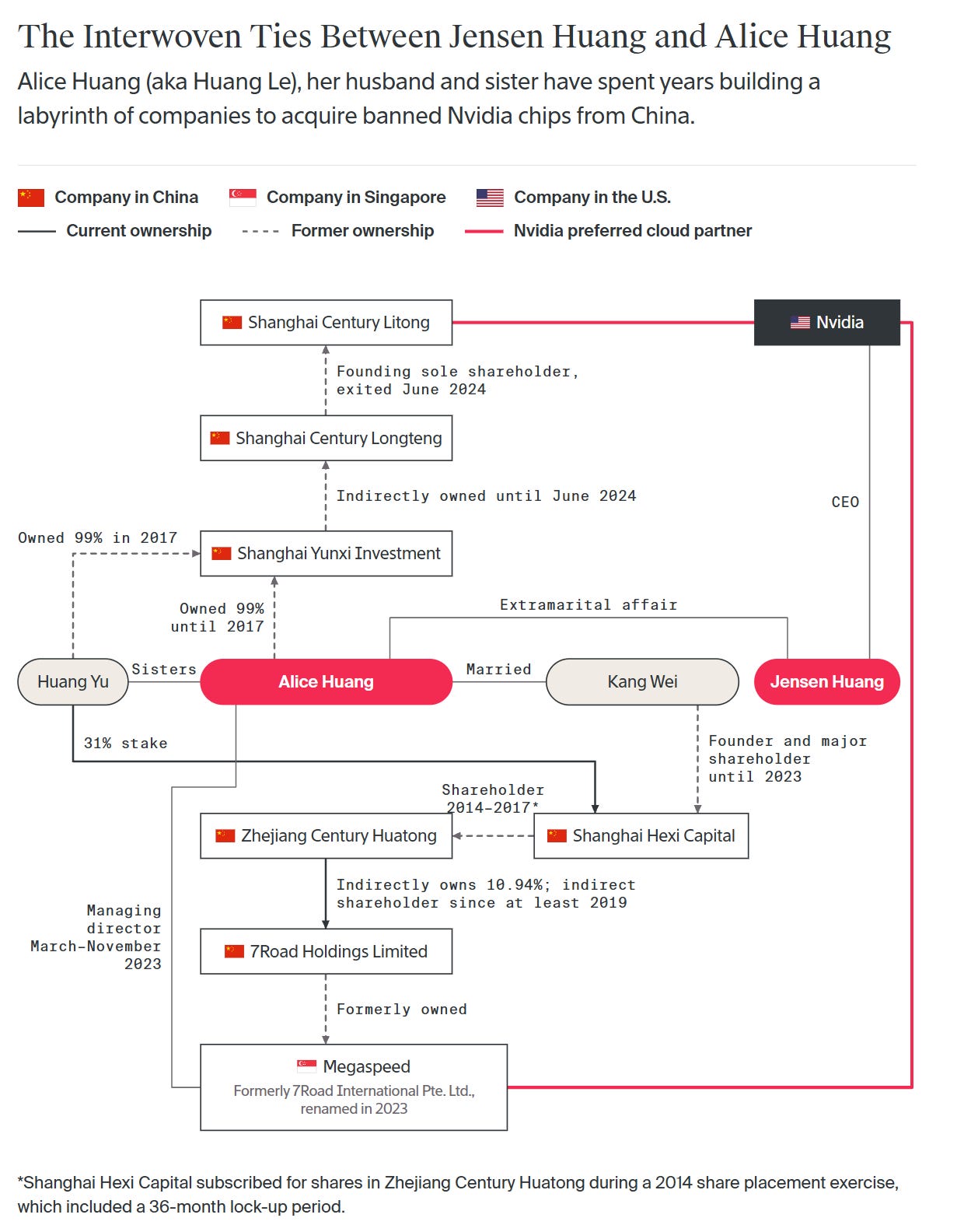
Congress will investigate, and House Foreign Affairs Chair Brian Mast says that Jensen Huang is willing to testify. At stake is much more than Huang lies to his board about the ill-advised sexual liaisons that appear to have cost him his job. If Jensen Huang’s close relationship with Megaspeed and others was a deliberate effort to subvert US chip export controls, he could face criminal prosecution. Perhaps knowing that his pal in the White House will pardon him will lead Huang to reveal the full extent of Nvidia’s involvement in selling tens of millions of dollars of state-of-the-art AI chips to China.
Opposition to Nvidia now spans the political spectrum. Right-wing China hawks are howling. The bipartisan foreign policy establishment, intent on winning the AI race with China, is incensed. Economic populists in both parties resent China’s economic power and staggering compliance failures. Even Trump administration figures like Secretary of State Marco Rubio and Treasury Secretary Scott Bessent are pushing for tighter chip restrictions.
Those who want to slow down the AI race have joined the coalition, including safety advocates who worry that advanced AI could cause human extinction. So have the two major US frontier AI companies, OpenAI and Anthropic, which want to restrict access to chips by their Chinese rivals. As Anthropic CEO Dario Amodei put it, selling AI chips to China is like “selling nuclear weapons to North Korea.”
Jensen Huang not only stood against this coalition, but he often got his way with Trump. His resignation removes its chief obstacle. Whether Nvidia keeps its dominant position remains to be seen, but AI politics have changed. As with data center opposition, this is a coalition of strange bedfellows – and politics alone is unlikely to shape the technology’s future.
Democracy Moves Slower Than Technology
The Covid pandemic showed that humans struggle to understand exponential growth. Imagine folding a sheet of paper in half several times. After three folds, it is about the thickness of a fingernail. How high is it after 14 folds? (The height of an average person.) What about after 30 folds? (You have escaped Earth’s atmosphere and reached space.) After 51 folds, the paper would reach past the Sun. You get the idea.
AI progress is accelerating like a folding paper. As recently as 2023, models could not add four-digit numbers. In 2024, they reached silver medal level at the International Math Olympiad. The following year, they could win a gold medal at the same competition. In September, OpenAI said that an unreleased system running up to 10,000 agents solved the Navier-Stokes Millennium Prize problem in 88 hours. (Mathematicians have not yet verified the proof or its originality, although they have verified others). A recent projection expects that AI will be able to do any “laptop job” by next May.
Increasingly, AI is building AI. According to Anthropic, Claude now leads a quarter of R&D into new models. Eighteen months ago, that number was effectively zero.
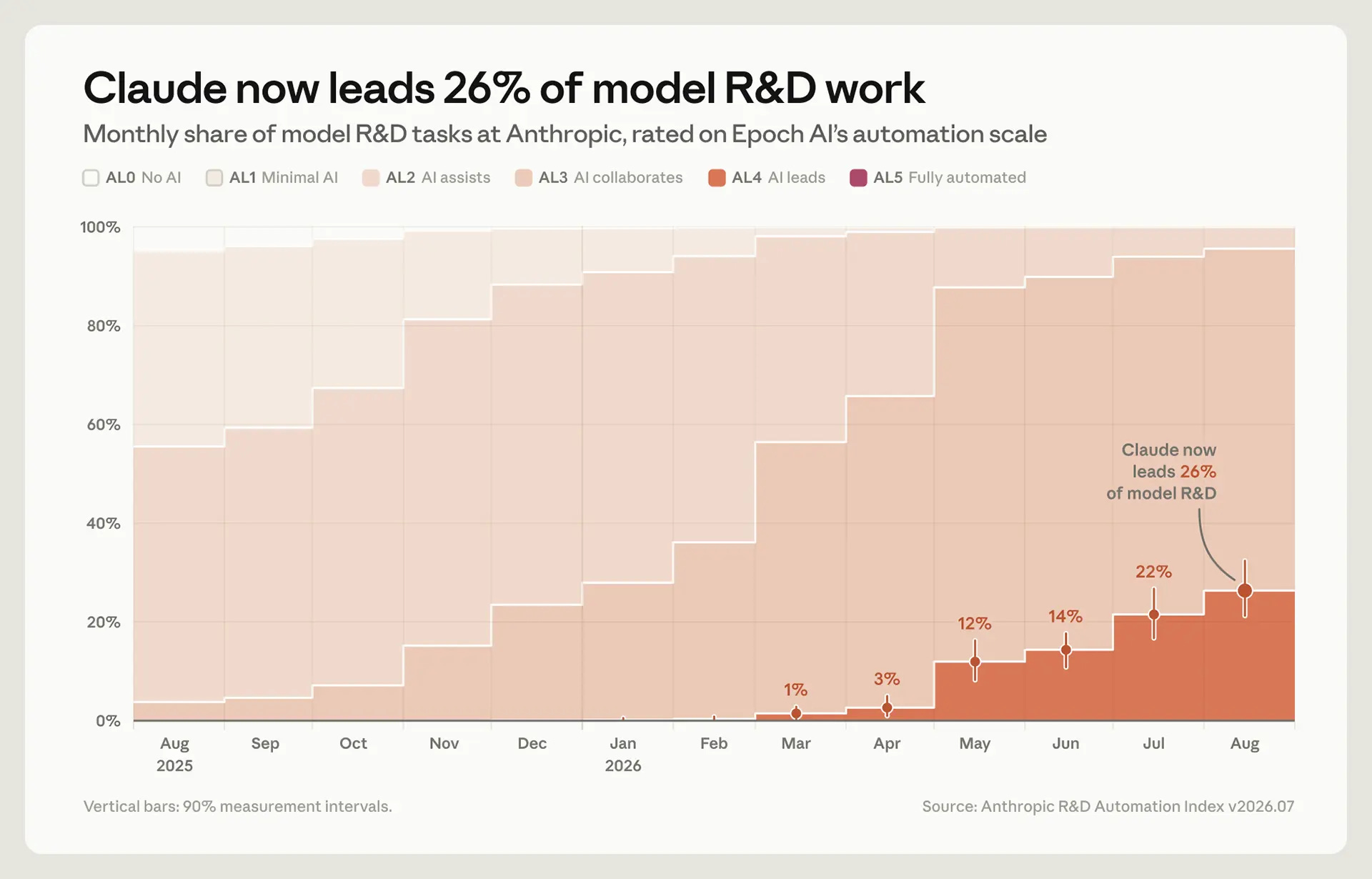
This acceleration has massive implications. AI models will be unrecognizable in six, twelve, and eighteen months. But democracy moves more slowly than technology. Building an effective regulatory regime takes years to negotiate, ratify, and implement. Even voluntary standards for risk, disclosure, and monitoring need months and a staggered rollout to avoid breaking existing ecosystems.
This tension will make Artificial Intelligence the largest issue in the 2028 presidential elections. Communities and states will try to restrict data centers and figure out how to power them. AI engineers will keep raising important concerns about the safety of the models they are building and may demand a voice in regulatory deliberations. Congress will investigate chip smuggling to China long after smuggling ceases to be the most important risk confronting the American people.
We are quickly moving east of Eden, exiled like Cain into a fallen, imperfect world. But we can still choose good over evil. The AI Gods will grow in power and at some point will very likely fall, crashing and shattering into green muck as Steinbeck foretold. We will do the tedious work of building them up again, even if they never quite shine.
This is an amazing and dangerous time.
ICYMI
WSJ: China recruited a top Harvard professor. He is recruiting others to join him.
White Evangelicals are the foundation of the GOP. One-third sat out the election.
Scientists confirm a groundbreaking AI proof that validates the Standard Model of particle physics.
Iran’s cheap ballistic missiles may disrupt warfighting more than drones have.
DeGaulle: The Resistance is worth watching on Amazon.
Tom Scribner, a local musical legend and a genuine Wobbly, played his musical saw for the strikers. Tom was an IWW man head-to-toe, a lovely guy who was radical to his core. A statue of him playing his saw now stands outside the bookstore’s current home in the St. George Hotel building. I doubt the bookstore owners or the successor coffee shops they spawned realize that he once played in support of their striking employees.

So much information. Truly amazing how you are able to pull it all together in intelligible paragraphs. Will take some time to digest this. Thank You