
TL;dr. Growing debt and declining population growth will soon force a reckoning. There are only three ways for the US to reduce its $40 trillion federal debt: grow faster, raise taxes, or accept inflation. Inflation is the most reactionary choice, and AI-driven growth is more hope than plan.
This post offers a framework for judging taxes based on yield, justice, and feasibility. It argues that we should judge the progressivity of outcomes produced by the tax system, not the progressivity of each tax. It asserts that America has already picked the least democratic approach of the trilemma: tariffs and inflation are both enormous, broad-based, regressive, and operate without civic consent.
No organization in human history has ever spent as much money as the United States Federal government. The feds spend about $7.5 trillion per year – almost a quarter of all spending in our economy. Raising taxes to support this level of spending is unpopular, so Washington borrows 26 cents of every dollar it spends. The result is a federal debt of almost $40 trillion. That’s almost $120,000 per person and well over one year of US economic output.
Forty Months
In 2030, which is 40 months away, a mix of debt and demography will make today’s debates about “affordability” look quaint.
The debt crunch. In 2030, the US federal debt as a share of the economy will break the record we set during World War II. But during World War II, 85% of federal spending was for warfighting. Today, three-quarters of federal spending goes to Social Security, Medicare, other mandatory programs, and interest payments on the national credit card. Congress only controls a quarter of our spending.
By 2030, US debt will amount to $300,000 per American household, but no magic alarm goes off on the day we cross this threshold. All that happens is that creditors notice that their risk is steadily growing, so they raise interest rates. This week, US borrowing costs hit a 25-year high as investors grew nervous about Trump’s mounting profligacy. On Thursday, a $25 billion Treasury auction of 30-year bonds fetched yields as high as 5.22 percent. The last time yields were this high, in 2001, the government was running surpluses, so it simply shut down long-term borrowing. The Treasury Department stopped auctioning 30-year bonds for almost five years. Today, the rising rates on long bonds represent a stealth tax increase because they drive up the price of every mortgage and auto loan. Worse, the interest bill grows – and it already costs every US household about $7,600 annually.
The retiree crunch. In 2030, every retired senior will depend on just 2.5 workers. In 2030, the last of the boomers will finally retire, and for the first time, seniors will make up 20% of the population. For contrast, it was about 12% in 2008. Old people like me not only increase Social Security and Medicare spending, but thanks to declining immigration and birth rates, we push these expenses onto a smaller working population. When I was born, six working people paid taxes to support every retiree. By 2011, there were just four. Today, there are 2.7.
This isn’t sustainable financially or politically. The US designed social services based on twentieth-century demographics. We assumed that a growing population would continue to drive economic growth and pay these bills. We worried about overpopulation, not underpopulation.
The demographic crunch. 2030 is also when the CBO projects deaths will exceed births for the first time in US history. A year ago, the agency put that milestone in 2033. It keeps moving closer. From 2030 on, the only source of US population growth will be immigration. Social Security, which has run annual deficits since 2010, is projected to become insolvent in 2032, triggering a 22% across-the-board cut in benefits.
Medicare is a bigger budget buster than Social Security. Of the projected $138 trillion budget shortfall over the next 30 years, $109 trillion is from Medicare. Rising health care costs, combined with an aging population receiving far more in benefits than it ever paid in taxes, isn’t sustainable. The Medicare Hospital Insurance trust fund is expected to become insolvent in 2033, forcing an 11% cut in hospital payments.
These baseline forecasts assume no surprises. If the US needs to borrow in response to an unexpected recession, pandemic, or protracted war, the situation worsens faster.
There are only three ways for a country to reduce a deficit this large: grow faster, raise taxes, or suffer inflation. There is no fourth door. The rest of this post looks at this looming trilemma.
Can AI Help the US Outgrow Its Debt?
Can growth help the US manage $40 trillion in debt? Only if the economy can grow more than 4.3% per year – roughly double the recent trend. Is there any technology that could double our growth rate? Probably not, although if there is, it is artificial intelligence.
By 2030, the US will have invested $3 trillion in AI infrastructure, give or take. The US is betting $500 billion to $1 trillion per year on AI, or roughly 2% of GDP.1 We have made massive bets like this before. Measured as a share of GDP, the largest ones have been:
Today’s AI bet is more like war spending than investments in long-lasting railroad tracks, highways, and electrical grids. About half of a data center’s cost is specialized chips that need to be replaced every 3 to 5 years. And unlike past software or internet booms, the physical bottleneck for AI is the capacity of our electrical grid. This forces tech giants to invest directly in new power generation and nuclear partnerships.
We have no idea whether this massive bet will pay off or fail utterly. Forecasts range from apocalyptic doom to growth rates that would render federal borrowing far less problematic. We do not know whether open-source models from China or elsewhere will turn “frontier model” companies into merchants of commodity tokens.
What we know for sure is that AI will be a vastly more powerful and dominant force in 40 months because almost every metric we use to measure AI is growing exponentially.
Raw compute. The raw compute required to train frontier AI systems doubles every six months or so – far faster than Moore’s Law.
Task length. Evaluations by safety and research organizations show that the length of autonomous tasks (such as coding or multi-step reasoning) that AI can successfully complete doubles every 7 months.
Token consumption. Google went from 9.7 trillion tokens in May 2024 to 480 trillion in May 2025 to 3.2 quadrillion in May 2026. That is 330x in two years.
Forecasters keep underestimating AI growth because of three compounding and confounding forces. Cost per token continues to fall faster than expected. Most agents now run continuously instead of waiting for a human to type a request. And tokens per query keep rising as complex tasks generate longer prompts and longer responses.
Fundamentally, however, anything that doubles every six months becomes one hundred times bigger in 40 months. Will 2030 AI be 100 times stronger? And if it is, will economic growth exceed 4% per year?
Not likely. There is a massive difference between computational scaling in a frontier lab and technology dissemination in the wild. While compute inputs may double rapidly, translating scale into breakthroughs in reasoning requires architectural advances. Physical limits such as data center power availability, grid capacity, and chip manufacturing constraints mean that exponential trends will run up against real-world frictions.
One of these frictions is political. Americans are mobilizing against data centers. Economic growth is popular if it increases opportunities and pay — but AI, big tech, and data centers that drive today’s growth are not.2
If we cannot outgrow our debt, the United States will either raise taxes or accept higher inflation, which will show up without a vote and hit low-wage families hardest. Taxes are never popular, but they can be democratic. So which taxes should we favor?
A Framework for Evaluating Taxes
Tax debates are eye-rolling because they are so predictable. First, someone proposes a tax. Then someone else says it will kill jobs, let the rich off easy, or never raise the money that sponsors claim. Often, all three objections are correct – and irrelevant because they critique three different goals. So let’s start with the goals. Warning: tax goals are contradictory.
All taxes are a trade-off between yield, justice, and feasibility.
Yield: can this tax fund the government we want? This comes down to a tax's revenue potential, breadth, and stability during a recession.
Size. A tax that raises a percent or two of federal revenue is a token gesture. It may be defensible, but the political capital burned to enact it is wasted. For example, inheritance taxes in most rich countries typically produce one to two percent of revenue. You may favor high inheritance taxes (I do, to inhibit dynastic wealth, not to generate revenue), but the fiscal juice is rarely worth the squeeze.
Breadth. Most of this is what tax nerds call “breadth of incidence”, meaning how many people pay the tax. A broad-based tax generates more revenue at lower rates. These taxes are easier to enforce because there are few or no exceptions. And they are politically easier because there is no small affected group with a concentrated interest fighting a public that will never care as much as the affected group.
Stability. Finally, we should prefer taxes that are stable across the business cycle. As California has discovered, taxes on corporate profits or capital gains swing violently with the economy. We built our state revenue system on top-bracket capital gains, so every downturn forces spending cuts at exactly the time the state needs to spend more, not less.3 In contrast, regressive VAT and payroll taxes barely move in a recession.
Justice: who should pay, and does this tax make them do so? Justice is a matter of progressivity and horizontal equity, or evenhandedness.
Progressivity rests on what economists call declining marginal utility. A thousand dollars matters more to someone earning thirty thousand than to someone earning three million. Progressive taxes help counter the tendency for income growth to concentrate at the top, which under a flat tax system yields less revenue over time. And of course, some progressivity is just basic Willie Sutton, who famously robbed banks because “that’s where the money is”.
Evenhandedness. This just means that two people in identical circumstances should pay the same amount of tax. This sounds trivial, but it matters because far too much of the tax system treats identical economic outcomes differently. A worker who earns wages and a partner who earns distributions owe wildly different sums for the same income. Likewise in California, where Prop 13 limits reappraisals, on a street of houses with identical market values, one neighbor paid property taxes that were one-tenth of mine and another paid 30% more.
Feasibility. Feasibility asks whether a tax is collectible, how it might distort behavior in unintended ways, whether it is durable, and whether the costs of implementing it are acceptable.
Collectibility. A tax that cannot be collected won’t work. European Value Added Taxes (VAT) are nearly self-enforcing because every business requires documentation from its suppliers to claim its invoice credit. Wealth taxes, on the other hand, can be hard to collect if they rely on valuations of assets without an established market price, such as private company equity, art, or closely held real estate. Every valuation becomes an argument won by the side that can afford better lawyers.
Distortions. Some taxes change behavior in unintended ways. Payroll taxes are easy to collect, but they raise the price of hiring – something we want more of, not less. If you hire a worker, your taxes go up. But if you buy a machine, you can depreciate it and deduct interest costs, which reduces your taxes. Lawmakers did not intend to subsidize automation relative to hiring – but they did.
Jurisdictional fit. For a tax to be feasible, it needs to fit its jurisdiction. Land cannot move, so a wealth tax focused on property works well, even at the county level. Income is leaky at the edges, so taxing it works nationally, but imperfectly. Taxing corporate profits barely works at all when a large company can simply shift profits to its Dublin subsidiary.
Durability. To work, a tax needs to endure. Payroll taxes are distasteful, but they persist because workers and employers believe that they are buying future Security. European VATs are hard to repeal because they are invisible. Estate taxes are the opposite. They are highly visible, targeted at a small number of very affluent people, and often portrayed as threatening family farms or businesses. Legislatures repeal them all the time.
Transition costs can kill excellent ideas. Since Henry George first proposed it, many economists have favored the land value tax because it applies to all land, making it broad-based. It is minimally distortionary, since land is hard to move, increase, or decrease. It is also hard to evade. The problem is getting it started: it reduces the value of land that current owners bought at full price. A new VAT does the same thing: it produces a one-time jump in prices. These costs are real, concentrated, and charged to people who did nothing wrong. These transition costs are often the real barrier to enacting these taxes. Debates about the steady state are arguments about the wrong thing.
Obviously, yield, justice, and feasibility can conflict. A tax that everyone pays hits the poor. A payroll tax is excellent on breadth and horrible on progressivity. Should progressives always oppose regressive taxes on principle?
Demand Progressive Outcomes, Not Progressive Taxes
No. Americans should judge the progressivity of a tax system, not the progressivity of each tax. Many countries fund progressive governments with regressive taxes. Compared with US progressive income taxes, Nordic VATs are reactionary. But measured by outcomes, these countries are dramatically more egalitarian because a broad, efficient base pays for transfers so large that they swamp the regressivity of the taxes themselves.
American progressive impulses demand that taxes themselves be lighter on the poor than the rich — only to discover that progressive taxes built on a narrow base raise too little revenue and mobilize opposition quickly. Americans end up with a system that looks progressive on paper, but actually collects less than it needs and delivers a thinner welfare state than in countries that impose a 25% tax on groceries.
Let’s apply the yield, justice, and feasibility framework to specific taxes:
Land value taxes score highly on neutrality and progressivity but fall short on revenue potential and transition costs. It is a genuinely good tax that cannot serve as a primary federal tax. Moreover, enacting it in places without property taxes is very tough because it requires a one-time wealth confiscation that few politicians can justify.
Payroll taxes bring in a lot of money, are terribly unfair, but are brilliant on feasibility and durability. This is why payroll taxes are a revenue workhorse that we cannot get rid of. We should fix the distortion by equalizing the treatment of labor and capital rather than by shrinking the base.4
Income Taxes. Income taxes are moderate in breadth because, in a typical year, about 40 percent of filers owe no federal income tax. The base narrows even further in recessions. But the revenue potential is high — it delivers roughly half of federal receipts. Stability is mediocre because it depends heavily on capital gains paid by top-bracket earners, so it swings with asset prices.
But it is the easiest tax to make progressive. A graduated rate schedule can be tweaked to become more progressive or regressive without touching anything else. Unfortunately, income taxes fail the fairness (“horizontal equity”) test. Two people at identical economic income owe wildly different amounts depending on whether the income arrives as wages, carried interest, qualified dividends, or S corporation distributions. That gap has nothing to do with ability to pay.
Administrability is excellent for wage income and poor everywhere else. Tax withholding from paychecks means that W-2 pay is almost perfectly compliant (credit in part a very young Milton Friedman, who helped design withholding taxes as a Treasury intern during World War II).5 Compliance with pass-through and proprietor income is far worse and represents perhaps the largest single source of unfairness in our tax system.
Wealth taxes score high on progressivity and low on administrability, which drags down everything else. Most OECD countries that have tried wealth taxes have repealed them for this reason. The moral argument for wealth taxes is compelling: since 1990, in nominal terms, paychecks have grown by 18%, homes by 66%, and stocks by 1,500%. But no amount of moral argument overcomes the feasibility problems that plague wealth taxes.
That said, treating borrowings against stocks as realization events subject to income taxes would be easy to administer and fair, since these loans provide current income to wealthy shareholders.
Inheritance taxes are a very tempting solution for those of us who oppose the accumulation of dynastic wealth. Note, however, that the top estate rate was 77 percent from 1941 to 1976, yet the tax produced only 1 to 2 percent of federal tax revenues. Very high statutory inheritance rates have never produced large tax collections in the United States.
Federal taxes on data centers. Data centers are immobile once built and score well on incidence, which is why local property taxes on them work well. A steep federal tax would prevent jurisdiction shopping and could be used to fund infrastructure build-out. Data centers employ relatively few workers once built, so taxing them does not threaten jobs. This tax would be quite popular, but fiscally irrelevant. An energy-based excise tax, restrictions on asset depreciation, and a gross receipts tax combined would generate perhaps $50 billion today.
Even if the whole package were tripled by 2030, it would cover less than 5% of the projected federal deficit — serious money, but not a fundamental change.
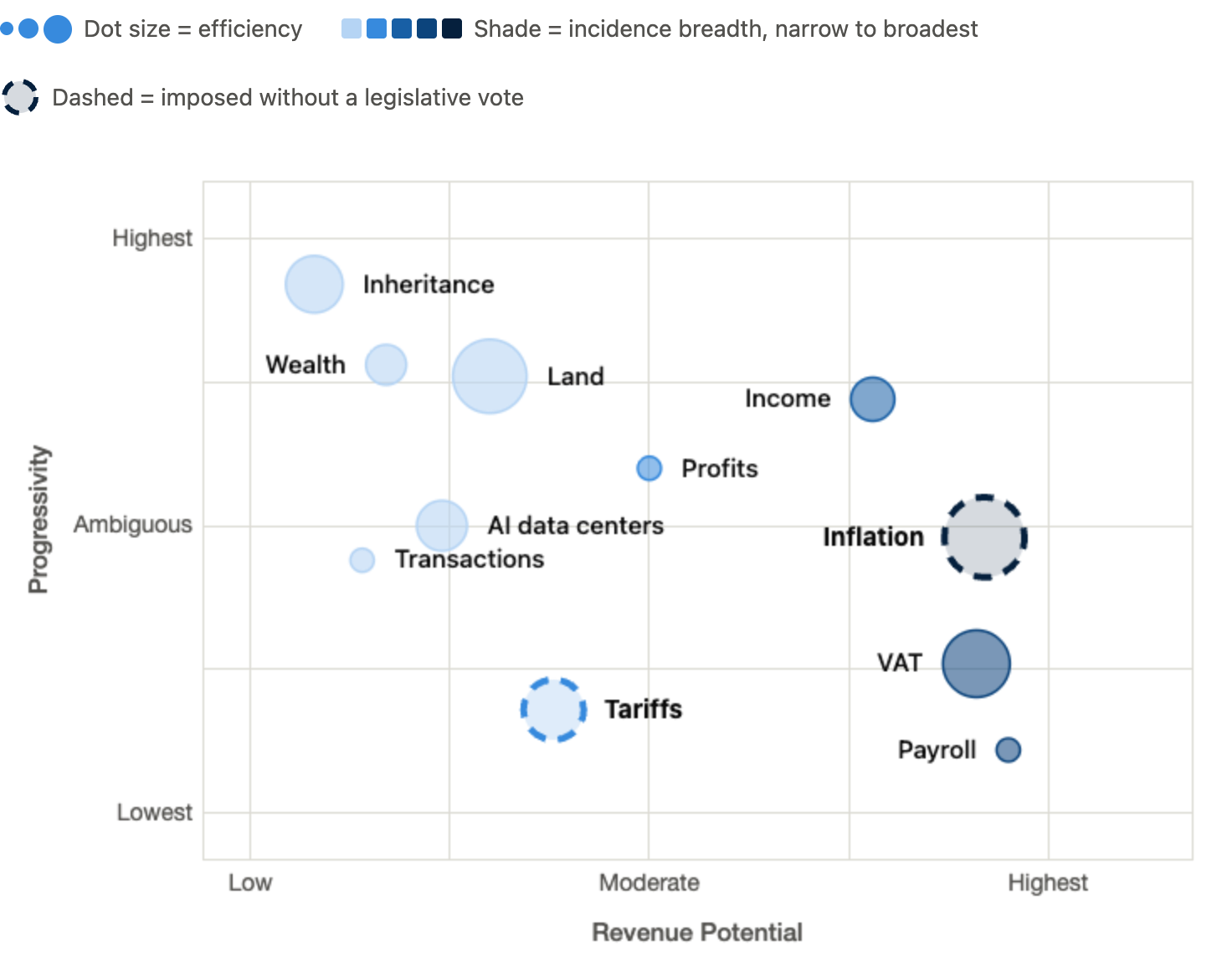
I plotted the relative progressivity, incidence, efficiency, and revenue potential of different taxes on a grid, using Claude as a research assistant. It’s not perfect, but it helps to illustrate the trade-offs.
The Taxes Nobody Votes For: Tariffs and Inflation
So far we have evaluated taxes that Congress might pass. But two taxes shown above need no Congressional vote and never appear in the tax statistics. Tellingly, tariffs and inflation are the two taxes America is actually raising right now.
Tariffs. Tariffs affect everyone – they carry a broad economic incidence. They hit roughly 330,000 importers of record, who pass the costs through to consumers. Add the exporters hit by retaliation and downstream manufacturers buying intermediate inputs, and tariffs affect a lot of people. They are very efficient and collectible, which is why tariffs were the first federal tax. Collection happens at the border, prepaid, on a bonded party, with no filing season. For most of the nineteenth century, they accounted for about 90% of federal revenue for exactly this reason.
But as a tax, tariffs are self-defeating. Like tobacco taxes that fund anti-tobacco campaigns, if tariffs work, they disappear. Tariffs that successfully promote reshoring or steer consumers away from high-duty imports go away.
Tariffs are highly regressive. The Tax Foundation puts the average tax increase at about $900 per household in 2026 – and goods are a larger share of the budget for households at the bottom.
And as revenue generators, tariffs have disappointed. Calendar 2025 customs duties totaled $264 billion, up from $79 billion in 2024, with the average effective rate reaching its highest level since 1947. That is five or six percent of federal revenue.
But tariffs have not proven durable. In February, the Supreme Court held that IEEPA does not authorize the President to impose tariffs. The court concluded that the Constitution vests the taxing power in Congress, not the President. Since the decision, the Court of International Trade has ordered customs officials to refund roughly $165 billion through a new system built for the purpose. CBP has already refunded $100 billion in tariff payments. Trump, meanwhile, is appealing to limit who gets their tariff payments back.
Trump has learned the hard way that courts can repeal taxes that were never enacted by Congress. As a result, the federal government finds itself refunding revenue it has already spent. Unlike any other tax on this list, tariffs can be clawed back even after they are collected.
Inflation. Inflation affects everyone, so tax policy wonks would declare it to have the broadest incidence of any tax. There is no exemption, no threshold, no filing status. It is also very efficient. Nobody avoids it, and it has zero administrative costs. There are no returns, no audits, no enforcement. Because it favors people who hold real assets, such as land, rather than financial assets like cash and securities, inflation can hurt the wealthy slightly less.
Looked at another way, however, inflation is the least neutral tax of all. Every other tax distorts some price at the margin, but inflation degrades the price signal itself. If inflation is unexpected, it rewrites every contract in the economy simultaneously and without consent.
Most economists treat inflation as regressive, and if you measure flows like wages, it plainly is. After all, food and energy account for a larger share of household budgets at the bottom. But if you measure inflation’s impact on balance sheets, it’s quite progressive. Inflation weakens creditors, who tend to be older and wealthier, and rewards debtors, who tend to be younger and middle class. The largest single debtor in the country is the federal government, so the inflation tax is a transfer from bondholders to taxpayers.
What about the revenue potential of inflation? It is enormous and mostly invisible. Between 2021 and 2023, inflation did more to lower the US debt-to-GDP ratio than any fiscal legislation in decades, and no one had to introduce a bill.
Put inflation and tariffs side by side, and their similarities are hard to miss. Both score well on collectability and terribly on neutrality. Both are regressive when measured in terms of flows. Both raise serious amounts of money. And both are imposed without a legislative vote: one by delegated executive authority and the other by monetary policy.
But a tax nobody votes on is a tax nobody consents to. That should trouble us more than the regressivity, because consent to taxation is a cornerstone of democracy.
Taxes and Democracy: No Representation Without Taxation
In an eye-opening book, The Price of Democracy: The Revolutionary Power of Taxation in American History, Brookings senior fellow Vanessa Williamson argues that America’s fights over taxes have always been proxies for deeper conflicts over who counts as “We the People.” Poorer Americans have repeatedly built movements to tax everyone, themselves included, to fund a more equal nation. Wealthy Americans have responded by constraining the power to tax and by shrinking democracy itself, through voting restrictions, gerrymandering, and violence. In her telling, anti-tax politics has always been an anti-democratic project.
The pattern runs deeper than American history. Comparisons across centuries and countries tell the same story: a ruler who seeks to tax becomes dependent on taxpayers. Taxes build a connection between the ruler and the ruled that gives power to taxpayers. As representation develops, taxes often go up, because taxpayers gain a say in what the government does.
This is why many high-tax countries are also among the freest and most democratic. The Nordic states convert the broad bases described above into universal healthcare, free higher education, and extensive family leave, which reduce financial precarity and stress for citizens. Theirs is a view of freedom as a positive enabler of liberty: the financial Security to change careers, start businesses, or live without fear of medical bankruptcy.
The American Trilemma
Only three things can close a fiscal gap the size America faces: faster growth, higher taxes, or higher inflation.
Growth is always the preferred path, even if it is never painless. At the moment, we are making a high-risk bet that AI can help. AI’s exponential growth metrics are real and steep. But a technology whose impact and financial returns nobody can forecast is a hope, not a fiscal strategy.
So we arrive at taxes and inflation, which America has already started choosing. Tariffs took $264 billion out of American households last year without a Congressional roll call. When the US debt-to -GDP ratio fell between 2021 and 2023, it was not because Congress acted bravely to reduce borrowing. It was because of inflation.
That should worry us more than the fiscal math. Williamson demonstrates that the power to tax and the power to govern are tightly linked — and those who want to shrink American democracy always begin by attacking the tax base.
A government must answer to the citizens that pay taxes to fund it. A government funded by tariffs and inflation answers to no one — as Donald Trump knows all too well.
ICYMI
Are orexins the GLP-1 drugs for wakefulness and sleep? Maybe.
Hedge funds are piling into US Treasuries. No, not good.
In 2019, China exported 600,000 vehicles. This year, 10 million.
Chinese bullet train hits 500 miles per hour in 5 seconds.
A treatment to prevent HPV and oral cancers relies on chewing gum.
Guess who is emerging as Europe’s energy powerhouse? The UK!
Democrats are voting in massive numbers. Hmmm…something wrong?
What do drone swarms look like? Scary AF.
2% of US GDP is about $650 billion/year. There are scenarios where AI spending exceeds this, although a lot depends on what you count.
McKinsey puts worldwide data center capex at $6.7 trillion by 2030, of which $5.2 trillion is AI-specific. Goldman Sachs figures that 55-60% of this is in the US. Not all of the spending on US data centers stays here. Morgan Stanley estimates that 60% of AI capex goes to computers and peripherals, which are largely made overseas.
There are reasons to restrict the growth of data centers in the longer term, but much of the current opposition is ill-considered and, in some cases, ill-informed. Noah Smith has a good roundup here.
Taking revenues away from elected state legislators is never easy, but the technical solutions are straightforward. Several states force themselves to divert excess revenue into long-term projects to avoid this problem. Massachusetts transfers capital gains collections above a certain threshold from the operating budget to a Stabilization Fund and public pension funds. California’s Prop 2 attempts to do something similar. Alaska uses a trailing five-year average in calculating withdrawals from its Permanent Fund, which reduces volatility.
Consider the choice facing a firm that is choosing between a worker and a machine. If you hire the worker: their wage is deductible, and the company pays 7.65 percent on top, with the employee paying another 7.65%. If you buy the machine, Trump’s One Big Beautiful Bill lets the company expense it, meaning depreciate it all the first year. If a company borrows to finance the machine, they can deduct the interest as well, which can push the effective marginal tax rate on the investment to zero or below. In short, a company receives a subsidy for automating and a penalty for hiring.
Ideally, we would exempt the first $15,000 of wages from payroll taxes and provide employers with a hiring credit to make wage increases easier for low-paid workers. We would end accelerated depreciation and return to economic depreciation, which reflects the equipment's useful life. This raises the after-tax cost of equipment without touching payroll at all. It also raises revenue.
There are many, many other ways to equalize the treatment of capital and labor under the tax code.
A subtraction-method VAT or a business cash-flow tax affects labor and capital equally.
We could also extend the Net Investment Income Tax logic. The ACA already applies 3.8 percent to investment income above the threshold, which is the Medicare rate applied to capital. Raising it and lowering the wage-side rate to match would be revenue-neutral and would close part of the gap without new machinery.
We should close the S corporation loophole that allows owners to pay themselves distributions that dress up labor returns as capital returns.
From the Wall St. Journal: “While withholding income at the source was more efficient, it also made the system more opaque and the tax bite less obvious. This is one of the main reasons Friedman’s wife, Rose, also an accomplished economist, vehemently opposed its introduction. Like some mistakes married men make, all indications are that she didn’t let him forget it. “Rose has never forgiven me for the part I played in devising and developing withholding for the income tax,” he once said.
Also, where would a progressive business revenue tax lie on the excellent chart? It would capture domestic taxes better while also having an inherent pro-competition effect.
Would a solution to the upfront hit of a land tax be to annuitize that hit?