

Political leadership demands two very different skills: winning elections and governing effectively. Trump is good at winning elections against party rivals and effete, coastal Democrats. But he is really bad at governing.
His ego and lack of political experience lead him to rely on the gut instincts he developed as a reality show host and real estate developer. When his deeply held views on tariffs, the efficacy of military power, gold-leafed renovations, and the benefits of mass deportation don’t work as he imagines, he rarely reevaluates. Moreover, he is extravagantly corrupt, reliably placing his private enrichment ahead of the public good.
Until last night, Trump seemed to defy political gravity. Voters seemed to relish his trademark cruelty and bigotry, wrapped in his roguish, vulgar charm. But this time, his crowds were concerned about living costs and his obvious corruption. His rantings about gold ballrooms and men’s backsides made him seem deranged. Without an opponent like Hilary Clinton or Kamala Harris to portray as DEI-loving, open-border, pearl-clutching mouthpieces of Washington professionals, he floundered.
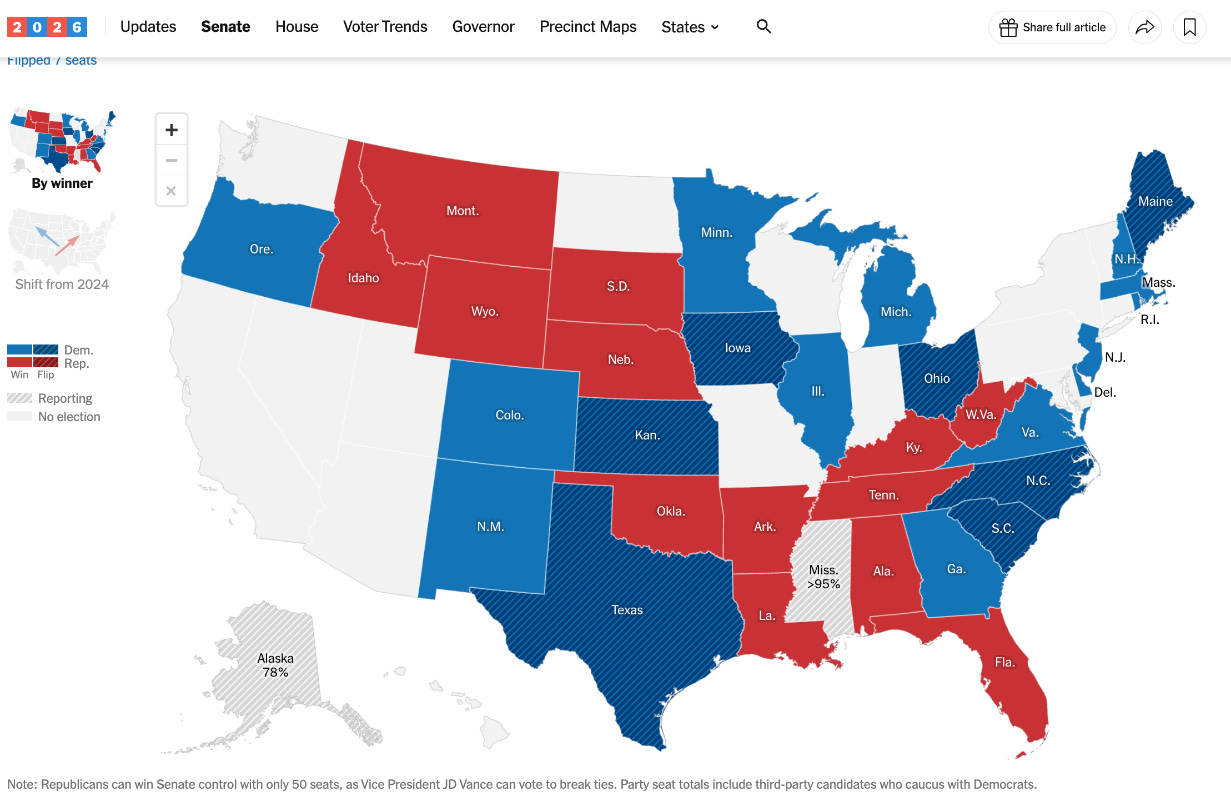
Trump didn’t just lose; he was crushed. Democrats led the popular vote for Congress by 13 points – the largest margin since Watergate. Democrats won a statewide race for governor, Senator, or both in 29 states, worth 379 electoral votes (and Mississippi could still add to this count).
You no doubt have your list of winners and losers. Here is mine.
Winners
The Tent. Progressive, moderate, and conservative Democrats all had races to celebrate. Although moderates outperformed progressives in Maine, Michigan, and Minnesota, progressives cheered Troy Jackson, who unseated Susan Collins in Maine, and Mohammad El Sayed, who became the nation’s first Islamic Senator. Mainstream Dems were pleased that John Ossoff, James Talarico, and Josh Shapiro won easily in Georgia, Texas, and Pennsylvania. Conservatives were delighted that Roy Cooper and Adam Hamilton prevailed in North Carolina and Kansas, respectively.
As the 2028 presidential primary gets underway, opposition to Trump is table stakes. Keeping a broad, unruly coalition in the same tent requires Dems to articulate practical solutions to salient problems. But last night was a very strong start.
Millenials. This was a generational election. The 80-year-old Boomer president was beaten by millennials like James Talarico (age 37), Jon Ossoff (39), and Abdul El-Sayed (42). According to The New York Times, voters under 30 swung even harder for Democrats (a 32% gain) than men under 45 (31%), or Hispanics (28%).
Chuck Schumer. For the most part, Democrats ran very high-quality candidates with strong local roots. This was not organic – it was the result of Schumer’s persistent effort to recruit strong candidates. He persuaded Mary Peltola to run in Alaska, Sherrod Brown in Ohio, and Roy Cooper in North Carolina. (He also backed Janet Mills in Maine, but she dropped out before the primary.) Trump, by contrast, again showed that he is horrible at selecting candidates. His endorsement of corrupt sycophant Ken Paxton in Texas allowed Talarico to win by 12 points, and his decision to back Darlene Graham almost surely cost Republicans a Senate seat in South Carolina.
Jon Ossoff. I always look to governors before Senators for presidential candidates, and there are some excellent southern and midwestern governors to choose from. But the single most important qualification of a 2028 presidential candidate is the proven ability to reach rural voters and noncollege men and to unite a broad spectrum of Democrats (many of whom define “unity” as “my way”). This requires a kind of pragmatic populism that is not easy to pull off. Ossoff may fade, and plenty of other candidates are worth considering, but he emerges from the midterms as the “it” candidate. If he continues to sharpen his considerable rhetorical skills and to articulate a compelling vision for the nation’s future, he will be a formidable candidate.
Losers
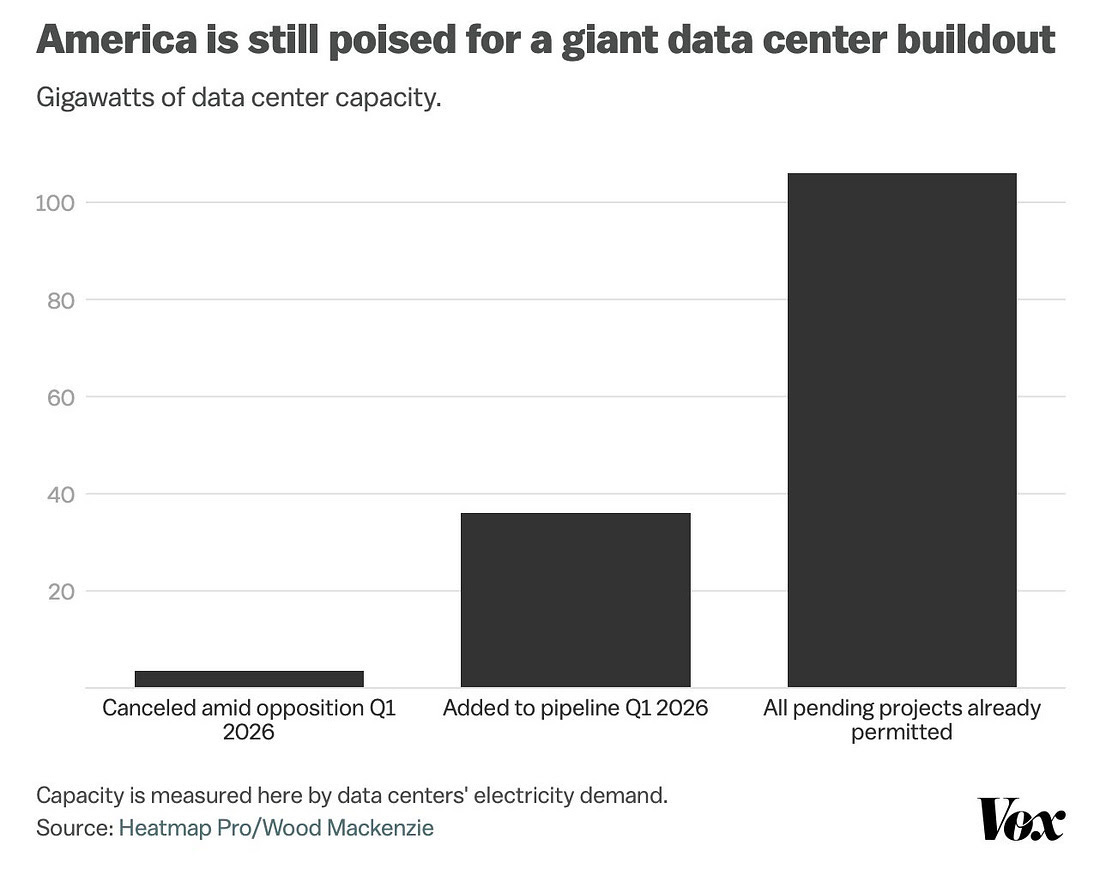
Data Centers. Of 44 local ballot measures that opposed data centers, 43 passed. Texas (a state scheduled to build more data centers than any other) elected a Democratic governor who has pledged to be tougher on data centers than the Republican she beat, who had already ordered a moratorium on their construction. This is the most bipartisan issue in American politics.
Until recently, chips constrained AI growth, but Nvidia and others have scaled up production. Right now, memory constrains much of the AI buildout, but several companies are building memory capacity. Power generation is the next constraint, and fixing that will take years and sometimes more than a decade. Political opposition may be the most serious hurdle yet. Community opposition to data centers has exploded, since the facilities are massive, ugly, occasionally loud, and frequently drive up utility prices.
Banning data centers everywhere is economically destructive, so they are likely to become much more expensive. Also, many are already fully permitted and under construction (see chart). In some cases, communities will force operators to sign community service agreements that require union labor, subsidies for local utility bills, or payments to reduce property taxes. Not every community has a price at which they will allow data centers – but many do. The bidding is about to get serious.1
Big Money. Except in California, where voters rejected a poorly designed wealth tax, it was not a great night for big political donors. Elon Musk wasted more than $400 million, but he won’t notice. It would cost the median US household (with a net worth of about $200,000) only $80 to donate the same fraction of their wealth as a trillionaire spending $400 million.
Ironically, Republican donors got such a horrible return on their investment that Bernie’s “billionaire class” is plainly not in control of our elections. So let’s tax them realistically and keep them from wasting large sums of money on elections. Really, it’s for their own good.
JD Vance. Vance is in trouble. In the words of US elections sage Charlie Cook, Trump “has gone from very unpopular to toxic and now to radioactive”. Nobody in his administration can avoid the stink.
If Vance wanted to run for president, his best option was to resign in February over the war. Now, it’s too late. Now he is forced to advocate Trumpism without Trump. He now begs Republicans to end Trump’s war, to reduce Trump’s tariffs, and to focus on cost-of-living issues that Trump disdains. He wants to distance himself from Netanyahu and Israel, which Trump warmly embraces. He wants to reseason Trumpism with a dash of flavors from Yale Law and Silicon Valley. It’s not a dish many voters will eat if Democrats surface a sensible alternative.
The GOP. Then who? Ted Cruz is the last Republican standing in Texas, but his personality is about as warm as Vance’s. Marco Rubio has become a neocon worthy of Dick Cheney and will struggle to escape the stench of the Iran war. Ron DeSantis? The ever-ready Chris Christie? Mike Pompeo? Protofascist Tucker Carlson? Trump has purged his rivals, sullied his allies, and repelled talent so systematically that Republican soil now produces more weeds than crops.
ICYMI
Conservatives debate: are US attacks on unarmed ships in the Caribbean war crimes or just murder?
Why America Needs Mandatory Vocational Education in High School. By the always worthwhile Chris Griswold.
Trump fans are gathering in the ballroom to help rehabilitate….Richard Nixon?
If you go to war to stop nukes, you either win that war, or you create a powerful incentive for your adversary to build nukes.
Trump’s approval on immigration, his strongest issue, is now underwater.
This will accelerate interest in space-based data centers (SBDCs). These are technically feasible on a small scale, but roughly 100 times more expensive than terrestrial facilities at scale. Google’s Project Suncatcher, SpaceX, and Amazon are all actively exploring orbit as an alternative to clogged, power-constrained terrestrial grids.
How do I unsubscribe from this diatribe? How did I get ever get on this list anyway?