
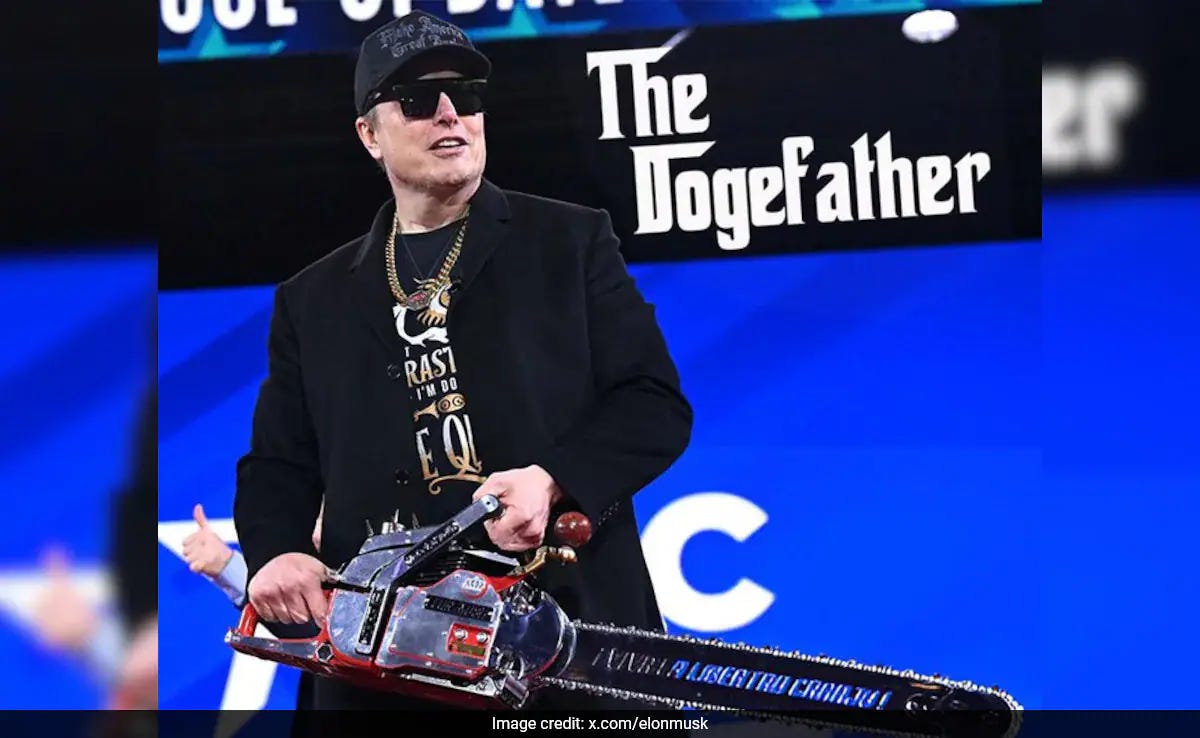
You wouldn’t know it from the apologetic bumper stickers that liberals paste on their Teslas, but Elon Musk is the most consequential industrialist of the 21st century. He is also, for good reason, one of the most despised.
Blue America fixates on his paleolithic politics and abrasive persona. Beijing is taking notes. To Chinese policymakers, Tesla, SpaceX, and Starlink aren’t just companies; they are strategic masterclasses in high-technology manufacturing at scale. If you want to know which industries China intends to dominate next, look at what Musk is building today. Not long ago, China outran him in the race to build the “electric stack” — solar panels, batteries, and EVs. Now it is obsessing over his reusable rockets and his 10,000 orbiting satellites.1 Soon it will be deconstructing “Heart of the Galaxy,” his plan for a million-satellite orbital data center designed to power space-based AI and bypass the terrestrial grid entirely.
In an era when most entrepreneurs settle for the safety of software, Musk is the only American building leading-edge hardware at a world-shifting scale. His Austin Gigafactory — 72 football fields of floor space — represents a feat usually reserved for the Chinese state: the ability to conjure massive physical industries from nothing, and then do it again. He has now scaled such businesses twice. By merging these interests with X, he is positioned to forge a behemoth of AI, autonomous transit, and satellite data. He will almost certainly become history’s first trillionaire.
But his true legacy isn’t the money.
The Dark Side of the Force
Musk is an asshole. But he is not an anomaly.
He is the latest iteration of a familiar American icon: the systems-building visionary who pairs technological brilliance with political paranoia, autocratic management, and a profound indifference to social norms. He is the direct descendant of Thomas Edison and Henry Ford — the resurrection of the autocratic, reactionary industrial titan.
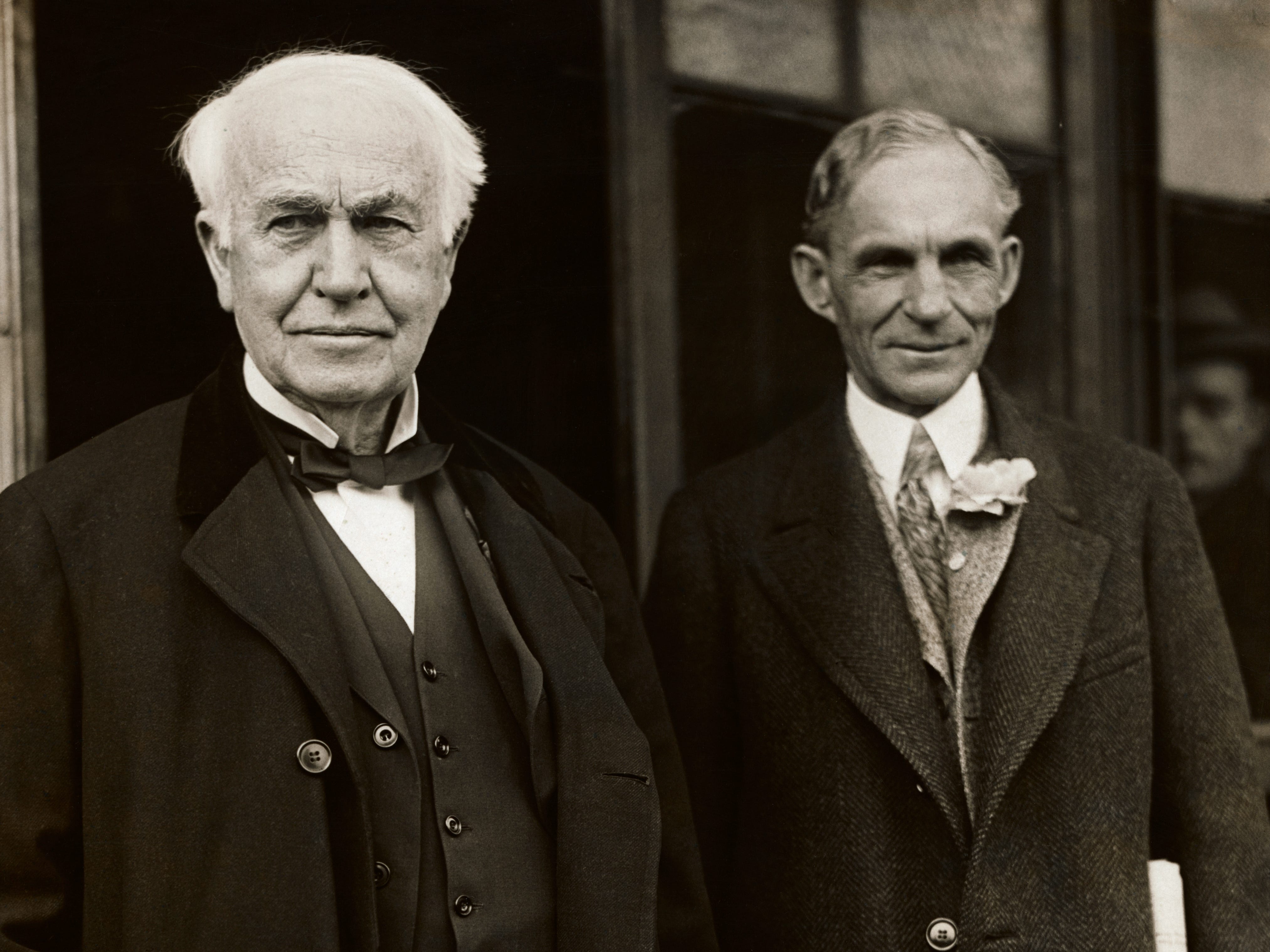
Like Musk, Edison and Ford built not just products but systems. Edison’s “Invention Factory” created the modern electrical grid, and along with it, the modern R&D lab. Ford’s massive plant at River Rouge created the automobile industry, and along with it, mass production. Musk is building the space-internet-autonomy system, with scrupulous attention to the industrial design process, which is a big reason China follows his work so closely.
These men didn’t just shape American progress. They shared a cluster of specific traits — and a nearly identical dark side.
They were pioneering technologists. Edison oversaw the creation of the phonograph, practical incandescent lighting, and the first commercially viable motion picture camera. Ford’s Model T revolutionized transportation not just as a vehicle but as a production system; by 1921, Ford produced over half of all automobiles in the world. Musk’s Falcon 9, the first orbital-class rocket capable of reusable flight, has now flown more than 300 missions, launching over 9,000 satellites.
They were systems thinkers. Edison didn’t just invent a lightbulb — he built the entire electrical grid, starting with the Pearl Street Station in Manhattan. Ford didn’t just build a car — he invented the moving assembly line and practiced radical vertical integration, controlling everything from rubber plantations in Brazil to iron mines in Michigan.2 Musk mirrors this approach with the Tesla Supercharger network and the Starlink constellation, which provides the high-bandwidth backbone for a global, space-based internet.
They were serial founders. All three viewed corporations as vehicles for their visions, not ends in themselves. Edison founded dozens of companies, including the ancestors of General Electric and Consolidated Edison. Ford actually failed with two automotive ventures — the Detroit Automobile Company (which became Cadillac) and the Henry Ford Company — before finding success with Ford Motor. Musk achieved the rare feat of scaling high-tech manufacturing twice, with Tesla and SpaceX, even though both companies nearly died in 2008.
They were probably neurodivergent. Musk has publicly described himself as being on the autism spectrum. Historians can’t retroactively diagnose Ford or Edison. Still, both exhibited traits commonly associated with extreme “systemizing” personalities: obsessive focus, indifference to social cues, and a ferocious capacity for sustained concentration on technical problems. Steve Jobs, no stranger to neurodiversity himself, slyly nodded to these qualities as he narrated his most famous ad campaign: “Think different.”
They were obsessed with controlling the narrative. Ford purchased The Dearborn Independent to bypass mainstream media and broadcast his antisemitic worldview directly to the public. Edison was a master of the press conference and of vaporware, using the media to sell a future that didn’t yet exist and freeze out competitors. Musk’s acquisition of Twitter is the 21st-century version of the same impulse — a tool for manipulating public discourse in real time.
They radicalized over time. Success bred a “Great Man” isolation that, in each case, curdled into paranoia. Ford became convinced of global Jewish conspiracies and used his newspaper to promote the thoroughly debunked “Protocols of the Elders of Zion”. Edison waged the brutal “War of Currents”, even filming the public electrocution of animals to smear his rival’s AC technology. Musk led DOGE, the shambolic effort to take a chainsaw to government payrolls, expressed support for the ultra-right AfD in Germany, and pivoted toward “anti-woke” narratives, warning of “population collapse” and “mind viruses” as existential threats.
They were viciously anti-union. And in each case, the relationship with their workforce was paradoxical: they simultaneously shaped the modern workplace and routinely violated their workers’ rights. Ford’s “Service Department” brutally beat union organizers in the 1937 Battle of the Overpass. Edison used strikes as an excuse to relocate factories to anti-union locations. After firing eight pro-union engineers, Musk successfully challenged the NLRB’s jurisdiction over SpaceX, winning court rulings that the agency’s structure was unconstitutional.
Are Autocrats Better at Disruptive Innovation?
This recurring pattern raises an uncomfortable question. Are the traits that make certain people capable of building world-changing systems — the obsession, the intolerance for dissent, the conviction that they alone see the future — also the traits that make them dangerous? China’s astonishingly rapid industrialization gives this question new urgency.
Researchers have clustered around three positions.
The system builder thesis. In American Genesis, Thomas Hughes argues that figures like Edison and Ford were more than inventors—they were “system builders” who needed to control the entire environment of their inventions, including labor, raw materials, and public perception. A singular vision, Hughes suggests, cannot survive the friction of democratic consensus. Autocracy isn’t a bug. It’s the operating system.
The Great Man psychology. Walter Isaacson, biographer of Jobs, da Vinci, and Musk, frequently advances a “two sides of the coin” argument. The obsessive-compulsive streaks, the lack of empathy, the siege mentality — these are demons, yes, but demons that power the work. In his biography of Musk, Isaacson frames the “dark side” not as a flaw but as the engine that enables Musk to force a new reality into existence — what associates of Steve Jobs called his “reality distortion field.” Historian Vaclav Smil makes a parallel case: large-scale industrial innovation benefits from a level of command-and-control that is inherently at odds with liberal sensibilities.
The collective innovation counterargument. Against the Great Man narrative stands a substantial body of work arguing that revolutionary technologies — the internet, GPS, mRNA vaccines — emerge from massive public and collective investment, not lone visionaries. Economist Mariana Mazzucato contends that figures like Musk and Jobs are “value extractors” who build on the public sector’s foundational risk-taking. Historian David Edgerton adds that the most transformative inventions are often mundane — the bicycle, the shipping container — developed incrementally by many hands, not forced into being by a singular will.
Proponents of this view point to specific figures who achieved transformative impact through collaboration rather than control. Jonas Salk developed the polio vaccine and refused to patent it. Grace Hopper invented the first compiler and COBOL, but emphasized teaching and collective standards over personal branding. Tim Berners-Lee created the World Wide Web and released the code for free, deliberately refusing to form a company around it.
The Uncomfortable Truth
All technological progress is collective in some sense — every breakthrough builds on the work of many people. But history suggests something harder to accept: that building entire technological systems from scratch — railroads, electrical grids, rockets, AI — often favors leaders with obsessive, combative, uncompromising personalities. Leaders willing to bend institutions to their will – who believe they alone understand the future.
Edison, Ford, and Musk are extreme instances of a general phenomenon. Not every great innovator is autocratic, reactionary, or neurodivergent. But the pattern recurs often enough that we ought to stop treating it as a coincidence — and start asking what it costs us.
ICYMI
For International Women’s Day: What People Get Wrong About Women’s Rights around the world.
Two weeks into the war with Iran, 12 nations are now involved. One has emerged as a clear winner: Russia. And possibly a clear loser: China.
Anthropic lost the battle with the Defense Department, but may win the crucial war for AI talent.
When will we finally get flying cars? This summer.
Why has the Chinese Communist Party embraced Greek and Latin?
Why does Donald Trump give this pair of shoes to all of his friends?
Starlink now accounts for about two-thirds of all orbiting satellites. According to Ken Kirtland, as of the end of 2025, the U.S. had made 229 orbital launch attempts without SpaceX. China had made 558 — more than twice as many. But including SpaceX, the U.S. total was 826, meaning SpaceX alone launched more than China and by itself accounts for America’s space supremacy. Credit Noah Smith.
The connection between Ford and Edison was far more than professional. They were lifelong friends. Ford purchased an estate in Fort Myers, Florida, next door to Edison’s winter home. When Edison was confined to a wheelchair in his final years, Ford bought one for himself so he could sit beside his friend — or race him down the hallways.