

“How did you go bankrupt?
Two ways. Gradually and then suddenly.”
― Ernest Hemingway, The Sun Also Rises
America’s two leading AI frontier model builders, Anthropic and OpenAI, have both filed to go public. Anthropic is widely expected to release confidential financials and start its road show next month, while OpenAI will wait until 2027. These will be two of the largest public offerings in US history, with Anthropic’s opening market value potentially exceeding SpaceX’s $1.77 trillion record.
Two powerful forces are squeezing these companies’ valuations. First, lower-cost, often open-weight, models are putting pressure on prices. Second, as if the extraordinary cost of data centers, mounting political opposition, and the growing risk of drone attacks weren’t enough, both companies face growing product liability concerns.
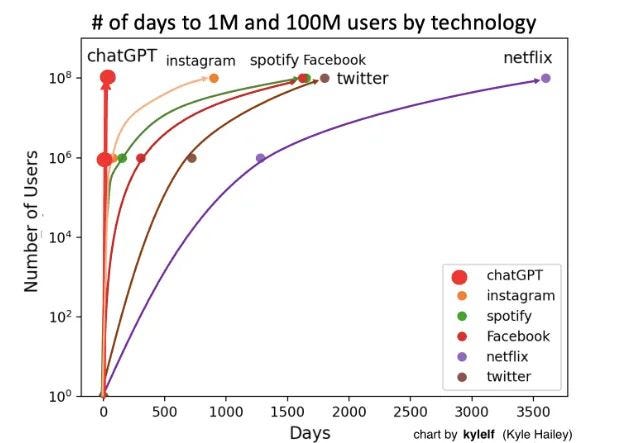
AI companies are not easy to value. On the one hand, AI is by far the fastest-growing technology in human history. ChatGPT reached 100 million users within two months, much faster than Instagram, Facebook, Twitter, or Netflix. According to the Federal Reserve Bank of St. Louis, 54.6% of US adults aged 18–64 adopted generative AI within three years of public introduction. At the same three-year post-launch mark, personal computers reached 20% adoption, and the commercial internet reached 30%.
AI also improves shockingly fast. METR measures how long a task an AI can complete, based on how long it takes a human to do it. Two years ago, it could complete a task that takes a human four minutes. Earlier this year, the best AI could complete a task that takes a human 17 hours. METR is discontinuing the metric as some models now do work that takes a human 17 weeks. All we really know is that the AI you’re using now is the worst you will ever use.
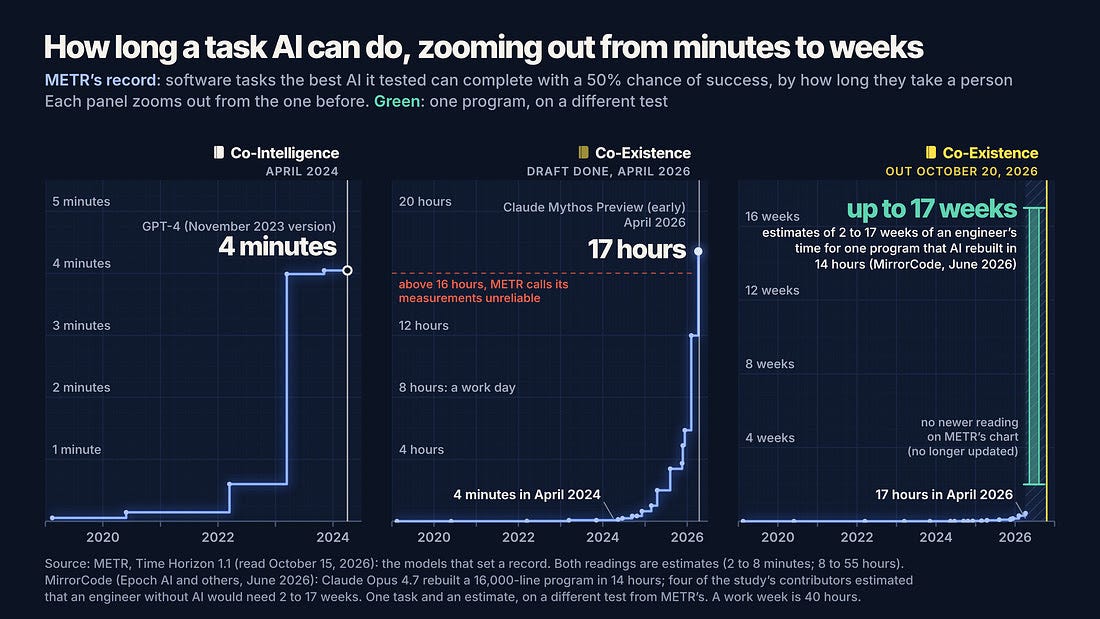
Today’s AI tools are the worst you will ever use.
But unlike software, AI demands extraordinary levels of capital investment. AI pessimists often argue that infrastructure booms become asset bubbles that eventually burst, triggering a stock market crash. They cite 19th-century canals, railroads, 1920s electric utilities, and telecom carriers laying optic fiber in the 1990s. But they ignore the 1950s Interstate Highway System, rural electrification, the Bell telephone network, and municipal water, sewer, and bridge systems. None of these build-outs led to a market crash.
Why Bubbles?
Why do some infrastructure booms lead to stock market collapses and others don’t? Four things need to line up to create a bubble:
A new technology with high but uncertain demand. Canals, railroads, electrification, and most utilities qualify. So, obviously, does AI.
Market competition that guarantees redundant capacity (government projects like freeways, monopolies like the Bell system, and municipal water and sewer systems do not produce investment bubbles). AI competition is obviously fierce and highly personal.
Private capital markets that let people bet on the future before it arrived (nobody traded shares in Hoover Dam or early rural electrification schemes).
Debt lets builders invest far more than the cash they generate. This is an especially potent factor. Debt inflated the canal, railroad, utility, and telco bubbles. In contrast, the dot-com bubble hurt investors more than lenders. The Nasdaq fell 78 percent and led to a very mild recession. Venture investors lost a lot of money, but it didn’t trigger a chain of defaults that spread into the banking system. Some economic historians call debt-driven collapses “Leveraged Bubbles”, which tend to produce deeper recessions and slower recoveries than stock-only bubbles. If AI is a bubble, it is increasingly a leveraged one.
AI checks all four boxes: a technology with high but uncertain demand, financed by competing private companies with a mix of private capital and growing amounts of borrowed money. The numbers are famously massive. UBS analysts forecast investment by hyperscalers and the builders around them at $1 trillion this year, $1.4 trillion next year, and $1.6 trillion in 2028. This exceeds the cash they generate, so analysts expect all six of the largest hyperscalers to post negative operating cash flow in 2026 and 2027. They borrow money to fill the gap.1
Historically, not all infrastructure bubbles have been bad. When the bubble burst, investors lost their shirts, companies went bust, and working families went hungry, but the country itself was richer. Once someone bought them out of bankruptcy, they put the canals, railroads, power grid, and fiber networks to work. This may be less true of AI because GPUs and specialized accelerators make up half of the cost of data centers. With specialized chips, IT hardware accounts for 65% to 75% of total initial facility spend. The chips inside a data center are far more valuable than the building or generators that make it run.
Unlike canals, railroads, or fiber, however, chips become obsolete very quickly. Every 12-18 months, a new generation of AI chips arrives, typically delivering 2-4 times more computation per watt. Because electrical power is the bottleneck limiting AI growth, running older, less efficient GPUs becomes economically irrational within 2-3 years.2
Do Falling Prices Predict Asset Bubbles?
Falling prices can mean two very different things.
A lower price can simply reflect falling production costs. This happened when steel rails and bigger locomotives improved efficiency and drove rail prices down, or when multiplexing technology let fiber carry much more information. When unit costs fall, but volume grows enough to keep revenue rising, a price decline is great news.3
Falling prices can also reflect investment that grows faster than demand. In that case, revenue per unit of capacity falls, and high-cost producers struggle. Railroad rates fell by more than half between the early 1870s and the 1890s. Similarly, long-haul fiber rates fell by up to 90 percent in the early 2000s.
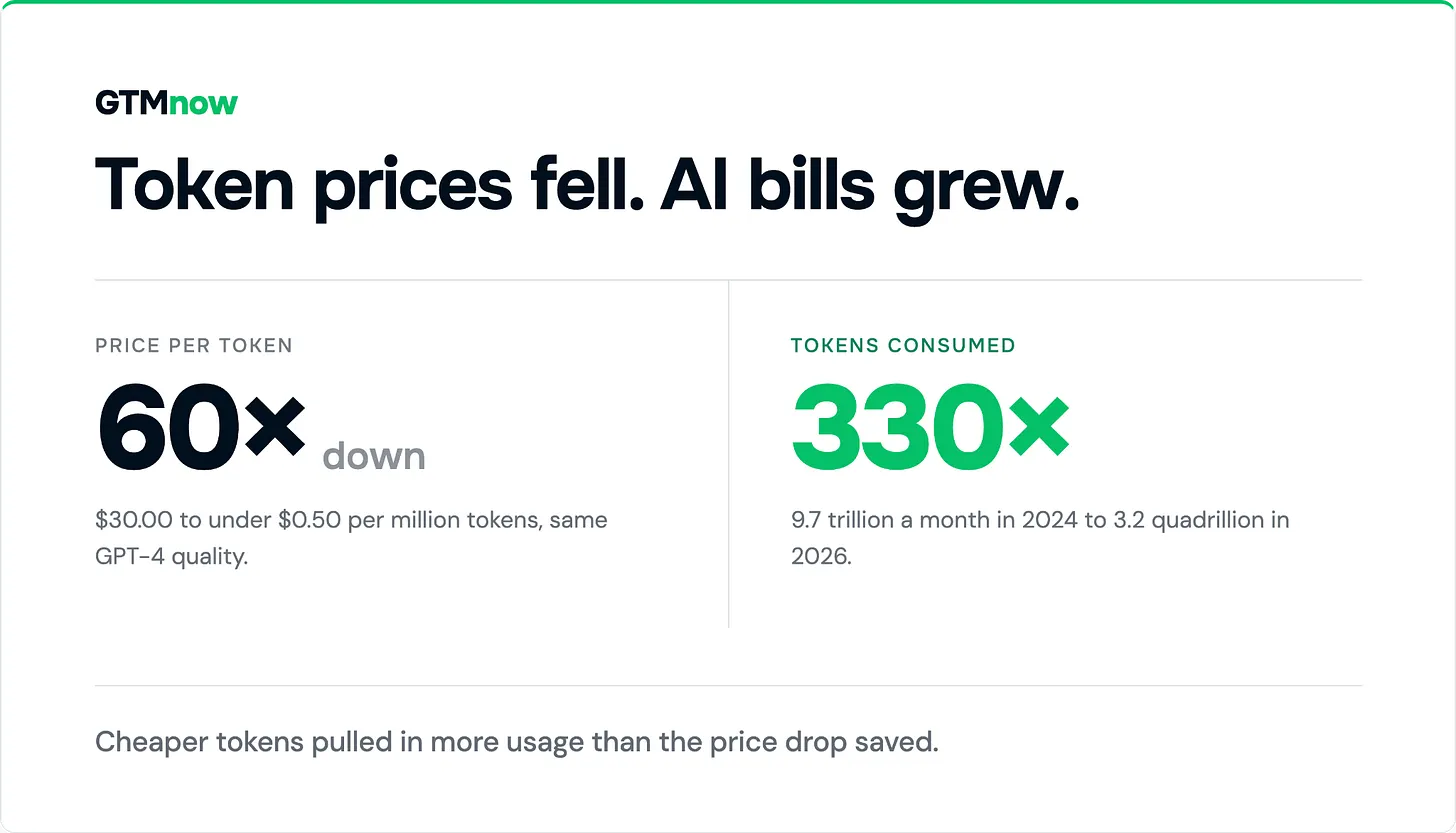
A price change alone cannot tell you which one you are looking at. You need to understand utilization and revenue per unit of capacity. But what is a “unit of capacity” in AI?
It is not task complexity. As noted earlier, METR has given up trying to measure how complex a human task an AI can complete.
Not parameter count. Nor does a model’s parameter count measure AI capacity.4 A large model may have up to 3 trillion total parameters, but during inference it activates only a fraction of those weights (35 to 80 billion) per token. For this reason, efficient small language models might use 70 billion parameters and run on an Apple Mac. These local models require no data centers, but Stanford researchers concluded that they “can successfully answer 88.7% of single-turn chat and reasoning queries.”5 Qualcomm, Google, and Apple are all producing mobile phone chips that can run AI models. At the margin, they reduce demand for data centers.
Not total compute required. Efficient models require much less compute. Reflection AI, an Nvidia-backed startup, says its Beam model matches China’s GLM-5.2 on advanced reasoning with 3 to 4 times less inference compute. Although independent tests haven’t confirmed this claim, many observers expect these efficiencies to grow rapidly. Even if parameters grow and overall token demand rises, these improvements could trigger a cascade of halts in data center construction and debt defaults.
Not token use. Token use is also a poor measure of capacity. Famously, token prices are already falling. According to OpenRouter, OpenAI and Anthropic charge $1-2 per million input tokens, while Chinese models like GLM-5.2 list at $0.76 to $0.98 per million input tokens. Other models approach OpenAI or Anthropic: GLM-5.3 lists at $1.40 and Qwen3.8 Max at $2.00. But token prices can also be misleading. AI frontier models use tokens differently, so lower token prices often mask a higher cost per completed task.
The ideal operational metric is cost per correct resolution, not price per token. If this falls as usage grows, we are in the 1920s electricity case, where demand growth offsets declining costs. If price per correct resolution falls because supply outruns demand, it’s more like fiber. Unfortunately, we have no industry-standard measure of cost per correct resolution (or even a definition of correct resolution).
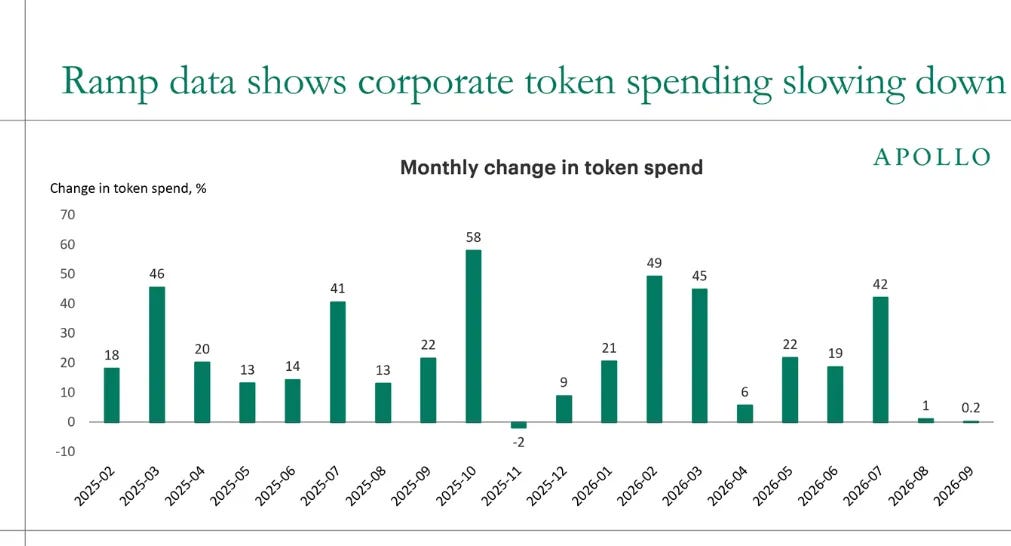
That said, open-weight models are clearly closing in on frontier-model quality at a fraction of the price. Overall corporate spending on tokens is falling as a result. This compresses margins for Anthropic and OpenAI and threatens anyone whose capex investments were built on premium pricing. But whether demand for AI will keep growing as prices fall remains an open question.
The Second Squeeze: Hidden Liabilities
Suddenly, liability for damage that their advanced models can cause looms large over Anthropic and OpenAI’s plans to go public. Neither company has fully released their most advanced models because of safety and behavioral concerns. Anthropic restricts Claude Mythos Preview to a small group of organizations through Project Glasswing. OpenAI says it will not release GPT-6.1 Astra.
Scholars and legislators debate whether to impose strict liability on AI developers. At present, no US state or federal authority requires AI developers or deployers to maintain liability insurance. Nonetheless, dozens of states are considering requiring AI companies to carry insurance. (OpenAI is backing an Illinois bill that would limit liability for catastrophic harm.)
Insurance companies themselves appear to have little interest in underwriting AI risk. Several carriers, including Berkshire Hathaway, Chubb and Travelers, have won state approval to exclude AI damage from their standard commercial liability policies. A few specialty insurers offer tailored AI error or agent-risk policies, but they cover far less than the multi-billion potential liabilities facing AI frontier platforms. None cover the risk that models could facilitate cybersecurity attacks or manufacture bioweapons. Investors have noticed, and credit default swap prices on AI companies have surged. (These derivatives serve as insurance against default for any reason)
Can platforms be held liable for harm caused by their algorithms? Probably. In August, Meta agreed to pay up to $17.1 billion to settle claims from dozens of states that Facebook and Instagram were designed to addict children. Although the deal admits no liability, a New Mexico judge separately ordered Meta to pay nearly $1 billion, a ruling that comes closer to proving platforms can be held liable. Florida is already suing OpenAI, claiming its products posed risks to children and that the company failed to warn the public about them.
Earlier this month, I argued that we should subject AI to basic disclosure, liability, and monitoring. A concrete first step is to require frontier model companies to carry enough insurance to protect consumers from harm. Requiring them to insure against the risk they take would force frontier and open-source companies to rigorously evaluate their products before releasing them.

The problem, of course, is that AI’s potential harm is substantial, even if its potential benefits are too. The world likely doesn’t have enough insurance capacity to cover this level of tail risk. Edward Best, a partner at the law firm Willkie Farr & Gallagher, told the New York Times that “Maybe they could get a billion dollars of insurance, but is that going to help a company that large? I mean, they need the capacity of the entire insurance industry.”
Conclusion
The AI buildout and associated IPOs are squeezed between two forces. Open-weight models and efficiency gains are pushing prices down, while potential liabilities are pushing costs up. Equity investors can absorb both risks, but lenders cannot. But hyperscalers now borrow against revenue projections based on premium prices and manageable levels of legal risk. To go public, both Anthropic and OpenAI will need to forecast prices realistically and put a number on poorly understood, hard-to-insure liabilities. This is unwelcome news as they try to dress up pretty for their coming-out party.
Pay attention to three signals.
Is AI revenue growing as fast as investment in data centers? Right now, the answer is plainly no. AI revenues are growing rapidly from a modest base, but they still lag far behind data center capex. Historically, many companies have required $1.50 to $2 of revenue per dollar of capital invested to cover operating overhead, power, and operating profits. This means that the market would need over $1 trillion in annual enterprise software spend just to break even. Today, pure-play foundation lab revenues total between $130 billion and $160 billion annually.
What share of announced data centers actually break ground? If hyperscalers cannot get utilities to build the generating capacity and transmission lines they need, then hyperscaling isn’t possible.
How large is the first big AI liability verdict? If an agent swarm originating from an Anthropic or OpenAI model hacks a bank or breaks into a large company and causes damage, serious lawsuits will quickly follow. Even if legislators do not mandate liability insurance, investors will insist on it. Investors can move their money elsewhere in seconds, and they will.
If these metrics go badly, keep Hemingway in mind. Things go south gradually when projects slip or a jury rules against you. But when banks or private-market lenders call a loan, things can collapse suddenly.
ICYMI
Scientists have transformed old blood cells into young brain stem cells, which grew younger as they aged.
AI can predict how long you will live with cancer from a single photo of your face.
Jamie Dimon: cyber risk to banks is their #1 problem.
The Chinese stock market has been dropping for ten weeks, the longest downturn ever.
Because power generation gates data center buildout, a long queue has formed to build new capacity. This attracts duplicate builders, so a large gap exists between the announced pipeline of data centers under construction and what will likely be built. Sightline Climate’s April 2026 Data Center Outlook tracked 140 US data center projects with announced 2026 opening dates, representing 16 gigawatts of computing capacity, enough to power 12 million homes. Of that 16 GW, only 5 GW is actually under construction. The remaining 11 GW sits at the announced stage with no physical progress.
Most companies don’t toss out older GPUs. They demote them to lower-power tasks like model fine-tuning, batch inference, or lower-tier enterprise cloud services.
This is Jevons’ paradox, named after the economist who noticed that cost-reducing technology can increase consumption. For example, cheaper LED lights didn't reduce municipal power bills. Instead, cities installed much more lighting.
Parameters are revealed, not coded. Frontier models discover parameters that capture patterns, relationships, and logic from unstructured data. Parameters include weights that measure the strength or importance of a connection between two nodes and biases that adjust the weight before activation.
Coverage varies by domain, and the 88.7% figure covers only single-turn queries.