
Imagine Google Maps for navigating your life. An always-on AI agent would give you turn-by-turn personal and professional advice, advise you on tricky social and professional situations, and help you build new skills. Because it would remember everything you hear, read, say, and do, it could remind you of people you’ve forgotten, and track your personal and professional commitments. It would understand and shape your tastes in books, movies, music, food, sports, porn, investing, travel, and friends. It could spend or invest your money, organize your day, and monitor your eating, exercise, social life, and sleep. Some users will doubtless try to max everything, everywhere, all at once. Others will flee in horror.
Your always-on AI agent will be a relationship like no other because, on some dimensions anyway, it will seem to know you better than you know yourself. It could give you the skill, knowledge, judgment, and confidence to make better decisions more quickly. You would feel more intelligent, productive, and creative — perhaps with good reason.
Would you be more likely to turn such an agent off or launch a second one? Or ten more? Would you enjoy having a dozen agents competing to create the best possible you?
Intimate Devices
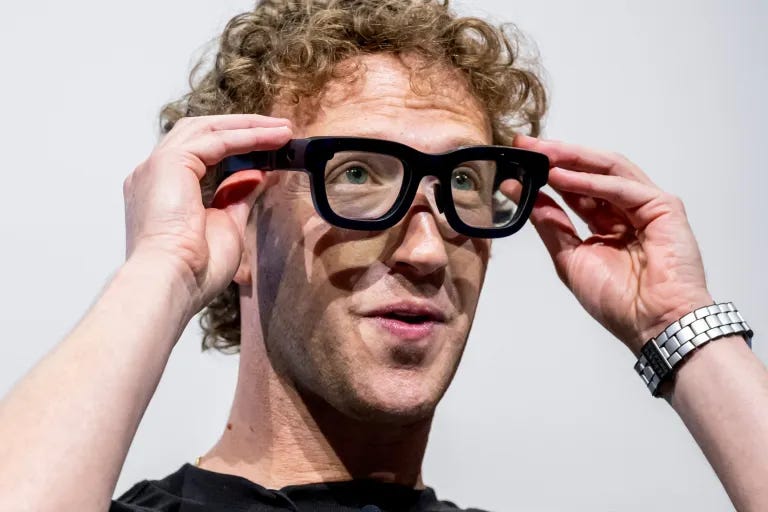
This is not science fiction, nor is it far off. Portable agents are arriving on devices you wear as glasses, carry as a phone or pendant, or — eventually — have implanted.
The French-Italian eyewear brand EssilorLuxottica sold over 7 million Meta AI glasses last year, up from the 2 million in 2023 and 2024 combined. The company is now discussing expanding production to 20 million pairs a year.
Meta is prototyping “super sensing” AI glasses that use cameras and audio recordings to capture a user’s every moment. It currently holds about 80 percent of the market for all-seeing, all-hearing devices, but Apple, Google, and Snap are all racing to launch rival products.
OpenAI has hired former Apple designer Jony Ive to build a wearable, AI-enabled smart speaker with facial recognition designed to “learn information about who is using it and what's around them.”
Apple, meanwhile, rebuilt Siri from the ground up — unveiled at WWDC in June, powered in part by Google’s Gemini models — as a full conversational companion that reads your screen, your calendar, and your mail, and acts across your apps.
And Elon Musk’s Neuralink, which had implanted brain-computer interfaces in 21 patients as of early this year, says it plans to move to high-volume production and nearly automated surgery in 2026.
At first, you might not like an agent who knows so much about you — especially one prone to hallucinations that are different from your own. But your agent will adapt. And so will you.
“And so will you.” But what does “you” mean if a person is continually refined, directed, and improved by her secret agent? Where does a user’s mind end and an AI begin? Philosophers Andy Clark and David Chalmers argued back in 1998 that technology extends our minds beyond our skull — a notebook, faithfully consulted, is an inseparable part of your cognitive machinery. An AI, or a group of AI agents, that knows you better than most humans do, becomes part of who you are. Would shutting it off be liberating or terrifying?
Will an agent-filled world be weird? Maybe not. Hearing aids and contact lenses are strange at first — then you cannot live without them. Count the buds and headphones on the young people you pass each day. Computers have moved from room-sized to desk-sized to wrist-sized. Why not an AI-enabled watch, Fitbit, Oura ring, earbuds, or video glasses? In Shenzhen, China, I tested prototype glasses that translated Mandarin into English in real time as captions. It wasn’t ready for prime time, but it was nice to read Chinese easily.
Whose Agent Is It, Anyway?
In pondering what he calls our coming “exoselves,” Kevin Kelly imagines four kinds of relationships with agents that know us better on some dimensions than we know ourselves. He imagines a twin who thinks like you; a tutor-guardian whose judgment you defer to; a hired counselor who is intimate yet professionally bounded; or a hero — a better half who models the person you aspire to be.
Kelly’s taxonomy is about you and your agent. But how will my agent get along with everyone else’s? Does my wife’s or my kid’s agent have our family’s interests at heart? What do they think about me?
And Kelly’s agent-enhanced self is only half the story. How will your agent interact with mine, with governments, or companies? What can my agent know or surmise about you? Will it steer us towards or away from each other? Will people without agents be more human, or just more isolated? Will an agent with knowledge of the most intimate and mundane features of your life improve your choice of friends, business associates, and lovers? In what domains will you trust your agent to have better judgment, and which not?
And in this context, what does “privacy” even mean? We are getting an early answer. Meta’s glasses are already at the center of a mounting privacy fight. In many states, it is illegal to record audio of a third party without their consent. Privacy experts worry that always-on devices could violate data privacy or biometric data laws. These lawsuits concern agents that film and record you. Wait until they can reason and hallucinate about you in conjunction with other agents.
And who has real agency here? Can I direct an agent to help me become more thoughtful? More domineering? Greedier? More spiritual? Who can teach us how to use an agent wisely? Kelly’s answer is sobering: learning to live with an exoself will be one of the major lessons of a lifetime, and society will take years to work out best practices. We have had three decades to learn how to manage social media. How’s that working out?
This points to the deepest problem in any new social technology: trust. An agent this intimate requires users to trust not just the software but also the platform and the company behind it.
Do you trust any company that much? Do you trust Elon Musk with your brain implant? What happens if your agent is erased, captured, spied on, or subpoenaed? What if the company behind it goes bankrupt? Kelly predicts heart-wrenching stories of people losing their exoselves when a platform folds. Imagine grieving a business or government failure because it felt like an amputation, or hating a company that purchased access to your digital soul.
AI agents are just the first step. Thanks in part to AI, many technologies that will reshape individuals are accelerating rapidly. Neural implants, targeted proteins, customized pharmacology, and genetic engineering are all advancing rapidly. We will soon be able to customize our mind, body, and personality directly — not through habit and education, but through hardware and chemistry. And we can influence not only ourselves, but our children and their descendants.
The post-human age is within sight. What are the odds that we use these capabilities wisely?
ICYMI
US semiconductor growth is stalling due to massive skill shortages.
American companies are shifting rapidly to Chinese open-source AI.
A Harvard research team unveiled a silicon chip capable of synthesizing 64 different DNA sequences simultaneously.
Trump changes US policy on Ukraine. Again. Now we support them.
El Niño is unrelated to global warming, but amplifies it, creating chaotic weather around the world. Can we mitigate it regionally by brightening clouds with saltwater? Maybe. But unknown unknowns are a bitch.
Chinese geologists warn of a fault line under the world’s largest hydro project.