
This week has presented several lessons in unexpected consequences. (We learn slowly, so many weeks do.) Consider a half-dozen examples:
Insider trading. A US special forces soldier was charged with using his insider knowledge of the forthcoming US raid on Venezuelan president Nicolas Maduro to make $400,000 on the prediction market site Polymarket.
But the charge has backfired by highlighting a much larger scandal: records show that insiders with advance knowledge of Trump’s market-moving announcements have made tens of millions of dollars trading oil futures. The White House knows it’s a problem, so it sent a memo to staff asking them to kindly stop profiting on inside information. These are easy cases to prosecute, but don’t hold your breath.
Stupid games with stupid prizes. Gerrymandering undermines democracy by allowing politicians to pick voters rather than the other way around. Trump, with characteristic forethought, started a partisan gerrymander war by demanding that Texas redraw its Congressional Districts to yield four more GOP seats.
California responded by abolishing its well-crafted system for drawing district boundaries, which used an independent panel. Five more states followed. Four others had already redrawn mid-cycle.1
Many Republicans now deeply wish that Trump had never started the fight. The moves are unpopular. Worse, it hasn’t worked: the GOP is unlikely to gain many new seats by jiggering the map. Moreover, leaders from partisan districts are, on average, more extreme (a problem Democrats will face as well). This does nothing to improve Congress or confidence in government.
Democrat overreach alert: Michigan. As Trump collapses, Democratic activists are tempted to move left and hope that voters sick of Trump will back them anyway. In the Michigan Senate race, which is critical to Democratic hopes of winning back the Senate, three members of Team Blue are competing in a primary for an open seat. Haley Stevens is a Congressional moderate whose views are closest to those of median light-blue Michigan voters. State Senator Mallory McMorrow is a liberal and a talented candidate (her TV ad is fire). Dr. Abdul El-Sayed is a progressive former public health official who has made Israeli warfighting a centerpiece of his campaign. He has held events with proud anti-semite Hasan Piker, equated Israel with Hamas, and advocated the abolition of ICE.
Nominate him, and Trump retains control of the Senate in anything short of a blue tsunami. Continue to indulge these instincts in other states, and Democrats will struggle to recover the White House in 2028 and find themselves on the ropes after the 2030 census, which looks to shift 7-10 Congressional seats from slow-growing blue states to faster-growing red ones.
We enter the “Find Out” phase. As Donald Trump brings to a close his ”Fuck Around” phase in Iran (five deadlines, five capitulations), the world is about to discover the full cost.
The first-order effects, meaning higher prices for gas, jet fuel, diesel, fertilizer, and condoms, are now obvious.
Second-order effects are coming into view: food shortages in the world’s poorest countries. An Iran run by hardened IRGC thugs instead of zealous theocrats. The nuclear threat worsened by an emboldened regime poised to collect $60-$80 billion/year of tolls on Hormuz shipping that they had only dreamt of previously.
The third-order effects will be the worst: a dramatically weaker US global position as adversaries are heartened by US fecklessness and domestic support for Trump implodes (although he still polls at 80% among Republicans). The US is providing swap lines to stressed Middle Eastern “allies,” so their forced asset sales do not shake our precarious private credit (“shadow banking”) system. Xi Jinping may notice that the US just shot up six years’ worth of ammo, and decide that Taiwan and TSMC are his to take. A worldwide surge in demand for Chinese electric vehicles could cripple US automakers, who just doubled down on fuel-burning cars.
Lip-Bu Tan may resurrect Intel. Intel’s shares have more than quadrupled in the past year, from $20 to more than $80 per share. Last August, Trump called for the resignation of the company’s new CEO, Lip-Bu Tan. Within days, Tan met with Trump and convinced him to drop the demand and take Intel shares in exchange for the release of the Biden administration’s almost $9 billion of CHIPS Act funds. Never one to turn down money, Trump agreed.2
Trump may not realize it yet, but at today’s stock price, government shares are now worth $35 billion, making Intel one of the best financial investments in US history (although College Land Grants, the GI Bill, the Interstate Highway System, the Apollo Space Program, the Human Genome Project, and several others created more long-term value. And buying Spirit Airlines would create far less.)
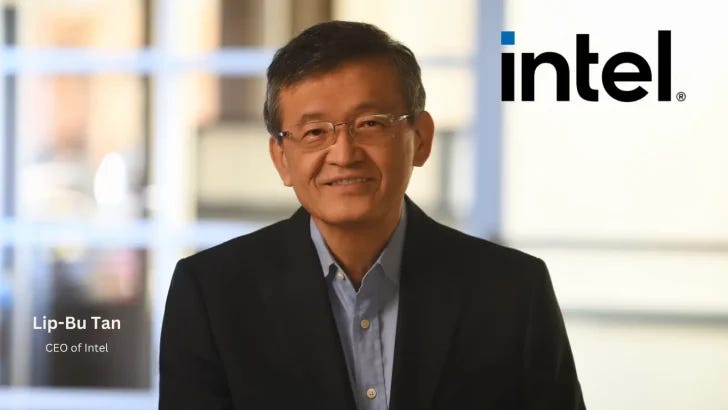
Credit for restoring Intel goes to Lip-Bu, a famously hard-working, Andy-Grove-caliber CEO, a capable engineer, and one of the most decent and popular leaders in Silicon Valley (admittedly, a low bar). The Malaysian-born, MIT-educated Tan created a culture at Intel that is much more disciplined, engineering-centric, and customer-focused. This, along with his formidable reputation as both an investor (he founded a venture fund that famously backed hundreds of early-stage Asian technology companies) and an executive (he turned around Cadence, a US electronic chip design company), enabled Tan to move quickly.3 He sold Altera, Intel’s programmable chip unit, and raised money from Nvidia and Softbank. This month, he repurchased the minority stake in Intel’s Ireland fab, persuaded Elon Musk’s Terafab to sign a strategic partnership, and announced a partnership to deploy Intel Xeon 6 processors across Google’s data centers.
The market noticed. Intel is not out of the woods, but a year ago, the pioneering company was widely dismissed as unsalvageable. Thanks to new leadership, a sustained AI boom, and timely federal backing, Intel is back on its feet and starting to run. Every American should be grateful.
Trump’s election fraud lies are working. A new Reuters/Ipsos poll shows that Donald Trump’s five-year campaign to convince the public that US elections are rigged and voter fraud is rampant is working. Although court and state investigations consistently find these claims to be false, 46% of voters believe that large numbers of fraudulent ballots are cast by non-citizens in US elections. 82% of Republicans and 38% of independents agree. Trump’s campaign aims to lay the groundwork for restrictive voting measures.
Note, however, that Trump rarely anticipates first-order effects, never mind second-order ones. In recent years, marginal and occasional voters have heavily favored Trump. If this remains true, voting restrictions, while bad in principle, could end up helping Democrats politically.
Missouri, North Carolina, Ohio, and Utah have passed maps aimed at the 2026 cycle. Alabama, Louisiana, New York, and Georgia have been redrawn due to court challenges. Florida and Wisconsin are still thinking about it.
Taking shares probably broke the law. A shareholder suit calls the deal an “unlawful contract that gives the U.S. government $11B worth of Intel stock for no meaningful consideration in response to extortionary threats by the government.”
Through Walden, Tan invested in more than 600 Chinese companies over 30 years — a very unusual profile for an American VC. Some of the chips produced by these investments inevitably helped fuel China’s military modernization, surveillance state, and human rights abuses. At least eight companies appear to have direct ties to the Chinese military.
A Congressional committee criticized major U.S. venture capital firms for injecting billions into Chinese artificial intelligence (AI) and semiconductor companies, arguing that, through these investments, American capital and expertise helped build China’s domestic semiconductor ecosystem and AI surveillance infrastructure. These sectors are central to the “military-civil fusion” policy, which eliminates the barrier between China’s private sector and its military.
The committee highlighted that these investments were legal at the time they were made. They focused on the “intangible” contributions—such as board seats, consulting, and talent acquisition—that Tan and his firm provided to strategically important Chinese entities. One commonly cited example: SMIC (Semiconductor Manufacturing International Corp.) is China’s largest semiconductor foundry. The committee noted that Walden International provided approximately $125 million in funding to support the company, and Tan served on its board from 2001 to 2018. SMIC was later placed on the US Commerce Department’s Entity List due to its ties to the People’s Liberation Army, at which point Tan left the board and, through Walden, sold his shares.
Great caption. :)