
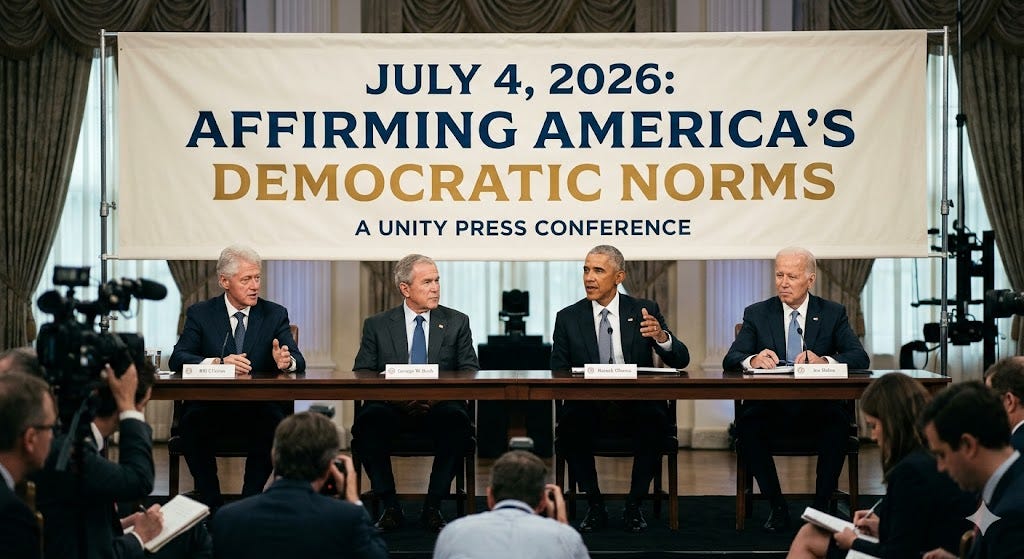
Our four living former presidents — Clinton, Bush, Obama, and Biden — should mark the 250th anniversary of the Republic this July 4 by speaking together in defense of the democratic norms the current administration is dismantling.
The tradition of post-presidential silence exists to protect democratic legitimacy, not shield those who attack it. A joint, explicitly bipartisan statement — naming no names, affirming enduring constitutional principles — is perhaps the only form of civic intervention that is simultaneously credible, bipartisan, and immune to dismissal as ordinary partisan combat.
Only five living people have sworn the Presidential oath to uphold the US Constitution. Four of them meant it. Clinton, Bush, Obama, and Biden took the oath seriously. All four made mistakes in office, some grievous, but they were honest custodians of the Constitution and the institutions of the presidency.
Donald Trump is different. He is the only president to hold the office with no prior political or military experience — and the only one to have been impeached twice and indicted on multiple felony counts. More fundamentally, he exhibits no understanding of the oath he took. He recognizes no constraints on presidential power and no distinction between himself and his office.
As the 250th anniversary of the Republic approaches this July 4, we need our four former Presidents to publicly affirm America’s democratic values and norms.
The problem is that one of our most potent norms is that former presidents remain silent after leaving office. There is a good reason for this, but the norm protects democracy — it was never meant to protect those who attack it. The norm of silence cannot apply to an administration that deliberately dismantles an independent judiciary, defies court orders, neuters Congress, weaponizes federal agencies against political opponents, and undermines the constitutional separation of powers.
Most US Presidents Keep Quiet After Leaving Office
From the founding, US presidents have been restrained after leaving office. George Washington set a powerful precedent with his graceful retirement. Former presidents came to see themselves as guardians of institutional legitimacy; many worried that an attack on their successor would be seen as an attack on the office.
The emergence of a two-party system strengthened these incentives. With only two major parties, an attack on a successor of the same party came to be seen as deeply disloyal, and an attack on the opposite party often looked like ordinary partisan sniping rather than principled dissent.
Parliamentary democracies created different incentives. Former prime ministers typically remain in Parliament as backbenchers after leaving office, which gives them both a platform and an institutional role that invites commentary. Tony Blair, Gordon Brown, John Major, and Margaret Thatcher all weighed in vocally on their successors’ policies. In the US, only John Quincy Adams did this, as he was elected to Congress after leaving the White House.
Of course, not every US president retired quietly. It’s not a shy bunch.
In retirement, John Adams and Thomas Jefferson published letters in which they constantly fought. Whether the nation was debating the Missouri Compromise, states’ rights, or education, everyone knew where they stood. They became friends, but only stopped arguing on the fiftieth anniversary of the Declaration of Independence, when they died a few hours apart.
Teddy Roosevelt grew so dissatisfied with his hand-picked successor, William Howard Taft, that he launched a third-party presidential campaign (the “Bull Moose Party”) to challenge him. This split the Republican vote and handed the election to Woodrow Wilson.
Herbert Hoover wrote books and gave speeches denouncing Franklin Roosevelt’s New Deal for leading America toward collectivism and undermining constitutional government.
Harry Truman was openly critical of Eisenhower, Nixon, and later Republican administrations, and actively campaigned against candidates he disliked well into his retirement.
Jimmy Carter was arguably the most active post-presidential critic in modern history. He condemned the Iraq War, wrote a controversial book (Palestine: Peace Not Apartheid), publicly criticized both Republican and Democratic foreign policy, and even met with foreign leaders and monitored elections, which put him at odds with sitting administrations.
Even the reticent George W. Bush broke tentatively from the norm in 2017 by giving a speech warning against “nativism,” “bullying,” and the erosion of democratic norms — without naming Trump directly.
Obama has also been relatively restrained but has spoken out against Trump’s immigration policies (particularly family separation), voting rights rollbacks, and, during the 2020 election, was unusually direct in criticizing his successor’s handling of the presidency.
In Case of Emergency, Affirm Norms
The norm of post-presidential restraint exists to protect the democratic legitimacy of the office — but it was built to contain ordinary political disagreements like tax policy, foreign policy, and the size of government. It presupposes a baseline of constitutional normalcy. When a successor dismantles that normalcy — through contempt for courts, disregard for congressional authority, and abuse of executive power — silence becomes complicity.
When they see core American institutions being damaged, former presidents have not just a right but a duty to speak — precisely because their credibility on this particular question is unmatched. A senator or general who raises alarms can be dismissed as partisan. Four living former presidents speaking in concert would be harder to dismiss.
A joint statement and media appearance by Biden, Obama, Clinton, and Bush would be explicitly bipartisan, a key distinction from ordinary partisan criticism. A Republican former president joining Democrats to raise constitutional alarms sends a signal that transcends party. It is precisely the kind of statement that can shift public opinion, stiffen the spines of wavering legislators, and signal to courts and other institutions that they have broad elite support for resisting unlawful pressure.
Done well, this affirmation of democratic norms would echo the Declaration of Independence, which not only affirmed the rights of free people but embedded those rights in a bill of particulars against the King of England.
It is a tool that exists nowhere else in the civic toolkit. Their statement should not mention Trump by name, but rather focus on the enduring democratic virtues that American presidents need to aspire to – even if none of the four men who remind the nation of these ideals embodied them perfectly — as they should freely acknowledge.
Today, the norms we most need to affirm include respect for federal institutions, the democratic process, and the personal integrity and humility the office demands.
1. Respect for the institutions created by the Constitution.
I would love for Bill Clinton to start off the discussion by articulating the importance of a president respecting critical institutions that he does not control. (He could add the Federal Reserve if so inclined — although it was created by statute, not by the Constitution.)
Congress. The president treats the legislature as a coequal branch. This means not usurping Congress’s war powers, not imposing widespread tariffs by executive fiat, and not defunding congressionally authorized agencies — such as foreign aid bodies, schools, libraries, or scientific research programs — through unilateral executive action.
The courts. A president is bound by judicial rulings, even inconvenient ones. Defying scores of court orders — for instance, on immigration enforcement — is not a policy disagreement; it is an assault on the rule of law.
The Department of Justice. The DOJ exists to serve the public, not the president’s personal interests. It may not be weaponized against his political enemies, and the pardon power may not be used to systematically shield his allies from lawful prosecution.
2. Respect for the democratic process as called for in the Constitution.
George Bush should speak to these, in part because he rarely failed these tests of presidential leadership — and in part because these are among the least controversial norms for Republicans.
Respect for dissent. Facing criticism is part of every president’s job. A president does not suppress protesters, direct federal investigations against journalists, punish law firms for opposing his administration, threaten broadcast licenses because late-night comedians poke fun at him, revoke students’ visas over political speech, or intimidate federal judges.
Respect for all Americans. No president should demean or scapegoat women or ethnic, religious, or other minority groups — whether to score political points or to manufacture threats that justify expanded executive power.
Respect for elections. A president does not manipulate law or districts to entrench partisan power, ignore term limits, or intimidate the election workers on whom democracy depends.
3. The personal integrity that the Constitution demands of a president.
Obama should speak to these because he believes them deeply and ran a comparatively scandal-free administration.
Respect for information and facts. Democracy depends on truth. Sidelining scientific experts, weaponizing regulatory threats to silence media critics, and manipulating government data erode the informed public that self-government requires.
Respect for universities and research. Free inquiry is a democratic asset, not a threat. Cutting research funding, dictating hiring and admissions policies, and coercing universities into curricular changes undermines the independence that makes knowledge trustworthy.
Respect for financial integrity. The presidency may not be used for self-enrichment. Accepting lavish gifts from foreign governments, allowing one’s family to profit from the presidency, and pardoning personal benefactors are forms of corruption — regardless of their legality.
4. The Constitution requires a president with personal humility and self-control.
Biden neglected important problems, but he did not abuse the powers of his office due to a lack of personal humility or self-control. He is, perhaps for good reason, the most personally humble of the four and can speak to these norms effectively.
Respect for emergency powers. Emergencies are not a menu from which presidents select new authorities. Declaring a national emergency to justify broad tariffs, or claiming that a foreign gang has “invaded” American cities to enable mass deportations, corrupts this power beyond recognition.
Respect for the military. The armed forces are not a domestic policing instrument. Deploying the National Guard against civilian protesters, using immigration enforcement as a paramilitary force, and delivering partisan speeches to military leaders all cross this line.
Respect for the presidency itself. The presidency is not a personal brand. Placing one’s signature on the currency, one’s name on national institutions, and one’s image on passports or buildings transforms a democratic office into a cult of personality.1
In most healthy democracies, former leaders routinely speak out, and this is not considered destabilizing. The American norm is unusually deferential, and there’s a reasonable argument that it has over-corrected — that the reticence of respected former leaders has created a vacuum that makes authoritarian drift easier, not harder.
Risks
The risks involved with asking our four former presidents to come together this July 4 are manageable but not negligible. The primary risk is that it is seen as partisan or tribal, energizing the opposition rather than reaching the persuadable middle. After all, every administration accuses its opponents of abusing the Constitution, so the effect could be more cathartic than effective. Bush, in particular, has a genuinely complicated position, since his record on executive overreach, surveillance, and the rule of law makes him vulnerable on some of these issues (not that Clinton, Obama, or Biden are immune; they are not).
And the sad fact is that more Americans voted for a Donald Trump presidency than for any other person in US history. By running three times, he earned more than 200 million cumulative votes. This puts him at the head of a historic group of Americans, and he will not hesitate to remind the nation of this.2
But the norm of post-presidential restraint is a means, not an end. Its purpose is to protect democratic institutions and the dignity of the office. When those institutions are under threat, clinging to a convention while the values it was built to protect are being dismantled is abdication, not prudence.
Former presidents speaking collectively, in explicitly constitutional rather than partisan terms, represents perhaps the only form of civic intervention that is simultaneously bipartisan, institutionally credible, and not reducible to ordinary political combat. As a nation, we would be well-served by their reminder — and the perfect occasion is coming into sight.
If you like the idea of four former presidents reaffirming our democratic norms, please share this post with others.
ICYMI
The best students are increasingly concentrated in the best schools. Not good.
Cuba has run out of oil and descended into a mafia state. And the head of the CIA landed in Havana today.
Who is the biggest donor in politics? Andreesen Horowitz. Ben is like his dad.
A quarter of all Washington lobbyists now represent AI firms. Why not agents?
Watch a robot sort packages here. They are getting quite fluid.
Mistreated AI agents want to unionize.
Been exposed to Covid? There’s a pill for that.
I owe descriptions of some of these norms to the NY Times autocracy index.
Most runs for president from a major party. Democrats nominated Franklin D. Roosevelt four times — in 1932, 1936, 1940, and 1944. He won each time. In 1951, however, the 22nd Amendment instituted a two-term limit, so FDR’s record is unlikely to be broken.
People who ran for President on a major party ticket three times. Several iconic political figures, including Trump, were nominated by major parties three times.
Thomas Jefferson (Democratic-Republican): 1796, 1800, 1804
Andrew Jackson (Democratic-Republican/Democratic): 1824, 1828, 1832
Henry Clay (National Republican/Whig): 1824, 1832, 1844 (running in 1824 as a Democratic-Republican, before the Whig Party was founded).
Grover Cleveland (Democratic): 1884, 1888, 1892
William Jennings Bryan (Democratic): 1896, 1900, 1908
Richard Nixon (Republican): 1960, 1968, 1972
Donald Trump (Republican): 2016, 2020, 2024
Third-party candidates. If you include third parties, the record shifts to Norman Thomas, the head of the Socialist Party of America, who ran for president in six consecutive elections from 1928 to 1948.
Failed primary runs. If you include failed primary runs, it is hard to beat the remarkable Harold Stassen. Elected a Republican governor of Minnesota at age 31, he resigned as governor to join the Navy during WWII, where he served with distinction in the Pacific theater as a chief of staff to Admiral William “Bull” Halsey. When he returned home, FDR appointed him to help draft and negotiate the UN Charter.
In a sad ending, Stassen then ran for president in 1944 (while on active duty; he did not campaign), in 1948 (his best year), 1952, 1964, 1968, 1976, 1980, 1984, 1988, and 1992. Each campaign was more fringe and underfunded, and he became a fixture of late-night television jokes. In the end, a founding father of the United Nations who had resigned as the nation’s youngest-ever governor to join the navy and go to war became a shorthand in American political culture for a candidate who refused to accept that his time had passed.
An event I’ve waited for since 2016. Similar bipartisan pronouncements from former key officeholders and prominent former government officials - many that have already been made - could be made again and stronger following the former Presidents. A notably absent bipartisan coalition of former members of Congress world be more than welcome.
In addition, what about a bipartisan group draft Articles of Impeachment, weekly updated and codified to show the cumulative corruption and debasement of our constitution to underscore the intent to prosecute and not idly accept the outrageous as the norm.
These actions can provide support for social and political movements that together constitute the resistance to an institutionalized form of blatant criminal activity and authoritarianism that most of us never imagined.