
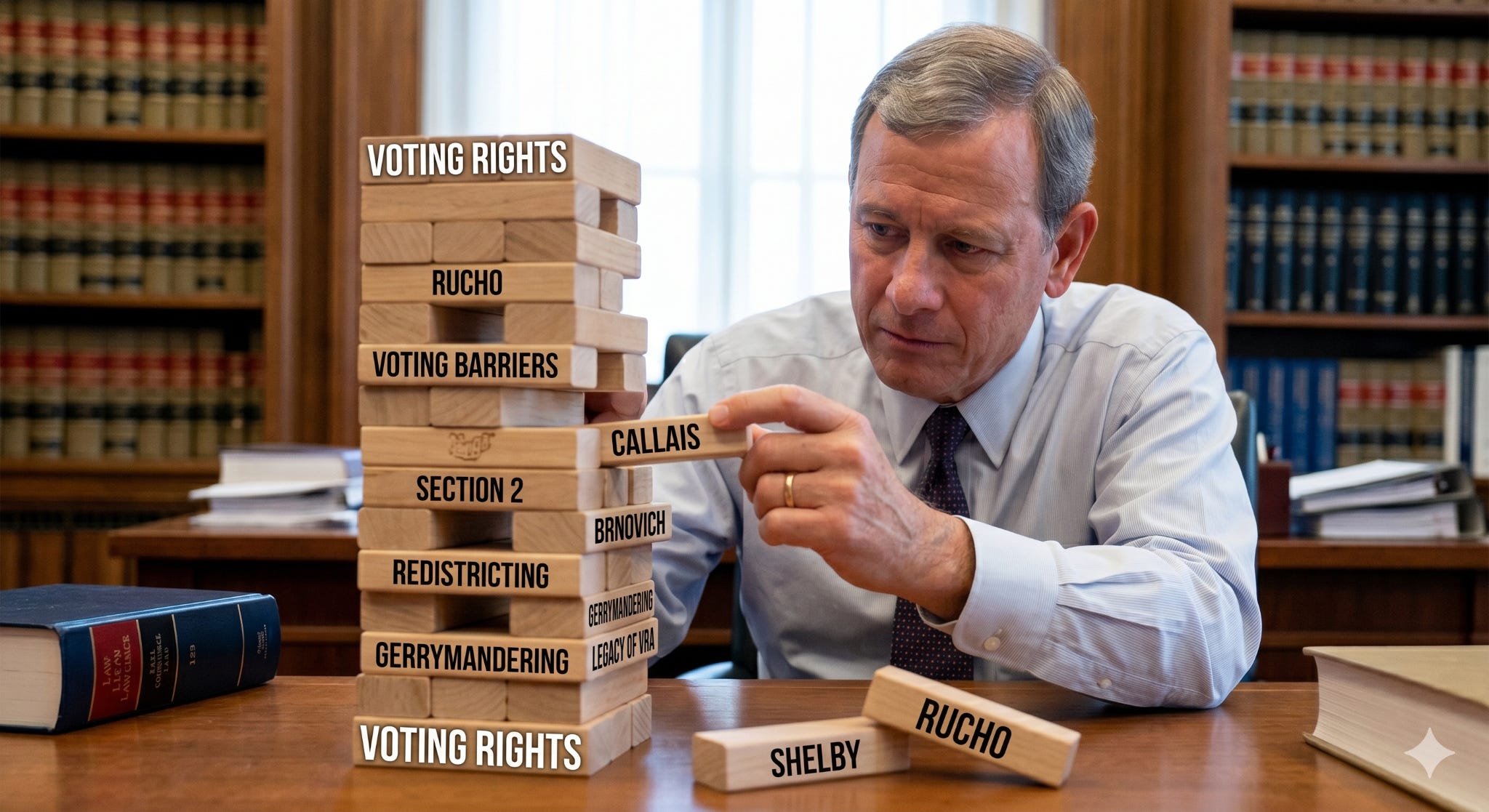
TL; DR: Like any massive legislative achievement, the Voting Rights Act (VRA) brought with it unintended consequences. It smashed Jim Crow but legitimized race-based gerrymandering. Its “majority minority” districts led directly to the election of more Black members of Congress, but also to more conservatives, who undermined Black policy interests.
The Roberts Court has held that partisan gerrymandering is off-limits to federal courts. This week, it banned redistricting based on race. The logic of these decisions is not groundless, but the result is a partisan redistricting race to the bottom that undermines electoral democracy.
To restore fair and honest political competition, Congress and the states should expand the House, mandate the use of independent redistricting commissions, and allow courts to use simple compactness tests to challenge suspicious maps.
The Voting Rights Act Ended Jim Crow
In 1870, the United States marked the end of its vicious Civil War by passing the Fifteenth Amendment, which promised Black Americans the right to vote. The defeated Confederacy spent the next ninety-five years breaking that promise with literacy tests, poll taxes, and white primaries. When those failed, out came the rope and gunpowder. Even majority-Black communities found themselves politically voiceless.
By the early 1960s, idealistic college students were joining civil rights organizations to register Black voters in defiance of Jim Crow laws. On Sunday, March 7, 1965, John Lewis of the Student Nonviolent Coordinating Committee and Hosea Williams of Martin Luther King’s Southern Christian Leadership Conference led roughly 600 marchers out of Selma toward Montgomery. They got as far as the Edmund Pettus Bridge. On the far side, Alabama state troopers in gas masks waited with billy clubs and bullwhips. They charged. Lewis took a blow that fractured his skull. The footage ran on every network that night. We watched it in black and white, but we saw red.
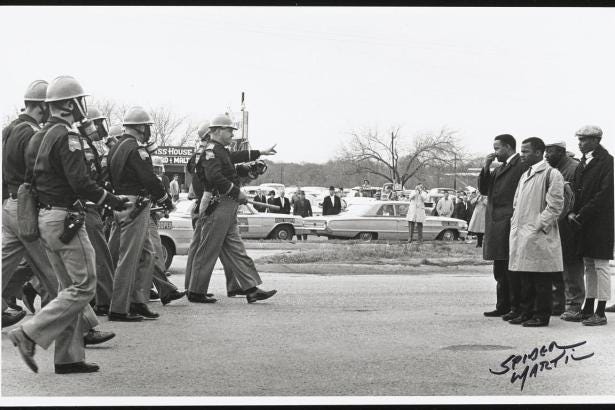
Eight days later, President Johnson stood before a joint session of Congress, declared “We Shall Overcome”, and called for federal legislation to protect voting rights. The Voting Rights Act (VRA) passed the Senate 79–18 and the House 328–74. Johnson signed it on August 6, 1965, with Martin Luther King Jr., Rosa Parks, and future Congressman John Lewis at his side. Seeing LBJ sign the VRA on TV was one of the most moving moments of my young life.
The VRA was a muscular bill. It prohibited any election practice that denied the right to vote on account of race, and it required jurisdictions with a history of voting discrimination to obtain federal approval, known as “preclearance”, before changing their election laws.
Preclearance was the VRA’s killer feature. It ended the whack-a-mole game in which Southern jurisdictions invented endless new ways to deter Black voting. It also produced immediate results. By the end of 1965, a quarter of a million new Black voters had registered. In Mississippi, Black voter turnout went from 6 percent in 1964 to 59 percent four years later. The registration gap between white and Black voters in the South dropped from nearly 30 points in the early 1960s to 8 points a decade later.
The Department of Justice still considers the VRA the most effective civil-rights statute Congress has ever passed. Congress has reauthorized it five times, always with broad bipartisan majorities.
The VRA didn’t merely tolerate race-conscious mapmaking; under the right circumstances, it required it. Section 2 prohibits “vote dilution” – maps that artificially submerge minority voters inside majority-white districts. Under the Supreme Court’s 1986 Thornburg v. Gingles framework, states were required to draw a majority-minority district if three conditions were met:
Compactness. The minority group had to be large and geographically concentrated enough to form a majority in a single-member district.
Political cohesiveness. The minority group typically voted for the same candidates.
Racial bloc voting. The white majority voted as a bloc consistently enough to usually defeat the minority’s preferred candidate.
Where these were satisfied, states could be legally compelled to draw a district in which the affected minority group constituted more than half the population. Today, about 70 out of 148 majority nonwhite congressional districts are protected by Section 2 of the VRA. Between 30 and 40 of the 148 have elected white Congressional Representatives.1
This racial decoupling represents a big change in American political representation. As recently as the 1990s, 90 percent of Black members of Congress represented majority-Black districts. Today, however, fewer than half of Black Congressional leaders come from majority-minority districts; the rest were elected from plurality or majority-white districts. (Importantly, however, in states like Alabama and Mississippi, the "90 percent" rule still largely holds. If a district in the Deep South isn't majority-Black, it almost never elects a Black representative. Racial "decoupling" is almost entirely a phenomenon of the North, the Midwest, and the West Coast.)
John Roberts Hates Racial Preferences
Chief Justice John Roberts gives progressives the vapors, but his view of racial preferences has been completely consistent for three decades. He genuinely believes the Reconstruction Amendments meant what they said when they barred discrimination based on race.
The Court had struggled with this issue for years, but it has become Roberts’s constitutional north star. In addition to voting rights, Roberts has applied his vision of “colorblind constitutionalism” to affirmative action in college admissions, public school integration, and government contracting. A quick review of his key decisions helps frame this week’s decision.
2007 Parents Involved v. Seattle. The Court found it unconstitutional for a school district to use race as a factor in assigning students to schools unless it was remedying a prior history of de jure segregation. John Roberts used his opinion to summarize his philosophy: “The way to stop discrimination on the basis of race is to stop discriminating on the basis of race.”
2013 Shelby County v. Holder. The Court declared the VRA’s preclearance regime unconstitutional. The aftermath was immediate, ugly, and decisive. Texas and North Carolina quickly activated voter-ID laws that had been blocked by federal preclearance. Across the South, counties subject to preclearance closed polling places—by one count, more than 1,600 between 2013 and 2018. The racial turnout gap, which had been narrowing for decades, began to widen again, growing roughly twice as fast in preclearance jurisdictions as elsewhere.
2019 Rucho v. Common Cause. The Court considered redistricting maps drawn by North Carolina Republicans and by Maryland Democrats. In both states, the mapmakers cheerfully acknowledged that they were hacking their districts for partisan advantage. Plaintiffs argued that the rigged maps penalized voters for their political associations and diluted their votes. They asked the Court to rule that federal courts could decide when partisan gerrymandering went too far.
In a 5–4 decision split along ideological lines, the Roberts Court said no. Writing for the majority, Roberts called partisan gerrymandering a “non-justiciable” political question. He acknowledged that “excessive partisanship in districting leads to results that reasonably seem unjust,” but argued the Constitution gave federal judges no “judicially manageable standards” for separating permissible politics from unconstitutional manipulation. Fairness, he wrote, was a political judgment, not a legal one.
Justice Elena Kagan’s dissent was scathing. The majority, she wrote, was “abdicating its duty” at exactly the moment when modern data analytics let parties draw maps with surgical precision -- letting politicians, in her phrase, “choose their voters.” Lower courts, she pointed out, had already developed workable standards for distinguishing severe gerrymanders from ordinary politics. The majority simply declined to use them.
Rucho’s effect was immediate. Federal courts shut their doors to partisan-gerrymandering suits. Activists shifted to state supreme courts and state constitutions, with mixed results. Plaintiffs hoping to challenge an obviously rigged map in federal Court now had to recharacterize it as a racial gerrymander.
2026 Louisiana v. Callais. With Callais, the Roberts Court has closed both doors by declaring race-based gerrymandering unconstitutional. Since partisan gerrymandering is unreviewable, now legislators can launder their racial intent through partisan language and draw any map they want.
Callais finishes the work that Shelby began. Six justices held that compliance with VRA Section 2 cannot, by itself, justify drawing a district where race “predominated.” More importantly, the majority rewired the Gingles framework so that vote-dilution plaintiffs must now show evidence of “present-day intentional racial discrimination.” Historical patterns and disparate effects no longer suffice.
Justice Kagan, in her dissent, said this new standard “renders Section 2 all but a dead letter” because intent is very difficult to prove in Court. As it did in Shelby, expect Kagan’s dissent to be more accurate than the carefully hedged language of the majority.
The effect of Callais has also been immediate. Within hours, states began delaying elections to create more partisan districts. The redistricting race to the bottom is now on.
Taking Roberts Seriously
It is tempting to dismiss Shelby, Rucho, and Callais as raw conservative judicial activism – and many have. That is a comforting story, but not entirely accurate. There is a serious case for what the Court did, and it deserves a hearing on its strongest terms before being rebutted. The strongest steelman version goes like this.
The Fifteenth Amendment only bars purposeful discrimination. Section 2 of the VRA is designed to enforce the Fifteenth Amendment, which forbids only purposeful racial discrimination in voting. Callais doesn’t formally strike Section 2 down. It construes Section 2 to require what the Fifteenth Amendment requires: evidence of intentional discrimination. That, the steelman version argues, is the textually conservative move. The complaint that the old construction was more useful in combatting racial discrimination is not a constitutional argument.
Callais resolves the VRA’s “Goldilocks” problem. For thirty years, the Court has held simultaneously that Section 2 sometimes requires states to draw majority-minority districts. But the Court also holds that the Fourteenth Amendment forbids states from drawing districts in which race “predominates” over traditional districting principles.
Election-law scholars have called this the “Goldilocks problem”: states are guilty of unconstitutional racial gerrymandering if they consider race too much, and guilty of statutory vote dilution if they consider race too little. Alabama, Louisiana, and North Carolina spent the entire post-2020 cycle being sued from both left and right over the same maps. Callais finally chose the only coherent resolution by declaring that the Fourteenth Amendment, which protects individuals against race-based government action, must govern. The alternative is to drown state legislatures in litigation over competing statutes.
Sorting citizens into racial blocs is repugnant. Since the Reconstruction Amendments were enacted, progressives have argued that these laws were not intended to authorize the federal government to sort citizens into racial blocs. Justice Harlan’s liberal dissent in Plessy v. Ferguson argues this, and it has become the founding text of color-blind constitutionalism. It is also the foundation of Thurgood Marshall’s argument in Brown v. Board of Education. The progressive shift to race-conscious remedies in the 1970s and 1980s was tactical, not an enduring constitutional principle. Those who disagree with this reading cannot dismiss it as bad faith.
Majority-minority districts do not, on net, help Black voters. The standard liberal story -- that majority minority districts are unambiguously good for the voters they were designed to help -- is harder to defend than it looks. The unintended consequences show up in the surrounding districts.
In 1997, the political scientist David Lublin published The Paradox of Representation, a careful study of every member of Congress elected between 1972 and 1994. Lublin asked what happens to the districts around the majority-minority districts created by the VRA? In the South, Lubin found that concentrating Black voters into a small number of safe seats drained Democratic-leaning voters out of the surrounding map. As a result, the adjoining districts were whiter, more conservative, and more Republican. Yes, majority-minority districts produced a handful of new Black members of Congress -- but they created even more conservative Republicans. Visible Black representation went up, but substantive representation, as measured by the ideology of the median House member, went down.2
These findings complicate an evaluation of Callais, which found these majority-minority districts unconstitutional. But if majority-minority districts have produced a Congress less responsive to Black policy preferences than a different map would have, then a Court ruling that constrains race-based mapmaking is, at minimum, a closer call than anguished progressive political reactions suggest. It implies, among other things, that repealing a requirement that Blacks be packed into heavily Black districts may actually diminish the power of white conservatives.
We cannot untangle race from partisanship. Race and partisanship are now so tightly correlated that increasingly, Section 2 vote-dilution suits were little more than partisan gerrymandering suits in racial drag. Justice Alito’s majority opinion candidly cites “partisan- gerrymandering claims being repackaged as racial-gerrymandering claims” as one of the reasons the Gingles framework stopped working. If federal courts can’t untangle race from party – and after Rucho, they aren’t supposed to try – then the choice is between two evils: a regime in which race-based claims are usable proxies for partisan ones, or a regime in which neither is. The Court chose the latter. That is at least consistent.
None of this means the Court got Callais right. First, descriptive representation builds civic legitimacy among historically excluded groups. It improves deliberation quality in environments marked by mistrust. Left-right policy ideology is not the only thing voting rights should care about. But the empirical evidence complicates the easy progressive line, and any honest defense of Section 2 has to start by acknowledging this.
Likewise, a serious conservative defender of Callais must acknowledge that the decision will reduce minority representation in the short run; that the partisan-gerrymandering defense it greenlights is, in many cases, a fig leaf for racial gerrymandering; and that Congress can fix the problem with new legislation grounded in present-day evidence of intentional discrimination. In short, even conservatives should admit that the Court has handed Congress a problem and told it to solve it.
Constitutional scholars will assure you that these steelmanned objections are serious, but wrong. I footnote their response because I want to turn to reforms, not because these arguments don’t deserve a close reading.3
Precisely as Justice Kagan warned, without a federal floor, partisan gerrymandering is devolving into a race to the bottom. Mid-decade redistricting, once rare, is quickly becoming routine. Prodded by President Trump, Texas redrew its congressional map in mid-2025 to add several Republican-leaning seats. California voters retaliated, passing Proposition 50, which effectively abolished the state’s well-crafted independent redistricting commission to authorize the legislature to redraw the map for partisan retaliation. Five more states have followed, and four others have already redrawn mid-cycle. This cannot end well.
House Minority Leader Hakeem Jeffries has called for “maximum warfare, everywhere, all the time.” Instead of channeling his inner Jacobin, Jeffries should think more broadly about the electoral reforms America needs. Specifically, he should lead an effort to expand Congress and mandate the use of independent commissions backed by simple math checks to curb abusive gerrymandering.
Expand Congress
If federal courts won’t police mapmaking, Congress and the states must do so. A hidden lever is the size of the House itself. I made the longer case for expanding Congress in an earlier post. I argued that Congress erred in 1929 when, fearing the political power of immigrant-heavy cities, it permanently capped the House at 435 seats. Until then, the House had expanded after almost every census. But the US population has tripled since Congress froze its size in 1911.

Instead of adding more districts, the House watched as the average district grew from roughly 210,000 residents after the 1910 census to about 762,000 today. That makes it harder for any community of interest to elect a representative. Plus, a smaller House magnifies the small-state bias in the Electoral College (Wyoming’s 3 electors each represent 195,000 residents; California’s 55 electors each represent 725,000).
Three rules have been proposed to fix this.
The Wyoming Rule sets the size of every district at the population of the smallest state. This would yield a House of about 575.
The Cube Root Rule most modern legislatures are roughly the cube root of the national population. The US actually tracked this rule for its first 130 years. This rule yields a House of about 692.
Holding districts to the 1910 ratio of 210,000 residents would yield 1,578 seats.
I favor setting the size of Congress by taking the cube root of the population after each census. A 692-seat House would make gerrymandering structurally harder because smaller districts are:
More sensitive to local geography. A mapmaker’s scalpel has less room to maneuver when the population target is lower, so “cracking” and “packing”, the central activities of any gerrymander, become more difficult.
Aligned more easily with natural communities of interest, such as neighborhoods, ethnic or religious communities, and counties, removing the standard excuse for snake-shaped “octopus” districts.
Leakier. With more seats overall, the partisan return on any single boundary manipulation falls, while the chance of swing-voter “leakage” rises.
It is also worth noting that a larger House would substantially relieve the Lublin paradox. With 479,000-person districts instead of 762,000-person ones, Black, Latino, and Asian American voters would constitute electorally meaningful pluralities in many more districts -- producing more crossover and influence districts of the sort Lublin recommended without requiring any race-conscious mapmaking at all.
Structural reform achieves through demographics what race-based remedies achieve through litigation, and does so in a form that Callais cannot reach.
Mandate Independent Commissions With Math Checks
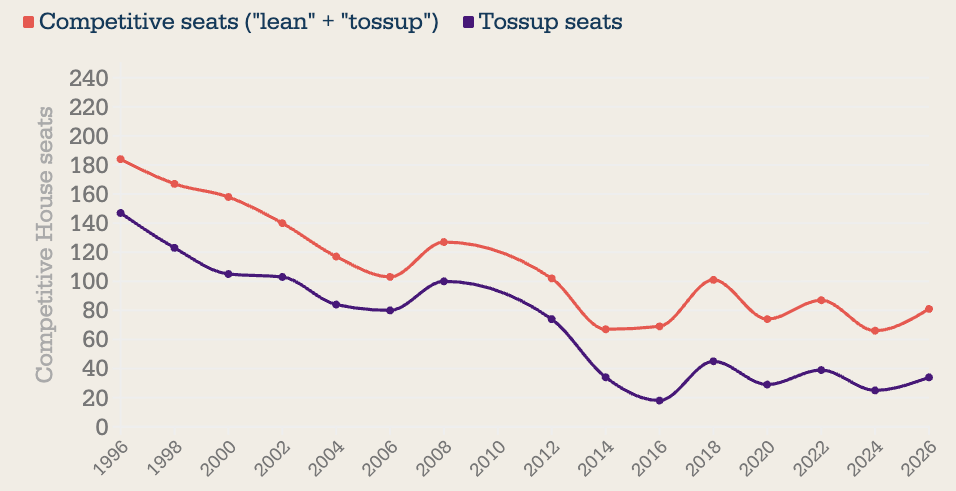
Gerrymandering has rendered most House elections meaningless. By Cook Political Report’s reckoning, only about 82 of 435 districts – fewer than one in five – are competitive in any meaningful sense, and the number of true tossups in any given cycle is closer to two or three dozen.
The crossover rate tells the same story. As recently as 1998, about a quarter of the House represented districts that voted for the other party’s presidential candidate. In 2024, only 16 of 435 members -- under 4 percent -- hold crossover seats.
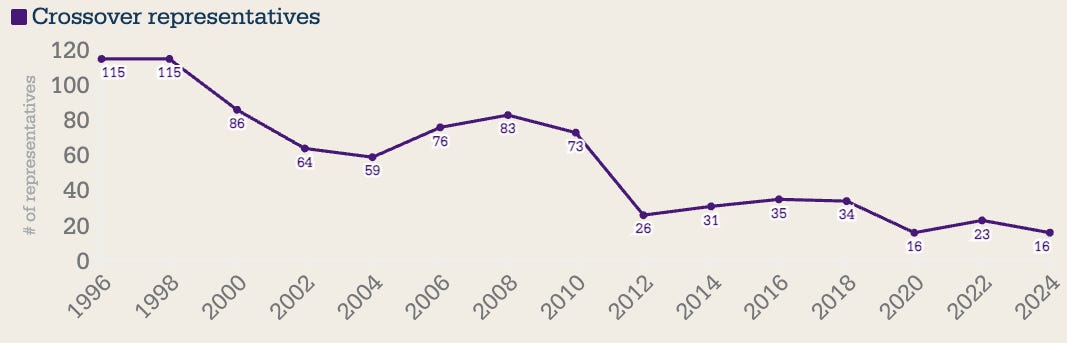
Some of this collapse is gerrymandering, though much of it is voter self-sorting: Democrats now cluster in cities and inner suburbs, Republicans in exurbs and rural areas, and even a perfectly drawn map will produce more lopsided districts than it did a generation ago. But gerrymandering is the part we can fix by changing the rules.
The Constitution’s Elections Clause grants Congress broad authority over the “Times, Places, and Manner” of federal elections, and the Supreme Court has long read this as authorizing Congress to override state regulations. Most legal scholars believe Congress could require independent redistricting commissions for federal districts, as the proposed Freedom to Vote Act would do. A federal mandate would standardize the order of operations used in commission-led states like California, Michigan, Arizona, and Colorado, making California’s retaliatory Proposition 50 unnecessary.
But commissions need tools to gauge results. Two simple compactness tests, used together, can flag the most egregious maps.
The Polsby-Popper Test compares a district’s area to the area of a circle with the same perimeter. A long, squiggly border with little area inside, like Massachusetts Governor Gerry’s salamander-shaped district that gave us the Gerry-Mander, produces a low score.
The Reock Test compares a district’s area to the area of the smallest circle that fully encloses it. Long, thin districts have a large bounding circle relative to their actual footprint, and so produce a low Reock score.4
The tests are colinear, and neither proves dispositive evidence of partisan intent. For example, Massachusetts could not draw a Republican district even if Governor Gerry rose from the dead holding a pen. But together they give courts and commissions a useful signal. Today, 82 of 435 congressional districts (about 19 percent) score in the bottom quartile on both Polsby-Popper and Reock tests. These “double-low” districts are concentrated overwhelmingly in states where the legislature, rather than a commission, controls redistricting: Texas, Illinois, Maryland, and North Carolina.
A federal statute could require commissions to prioritize geographic compactness, prohibit the use of partisan voting data in mapmaking software, and direct courts to subject any map failing both compactness tests to heightened scrutiny. None of this resurrects the dead-letter version of Section 2 that the Court just buried. But it would give voters something they currently lack: a route, in federal Court, to challenge a map drawn for the explicit purpose of choosing them.
Conclusion
Gerrymandering is a sin as old as America itself. Back in 1789, Patrick Henry tried to draw a district that would keep the Constitution’s main author, James Madison, out of Congress. But 1789 technology did not enable state legislators to draw district boundaries that would reliably elect their candidate for a decade. Today’s partisan mapmakers, armed with voter files and machine learning, can do so easily. The Roberts Court has now told them that as long as they’re disenfranchising voters for being Democrats or Republicans rather than for being Black or white, the Constitution has nothing to say about it, and federal courts will not interfere.
The conservative defenders of Callais make a serious argument that the Court has finally aligned the Voting Rights Act with the Constitution’s color-blind text. They are right that Section 2 was always in tension with the Fourteenth Amendment’s anti-classification principle, and that majority-minority districts have produced mixed results for the voters they were designed to help. We can concede all of that.
But Callais is nonetheless a disaster because it subverts electoral democracy. It is a license to gerrymander, with the Chief Justice helpfully spelling out the precise techniques for doing so in his majority opinion.
If the federal courts won’t fix this, Congress and the states must. Expand the House. Mandate independent commissions. Use straightforward mathematical tests of compactness. The alternative is the regime we have now: maps drawn for the explicit purpose of choosing voters, protecting incumbents, and denying voters a federal forum in which to object.
Most of these districts mandated under Section 2 of the VRA are for Black voters. Some are for Latino voters, and a few are for Asian voters. Not all of these districts elect Democrats, although most do. The VRA rule applies to state legislative and school board districts as well as Congressional Districts.
Lublin found that this trade-off held only in the South; in Northern cities, the demographics were different enough that it didn’t apply. But most majority-Black districts were in the South. Lublin’s finding is not a fringe view. The political scientists Cameron, Epstein, and O’Halloran reached similar conclusions in 1996. So did Grofman, Griffin, and Glazer in 1992.
Congress can ban a wider range of conduct to enforce the Fourteenth and Fifteenth amendments than the Constitution itself does.
The Court created the Goldilocks problem, then chose not to resolve it. The Court’s own racial-gerrymandering doctrine – the one that says race must not “predominate” over traditional districting principles – is itself a judicial invention, as Kagan’s dissent points out. There was no Goldilocks problem before the Court decided Shaw v. Reno (1993). The Court could have resolved the tension by relaxing the Shaw predominance test. Instead, it kept Shaw and gutted Gingles. That’s a substantive choice about which line of doctrine to privilege, dressed up as logical necessity.
The historical argument has a hole in it. The drafters of the Fifteenth Amendment in 1869 were not naive about race-conscious remedies. The same Reconstruction Congress that wrote and ratified the Reconstruction Amendments also passed the Freedmen’s Bureau Acts, which provided federal benefits explicitly and exclusively to formerly enslaved people. The same Congress passed the Civil Rights Act of 1866, which used race-conscious language to protect Black citizens.
The original public meaning of the Reconstruction Amendments was anti-subordination at least as much as anti-classification. The strong color-blind reading is a defensible interpretation, but it is not the only originalist reading on offer, and pretending otherwise is selective history.
If majority-minority districts have produced a Congress less responsive to Black policy preferences, we should reform the electoral system toward multi-member districts, ranked-choice voting, or a larger House in which minority voters can elect candidates of their choice without being numerical majorities. None of those reforms requires drawing race-predominant districts. None of them is foreclosed by Callais. But none of them is what Callais delivers. What Callais delivers is a regime in which states can draw any map they like – including maps that crack minority communities across many districts to dilute their votes – as long as they call it partisan.
The Polsby-Popper formula is 4π·A / P²; scores range from 0 to 1, with 1 corresponding to a perfect circle. A close cousin of the Reock test uses the district’s convex hull instead of a bounding circle and catches districts with deep, neighborhood-excluding bites taken out of them.