
This week, a friend whose native language isn't English asked for help. She had hired attorneys, and their bills were much higher than she expected. Gemini agreed that the fees seemed high for her type of case in this part of the country and quickly drafted an inquiry to the law firm. The attorneys responded promptly with several hundred pages of documentation. Of course, I fed that back into Gemini, which spotted a dozen or so problems, composed a reasonable letter pointing them out, and suggested a solution.
I feel for both parties. On the one hand, my friend is being overbilled thousands of dollars for routine legal work that could (and I suspect soon will) be done by AI agents. On the other hand, my detailed AI-generated inquiries likely forced the attorneys to respond using the same tools.
Patching the Patches
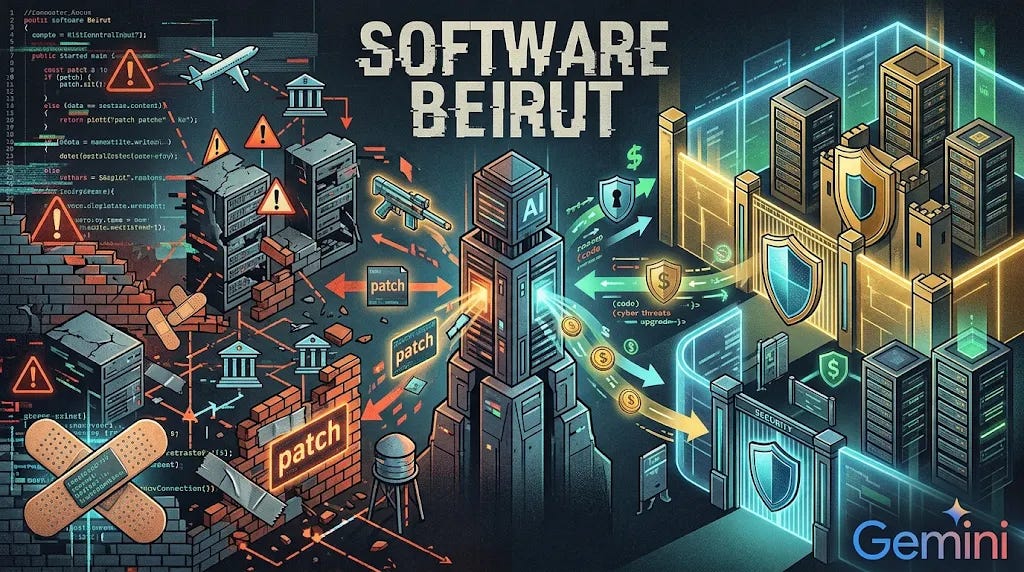
This is happening everywhere. Post a job opening, and you can be overwhelmed with thousands of AI-generated applications. You will be forced to use AI tools to screen them. Result: more work and lower-quality hiring. Likewise, we now routinely ask AI agents to patch software with vulnerabilities these same AI agents just discovered. Of course, some of these patches need patches, so rushed updates cause shit to fail at scale. Even without cyberattacks, poor upgrades have recently caused airline systems, MS Office, banks, and federal intelligence gathering to fail.
More of this is to come. Journalist Josh Tyrangiel has written an excellent book, AI for Good, that examines creative uses of AI. He calls this state of affairs “software Beirut” — a new normal of chronic, unpredictable software and infrastructure instability. Beruit refers to a state “where nothing is broken all the time, but anything might break at any time, and the main skill you need is not being surprised.” Anthropic and OpenAI sell technology to attackers and defenders alike.
Tony Soprano would understand. For him, racketeering was a simple game: he charged clients to protect them from threats he created. His goons demanded protection money from local merchants – perhaps 5-10% of their revenue. Anthropic has “our thing” (La Cosa Nostra) beat, since it not only keeps 85 cents on every dollar spent on its tokens, but, like an arms dealer, it sells to both sides in the war.
Software Beruit
AI can usher in valuable new forms of productivity. Or it can contribute to a Red Queen’s race, where each side’s spending cancels out the other’s. Individually rational expenditures produce a collectively lousy result. Participants must run hard, Alice-like, just “to keep in the same place. If you want to get somewhere else, you must run at least twice as fast as that!”
Defensive AI spending maintains our economic baseline instead of raising it. Each side's spending cancels out the other's. Individually rational outlays produce a collectively poor result — the classic prisoner's dilemma. It raises GDP without raising economic welfare. Some economists classify this sort of spending as a "regrettable necessity".
How does this end? Are we actually hardening our infrastructure – perhaps paying for deferred maintenance? Will Software Beruit become the new normal? Or will the regular collapse of trusted digital infrastructure accelerate a broader collapse of social trust?
The optimists’ case is that cheap, automated vulnerability discovery cuts both ways. Glasswing-style access (AI labs give defenders the newest models first) means that the biggest, most critical codebases can get scrubbed before attackers pounce. As code generation gets cheaper, this may be realistic. Cloud providers, browsers, operating systems, banks, and payment providers all have big budgets, big capabilities, and big incentives to harden up. We might end up with tougher, safer infrastructure.
But the risks are asymmetric. Finding a bug now takes a few minutes. But shipping the fix to the software inside a hospital’s infusion pumps, your local water system, or a router built during the Bush Administration can take years. Sometimes it is simply not possible to update devices that are too old, embedded, or reliant on some long-abandoned open-source package.
The Return of Walled Gardens
“Regrettable necessities” strengthen profitable incumbents. Security becomes a private good enjoyed behind walled gardens. As in Beirut, those who can afford protection live in gated communities. Everyone else lives with constant, low-grade breaches and much higher ambient risk and stress. Differential access to digital security deepens class divides.
Modern economies absorb fraud better than most people expect. They build spam filters and procedures to protect consumers against most credit card scams. This turns insurers into de facto private regulators. They price risk and refuse to cover what they cannot anticipate, contain, or audit. This shifts liability toward vendors, hurting the little guys and undermining social trust.
We are already learning to be suspicious. Downloading bespoke software, opening unknown files, and running unvetted plugins is like drinking water from the local creek. We have all learned the hard way to only trust curated channels.
The pace of technology diffusion will help decide how secure most infrastructure is — and public policy can speed it up. Mandatory update channels, vendor liability, and funding to rewrite critical open-source software can make a difference. And taxing the arms dealers that feed both sides of this war seems like an elementary first step.
We are very likely starting a rough decade of transition into a series of gated cities. The core of the internet will be hardened, curated, and expensive. Nobody will drink from the creek, so unverified software for anything important will disappear. Small developers who cannot afford verification and constant security updates, and users who cannot afford premium protection, will be hurt again and again. It will be a safer but far less innovative internet.
ICYMI
Peace has broken out with Denmark over Greenland.
China finds it painful to do AI without Nvidia chips. Duh.
Bankers who lend against SpaceX assets don’t want them launched.
How pensions ate France, Spain, and Italy. It’s a quarter of public spending.
Does the US actually lead China in AI diffusion? Maybe.