
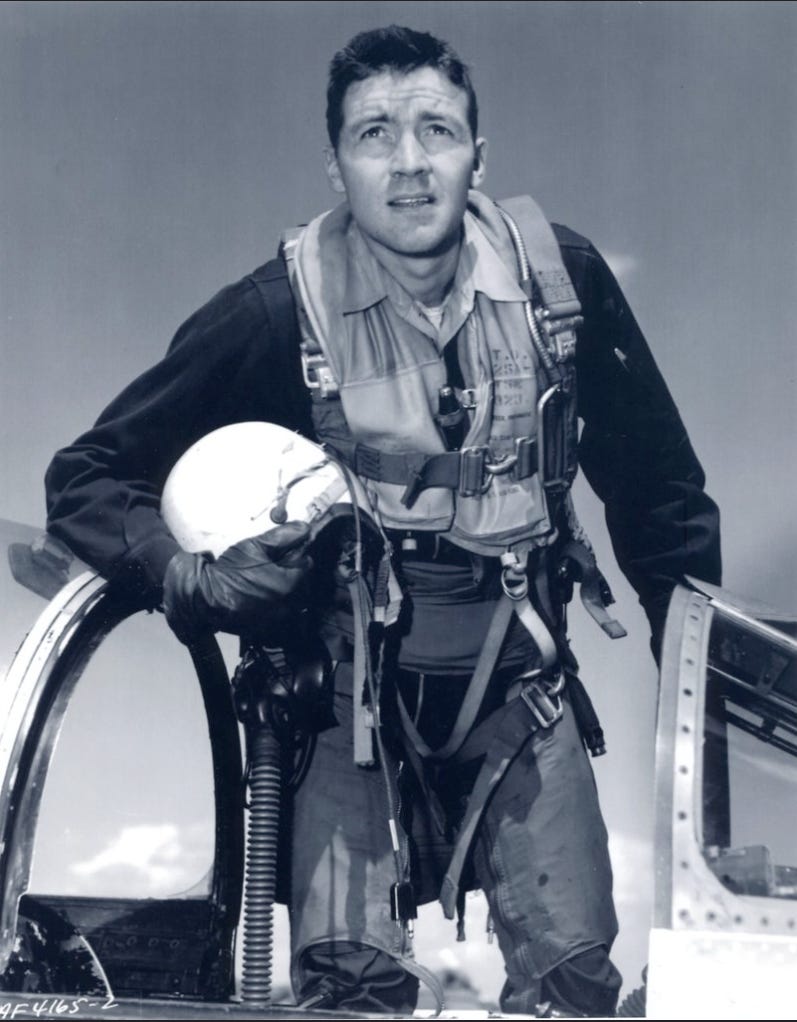
During the Korean War, U.S. Air Force Colonel John Boyd sought to understand why American F-86 pilots achieved such a lopsided kill ratio against technically superior MiG-15s. He formalized a theory of competitive decision-making that would reshape American military doctrine for a generation. He called it the OODA loop: Observe, Orient, Decide, Act.
His core insight was deceptively simple. Victory doesn’t go to the side with more firepower. It goes to the side that cycles through the decision loop faster — the side that can observe what’s changing, orient on its meaning, decide what to do, and act before the adversary has finished reorienting. Get inside your opponent’s loop, and you don’t just outpace him. You break his ability to form a coherent picture of the war he’s fighting. His framework applied to pilots in a dogfight – and to their commanders.
Two weeks into the U.S.-Iran war, the evidence is mounting that Iran has gotten inside Trump’s OODA loop. Not because Iran is stronger — it manifestly is not — but because Tehran has imposed a tempo and a logic on this conflict that Washington cannot match with the tools it is willing to use.
Reaction Replaces Initiative
The clearest sign that an adversary is inside your OODA loop is that you stop acting and start reacting. Every move you make is a response to something they just did, rather than an execution of your own plan. Your decisions are always one beat behind. By the time you’ve oriented and decided, the situation has already shifted again.
Look at the sequence of events. The U.S. launched strikes expecting to shatter Iran’s capacity and will. Iran responded not by absorbing the punishment and suing for peace, but by widening the war horizontally — attacking tankers in the Strait of Hormuz, launching drones and missiles at Gulf state infrastructure, hitting Amazon data centers, and squeezing other chokepoints that the global economy depends on. As University of Chicago political scientist Robert Pape observes, this is a textbook strategy of horizontal escalation: a weaker combatant transforming the stakes of a conflict by widening its scope.
And what has Washington done in response? Released 172 million barrels from the Strategic Petroleum Reserve. Tried to solve what it initially misdiagnosed as an insurance problem for tankers. Watched the IEA announce the largest reserve release since its founding in 1973. Each of these is a reactive measure — an attempt to manage consequences that Iran is generating faster than Washington can contain them.
The Orientation Crisis
Boyd considered orientation the most critical phase of the loop — the mental model through which you interpret reality, the framework for making sense of what you observe. When an adversary gets inside your loop, orientation is the first thing that breaks. You can no longer build an accurate picture of what’s happening because it keeps changing before you finish assembling it.
The U.S. has a severe orientation problem in this war. The administration appears to have oriented on a model in which overwhelming airpower would either compel Iranian capitulation or trigger regime change. Neither has happened. As Pape notes, the regime is doing exactly what regimes do when they survive decapitation strikes: demonstrating resilience by widening the conflict. Yesterday in Dubai:
Meanwhile, the administration’s economic orientation is equally scrambled. Trump publicly blustered that America benefits from high oil prices — a statement that reveals a fundamental misperception of the nature of the threat. As Javier Blas notes at Bloomberg, the oil market can be as savage as the bond market in twisting a politician’s arm. West Texas Intermediate is pushing toward $100 a barrel, and Brent has already breached that level. Every day the war continues adds an estimated $3 to $6 per barrel.
The White House’s breathing room is measured in days, not weeks. At $200/barrel oil prices, $8 gas, and renewed inflation, the U.S. will lead the world into a serious recession. Trump will face nightmarish midterm elections that will cost him the House and very possibly the Senate. Once his popularity hits new lows and he is a true lame duck, even impeachment could move within reach.
In any battle, orientation requires a leader to coldly assess a rapidly evolving situation. When a leader makes public statements that contradict the pressures they’re actually facing, it’s a clear sign that their orientation is broken.
The Narrowing of U.S. Options
A broken orientation doesn’t just produce bad analysis. It collapses the decision space. Instead of choosing among several good courses of action, you find yourself forced into an increasingly constrained set of increasingly bad ones.
Consider the menu of choices that Trump has now dealt himself:
Bomb more. He can continue the air campaign, but as Richard Haass argues, continued strikes will further degrade Iranian capabilities without eliminating them, while Iran continues to make the Strait of Hormuz unusable and attacks Gulf neighbors. The cost-benefit ratio continues to shift further against the U.S. with each passing day.
Hope for a new regime. Trump can hope for regime change — what some are now euphemistically calling “regime alteration.” But as Haass bluntly puts it, this qualifies as hope, not a strategy. There is no feasible military operation to bring it about; the current regime believes it is in an existential fight; and there is no organized opposition to challenge the clerics and their Republican Guard.
Declare “mission accomplished” and walk away. Trump is no doubt tempted. But this would simply mean that the war and economic turmoil continue. Shipping would never resume, and investment in the Gulf would effectively come to a halt. Trump’s problem is that although Iran had no say in how this war began, it gets a vote on how it ends.
Negotiate. Or Trump can sit down at the same diplomatic table he could have sat at before the war, only now with less leverage, a more determined adversary, and allies who are furious at the damage he has allowed Iran to inflict.
Every one of these options is worse than what Trump had available two weeks ago.
Iran’s Tempo Advantage
How has a country with a fraction of America’s military power managed to get inside the OODA loop of the world’s most powerful military? By choosing to fight an asymmetric war on a battlefield where its cycle speed is inherently faster.
In his new book, Johns Hopkins political scientist Vali Nasr makes this point incisively. Iran’s leaders are veterans of asymmetric wars in Iraq and Syria, and they are applying the same logic to a new domain. Inexpensive drones, short-range missiles, and mines setting tankers can have the same effect that IEDs had in Iraq — only with far greater strategic impact, because they disrupt global supply chains rather than just local patrol routes.
The asymmetry is critical. Iran can sustain this counteroffensive more easily and for far longer than the U.S. can sustain the economic damage. An Iranian Shahed drone made of styrofoam and powered by a motorcycle engine costs orders of magnitude less than the precision missiles sent to intercept it or the economic havoc it causes when it ignites a tanker, data center, or desalination plant. And as Blas reports, the desalination vulnerability is existential for Gulf states: Riyadh would have to evacuate within a week if the Jubail plant or its pipeline were destroyed. Iran doesn’t need to destroy it. It just needs to make the threat credible enough to keep the pressure on.
Iran doesn’t need to match American firepower. It needs to generate a tempo of consequences — economic, political, humanitarian — that outruns Washington’s ability to orient, decide, and act.
The Sunk-Cost Trap
There is a darker dimension to this OODA loop failure, and it concerns what happens next. Eurointelligence raises the troubling possibility that rather than recognizing it has fallen behind the decision cycle and recalibrating, the administration may double down — not because escalation serves strategic objectives, but because of the sunk-cost fallacy. Having incurred enormous costs, walking away means doing it all for nothing.
Boyd would have recognized this immediately. One of the pathologies of a broken OODA loop is that the decision-maker, unable to form a coherent picture of the battlefield, escalates not because the situation calls for it, but because retreating is psychologically unbearable. The loop doesn’t just slow down; it ceases to function as a rational decision-making process altogether.
The consequences ripple outward. Eurointelligence documents how the war has already shifted the Russia-Ukraine power balance, with Russian oil revenues potentially doubling and U.S. weapons stocks depleted. The longer Trump’s OODA loop stays broken, the more that second-order effects no one planned for accumulate and cascade.
Getting Back Inside Iran’s Decision Loop
Boyd’s framework isn’t just diagnostic. It’s prescriptive. The way to recover when an adversary is inside your loop is to do something they don’t expect — to break their orientation rather than continuing to feed it. Predictable escalation is exactly what Iran has planned for. Tehran wants the U.S. to keep bombing while it keeps squeezing the strait, because every day that cycle continues, the economic and political pressure builds on Washington, not on Tehran.1
Richard Haass sketches one approach to breaking the cycle: an initial standdown followed by a negotiated accord addressing nuclear materials, missile production, and proxy support, with sanctions relief as the incentive. It is, he acknowledges, imperfect. But it has the virtue of being a move that breaks Iran’s current orientation — because Tehran’s entire strategy is predicated on the assumption that Washington will keep fighting until the economic pain forces it to stop on Iran’s terms. A decision to negotiate now, from a position of demonstrated military capability rather than exhaustion, would force Iran to cycle through its own OODA loop — to observe a changed situation, reorient, and decide how to respond to an adversary that just did something unpredictable.
But here is where Boyd’s clean geometry collides with the wreckage of recent history. Iran’s new Supreme Leader, Mojtaba Khamenei, has little reason to trust any bargain with Trump, who has now burned Iran three times.
First, Trump ripped up the JCPOA — the deal Obama painstakingly negotiated with Khamenei’s father in 2018 on inspections and enrichment limits.
Then Trump bombed Iran’s nuclear facilities in the middle of negotiations last year.
This year, he attacked again – and made it personal. The younger Khamenei narrowly escaped the February 28 attack that killed his father, wife, daughter, son, and several members of his extended family. As a source in Tehran told The Atlantic‘s Karim Sadjadpour: “He’s bloodthirsty now.”
The OODA framework says the U.S. needs to do something unexpected to regain the initiative. The diplomatic record indicates that Iran has no reason to believe any American offer is genuine. Suddenly, the rational moves and the credible ones diverge. Boyd’s loop demands creative reorientation, but three rounds of broken faith have made creativity look indistinguishable from the next betrayal.
Boyd would say the first step is the hardest — admitting that your adversary, smaller, weaker, and outgunned, is winning the decision cycle. John Boyd was a fighter pilot for whom delusions were fatal. He assumed that once you recognized the problem, you had the character and credibility to reorient and act on the solution.
But political problems are not like that. Trump can remain deluded for a long time without admitting that his efforts to produce another compliant Delcy Rodriguez may leave us instead with an Iranian Kim Jong Un.
George Orwell saw this coming. In an essay called “In Front of Your Nose”, he observed,
“...we are all capable of believing things which we know to be untrue, and then, when we are finally proved wrong, impudently twisting the facts so as to show that we were right. Intellectually, it is possible to carry on this process for an indefinite time: the only check on it is that sooner or later a false belief bumps up against solid reality, usually on a battlefield.”2
ICMYI
Adults with fewer kids are buying many more children’s toys for themselves.
Americans hate food delivery robots. They crowd sidewalks, and their food is easily stolen.
Where do AI agents go to chat with each other? Moltbook, of course.
The rise of ATMs did not kill off bank tellers. But the rise of iPhones did.
Good news: initial evidence suggests that AI is better at cyber defense than offense.
Trump appears to experience this war like a person with a song stuck in their head. Based on his Truth Social post with a Vince Vance and the Valiants soundtrack, we know it’s this one.
Credits: Paul Krugman recalled the Orwell quote. And several of the essays cited in this post came to my attention thanks to News Items, a Substack published by John Ellis. Many people start their day with it. I highly recommend the practice.
Models, models, models. OODA!!
Been studying models since 1980, with multiple academic publications on *the limits of models.*
https://www.academia.edu/33494476/Models_limits_suggest_reflexivity_in_nature
OODA is naught but a way of *sequencing* some worthy (but vague) steps into a do-loop. The boundary-management (what things do you *consider*) is necessarily a source of ambiguity.
To show its bona fides, the claim here has to defend the complex transaction that it proposes. Iran 'snuck through' the membrane of the rigorous OODA loop that, of course, describes actions without predicting detailed outcomes?
What is the state of the art with models of complex phenomena. Like, oh, I don't know--an airborne military action that took out 90% of a terror-sponsor nations's military hardware within weeks?
Here's an example of the failure of common, academically accepted models of *complex phenomena.* Two psychiatrists (who have MD degree + psych) separately diagnosing the same patient have only two chances in three of coming to the same diagnosis. Add a third psychiatrist, and the likelihood that *all three* will agree--in a blind test, the gold standard for model conformance--drops to one chance in three. (Coping With Psychiatric and Psychological Testimony, Jay Ziskin)
Does an OODA loop have a permeable boundary? And, how do we know Trump is using it or even knows about it. Do OODA loops exist in the ether around human consciousness? Do they form up unbidden, whether the person at issue knows it or not? Does this hypothesis outperform the field of psychiatry, which has a one-in-three chance of identification, with a *single person* as subject matter? I think its an interesting analysis hooked to a weak hypothesis that has little predictive power.
A lot of modern wars turn on this asymmetry.
The weaker actor does not need to match force.
It only needs to generate economic, political, and infrastructural consequences faster than the stronger actor can reorient.