
“The transition from peace to war is a transition from the world of logic to the world of chance.”
— Winston Churchill
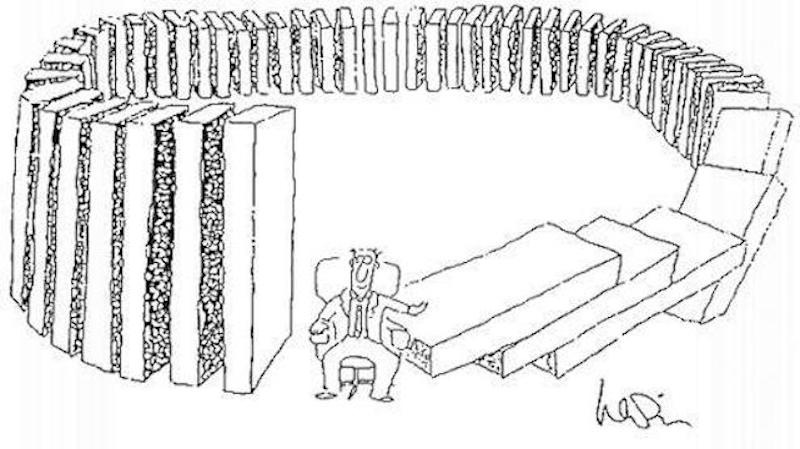
Derek Thompson recently argued that “nobody knows anything” about AI. He could just as well be discussing the US attack on Iran. Consider two surprising views that have emerged since the war began three days ago.
China?
Journalist Haviv Rettig Gur argues that the US attack on Iran is really about China, which buys 90% of Iran’s oil and was preparing to provide Iran with hypersonic missiles capable of sinking American naval vessels. Specifically
“Reports emerged in late February of a near-finalized deal to supply Iran with supersonic anti-ship cruise missiles capable of speeds exceeding Mach 3 and engineered to evade the Aegis defense systems deployed on American carrier strike groups. China was replacing Iranian government and military software with closed Chinese systems, hardening Iran against CIA and Mossad cyber operations. Joint naval exercises between China, Russia, and Iran in the Straits of Hormuz were becoming regular events, building real-time operational familiarity between the three navies. Iran had switched from the GPS system to the Chinese BeiDou system. And Iran was providing China with the port at Jask, as part of China’s “string of pearls” base system in the Indian Ocean.”
I didn’t see that coming. Is this the partisan analysis of an Israeli journalist, is someone in the CIA thinking three steps ahead, or is this just noise?
Water
Then, writing in Bloomberg, Javier Blas reminds us that 100 million people in the Gulf States are now completely dependent on 450 desalination plants for water. He observes that:
“The risk is enormous. Take the Jubail desalination plant, located on the Persian Gulf coast of Saudi Arabia. It supplies Riyadh, via a roughly 500-kilometer-long pipeline system, with more than 90% of its drinking water. “Riyadh would have to evacuate within a week if the plant, its pipelines, or associated power infrastructure were seriously damaged or destroyed,” according to a 2008 memo from the US embassy in the kingdom released by Wikileaks. “The current structure of the Saudi government could not exist without the Jubail desalination plant,” the memo stated.”
I didn’t see that coming. Is this fear-mongering, or will Geneva Convention prohibitions against attacks on water infrastructure restrain Iran? Iran has already attacked a power station in the UAE that keeps a desalination plant running. Targeting these plants could put Persian Gulf countries in an impossible situation and make water potentially a bigger geopolitical commodity in the conflict than oil.
During the coming weeks, we will see some predictable results of a feckless war. Oil prices will rise. Democrats will complain about the process. Innocent people, especially vulnerable ones, will suffer and die. Migrants will flee to Europe and trigger the usual backlash.
But even more things will happen that most of us cannot anticipate. Or as Clement Attlee, who followed Churchill into Number 10 Downing, put it, “No one can say that he has the slightest idea what the consequences of a war will be. It is like a great building that is being pulled down. You don’t know where the pieces will fall.”
ICYMI
As Cheap Chinese EVs come to Canada, the Big Three are writing off more than $50 billion in EV investments -- a third of their combined market cap. The NYT thinks they may end up niche suppliers of gas engines.
Which Democrat has the most electable track record? Hint: Not Gavin Newsom.
The economic case for free buses paid for by taxes on parking.
The late Jessie Jackson does a very effective parody of himself on SNL.