
As the Great Financial Crisis descended in 2009, Peter Thiel gave up on democracy. The PayPal multimillionaire and first investor in Facebook declared democracy “incompatible with freedom”. By freedom, Thiel meant freedom from government rules and taxes. His notorious essay blamed his libertarian woes on the extension of voting rights to women and welfare beneficiaries.
In his own imperious way, Thiel was highlighting a real dilemma. In most economies, a small group of highly paid people earns much more than folks in the middle. In the US, those who earn $450,000 or more per year (the top 1%) take home 15% of all pay. This share has doubled since 1979. The top 10% ($200,000 and up) receive 40% of all pay. Economists say that income skews right – and wealth famously skews even further right than income.
As a result, median (midpoint) incomes are lower than mean (average) incomes. A handful of professional athletes, rock stars, or senior law partners making $25 million/year raised the average 2024 pay for a full-time US worker to $84,603, but this had little effect on the median income of $65,000. Obviously, the gap between mean and median incomes widens as high earners capture more of the income pool.
How much does this matter? One view says it’s irrelevant because high earners are not a club with a permanent membership. There is a lot of churn, especially at the very top. The vast majority of people who reach the top 1% or the top 10% of income earners do not stay there for long. Research by Thomas Hirschl and Mark Rank found that more than 53% of American workers spend at least one year in the top 10% of income earners over their working lives, but fewer than .6% of Americans manage to stay in the top 10% for ten consecutive years.
More than 53% of American workers spend at least one year in the top 10% of income earners over their working lives.
On the other hand, the top 20% churns at a much lower rate. Economists Gerald Auten and Geoffrey Gee found that two-thirds of taxpayers who reached the top 1% were out within a decade. But they did not fall far. Nearly 70% of those who reached the top 1% remained in the top 10% two decades later, and about 70% of those in the top quintile remained there a decade later. The Federal Reserve found similar results using more recent data. So although membership in the very top income bracket is often fleeting, the US manages to produce a class of affluent, professional-income households that is durable enough to form stable political interests.
This group now controls the Democratic party.
Does Democracy Hurt High-Income Voters?
In a democracy, median voters decide elections. This means that voters in a country with a large gap between median and mean incomes have an incentive to elect politicians who will tax the rich and use public services, infrastructure, or direct transfers to redistribute wealth downward. This is less true if income is shaped like a bell curve, in which median and mean incomes converge.
Peter Thiel is not the only high-earner who assumes that democracy shifts political power towards poorer voters, leading to higher taxation of income, if not wealth. Scholars have long theorized that for this reason, economic elites have a rational incentive to suppress democracy to protect their capital.1
But is it true? Does democracy actually expose economic elites to the risk of redistribution via higher taxes, weaker property protections, or more competition? If it were true, then assets held by high earners should lose value as a country becomes more democratic or as democratization becomes more likely. Markets will price in the risk of future redistribution, so researchers should be able to use asset prices to test Acemoglu and Robinson’s highly influential theory that elites use democracy to avert revolution by shifting legal power to median voters.
Recent research by Max Miller at Harvard Business School tested this. He found that democracy really is more expensive for high earners. He matched stock market data on equity returns from 90 countries from 1817 to 2018 against a database of regime transformations to identify “democratic episodes”. He exploited the Vatican II endorsement of democracy as a shock to Catholic autocracies, and used an instrumental-variables approach with “waves” of democratization to build a theoretical model to interpret the magnitudes.2
Miller found that markets treat democratization as equivalent to a financial crisis – meaning investors demand a much higher risk premium to compensate for the risk of future redistribution. Dividend yields typically rose about 20% in the five years before a country democratizes. Neither coups nor political crisis produced as big a reaction as the threat of democratization. Catholic-majority autocracies saw excess stock returns fall by roughly 6–11 percentage points after papal pronouncements during Vatican II simply raised the odds of democratization.
Were markets rational or just gripped by fear? Maybe both. Miller shows that democratization led to real redistribution: the government's share of GDP rose by about 4.8 points, the Gini coefficient fell by about 2.3 points, and labor’s income share rose by about 6.7 points. This suggests that investors’ fears were rational, not just sentimental. Miller’s analysis suggests that most (~58%) of the risk premium was due to taxes and redistribution. The rest was due to increased competition that eroded government-protected rents.
This is not surprising, but why does it matter? Because the world’s oldest democracy has come to rest on two parties, one increasingly authoritarian and the other built to serve the interests of high-income voters. This is unsustainable, and it matters enormously.
When Did Democrats Become the Party of High-Income Professionals?
Before the 1980s, the Democratic coalition remained grounded in the New Deal and was recognizably working- and middle-class. Its backbone was non-college-educated white voters, who made up two-thirds of Democrats as recently as 2016. The big tent held unionized factory workers, urban ethnic minorities, Southern Dixiecrats, and Prairie populists. Money came from private sector union PACs, individuals, and traditional liberal donors.
During the 1980s, deindustrialization and globalization shrank the unionized manufacturing workforce that anchored the Democratic coalition (and progressive coalitions in Europe and Canada as well). At the same time, the expansion of higher education created many more college-educated professionals.
This educated population was not homogeneous. One group of grads, consisting of teachers, journalists, nonprofit workers, and government workers, was more hostile to the private sector, more female, and more unionized. They moved steadily left. College-educated business and technical professionals remained more moderate as a group. Over time, this branch of the party became anti-business and placed increasing emphasis on cultural and social issues. This made the party more attractive to educated professionals and donors – and less visibly working-class in its economic and cultural identity.
Like a Hemingway character going bankrupt, this transition was gradual, then sudden. In 2008, 36% of Republican white voters were college-educated, compared with 32% of Democratic voters. By 2020, 52% of white Democrats were college-educated – a 20-point swing in twelve years. By then, college-educated whites outnumbered non-college whites among Democrats for the first time (remember, only 40% of Americans have a four-year college degree). According to Pew, white non-college voters now make up 57% of the Republican coalition, while Democrats increasingly rely on college grads. The gap is especially pronounced among women.
Ruy Teixeira, whose 2002 book with John Judis, “The Emerging Democratic Majority”, predicted growing Democratic strength, has become one of the most prominent critics of this trend. He points out that the education gap between college and non-college Democrats hit 27 points in 2024, more than double its 2016 level when Trump beat Hillary Clinton. French scholar Thomas Piketty coined the term “Brahmin Left” to describe progressive parties around the world that college graduates dominate.
Political fundraising reinforced this trend. As union density fell, labor PAC money dried up, especially from unions representing private-sector workers. Wealthy donors from Wall St., Silicon Valley, and Hollywood – and the law firms they spawned – took their place. The Supreme Court’s Citizens United decision removed limits on most PAC spending, which accelerated this trend. About 20 million people contribute money to campaigns, but 12 megadonors accounted for 7.5% of all federal political contributions between 2009 and 2020. Roughly 20% originated from less than 1% of the population living in the top 100 highest-giving U.S. ZIP codes.
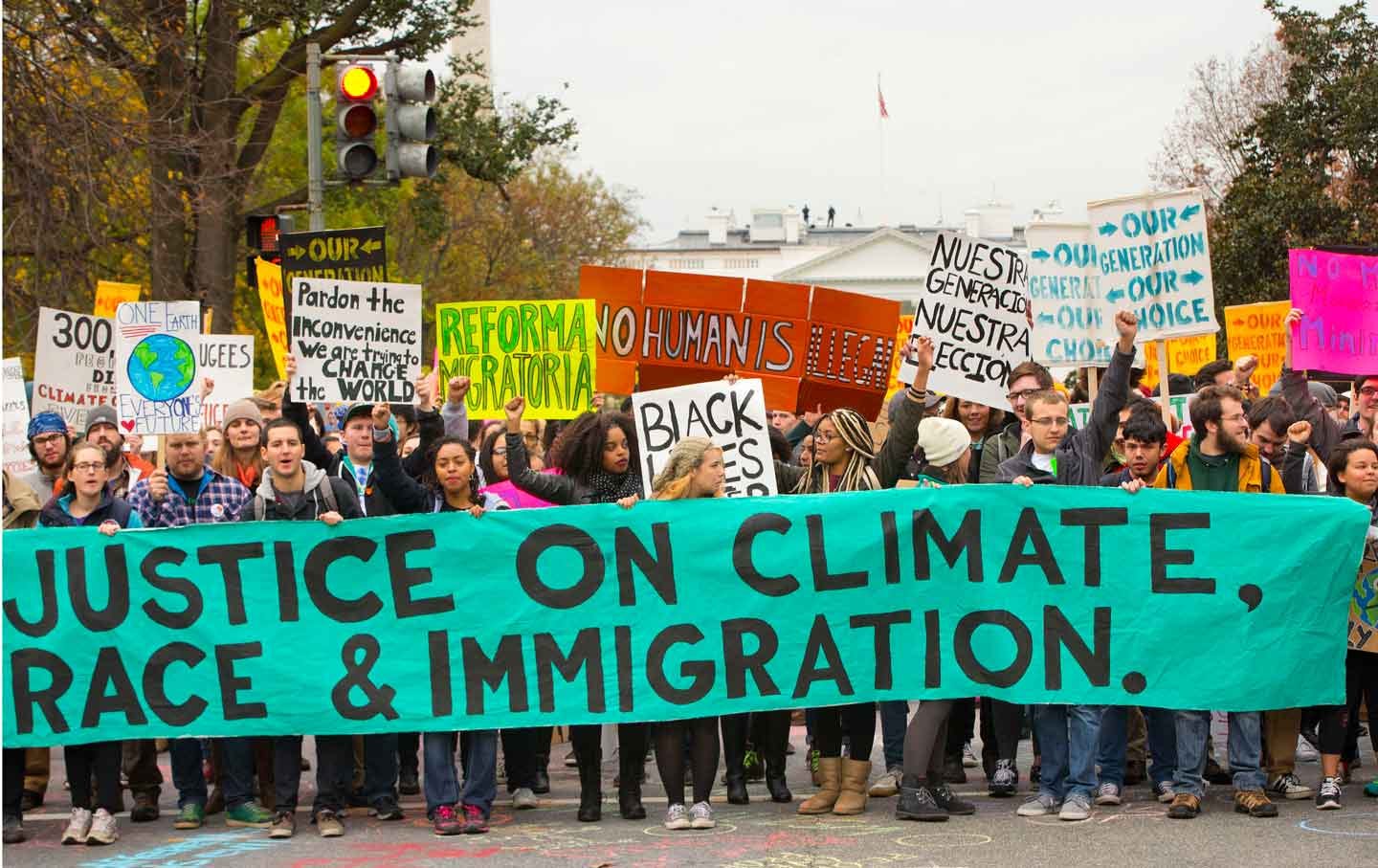
Even the party’s small-dollar donor base, which Democrats often present as a counterweight to megadonors, skews “wealthier, more educated, older, and whiter than the average American”, according to Brookings. This ideologically energized small donor class has pulled Democratic legislators much further left on racial, immigration, transgender, and climate issues and further disconnected them from working-class and non-white voters.
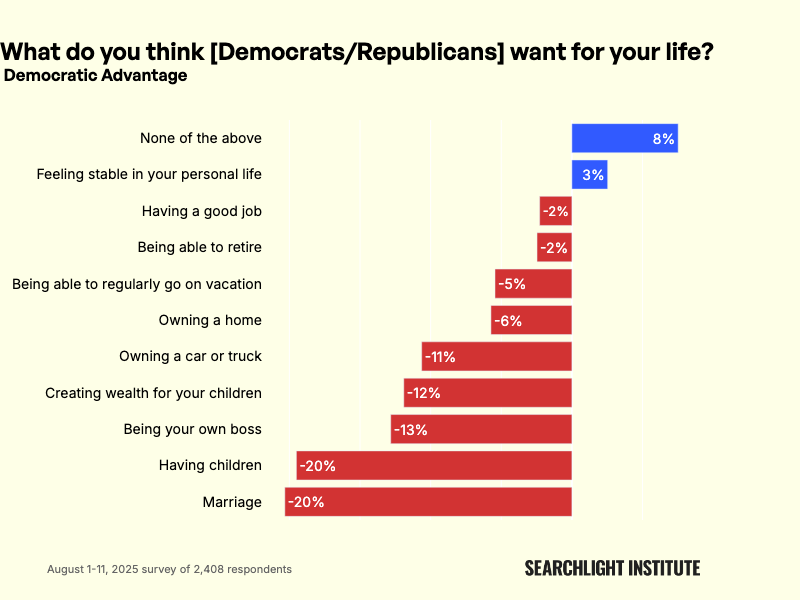
Compare this with how well non-college voters believe that Democrats speak to their actual priorities.
Democrats Have Drifted Away from Redistribution
A party reveals its priorities not in its slogans but in its spending and actions. Democrats still favor redistribution, but the party’s attention has drifted elsewhere. Political scientists tracking Democratic platform language since 2012 find that references to “growth” have dropped 32%, while “climate,” “LGBT/LGBTQI+,” “equity,” and “environmental justice” each rose by triple-digit percentages.
Modern Democrats have a different relationship to redistribution than their predecessors. The wealth of many college-educated professionals lie in credentials, skills, experiences, and networks of professional relationships. These assets are largely insulated from the threat of income redistribution because it is portable across state lines, industries, and national borders. No state can easily seize, tax, or redistribute what is inside a software engineer or an attorney’s head.
One telling indication of this is the growing number of US college grads who have moved overseas. Although a small share of the total population (5.5 million Americans were living abroad as of late 2024), this number is growing quickly.3
In 2025, 2.2 million people left the US, and 180,000 of them were US citizens – the first time America experienced a net loss of citizens since the Depression.
A 2026 survey indicates that serious intent to relocate internationally has quadrupled year-over -year. Nearly every state in the European Union reports record numbers of Americans arriving to live and work.
Over 90% of Americans living abroad have at least a bachelor’s degree. They are not mostly retirees: mid-career professionals aged 35 to 54 account for 41% of overseas Americans and are the fastest-growing group of emigres.
Renunciations of citizenship have skyrocketed. The US Treasury reports 30,000 people are now in line for renunciation appointments. Gallup reports that serious intent to relocate quadrupled from 2025 to 2026, especially among women.
In contrast, the conservative “Merchant Right” is much more likely to attract owners of auto dealerships, regional contractors and developers, and businesses that depend on resource extraction. These companies rely on fixed physical assets and local regulatory capture. They are highly vulnerable to taxation and redistribution because they cannot move to Portugal.
The Case For Predistribution
So-called “predistribution” policies have very different economics from traditional redistribution. The difference is when and how the state intervenes to address inequality. Traditional redistribution accepts the existing division of profits between capital and labor and taxes economic winners to compensate losers. Predistribution directly challenges the labor/capital division by seeking to increase labor’s bargaining power so workers capture a larger share of corporate revenues upfront.
Redistribution and predistribution rely on very different policy mechanisms.
Predistribution policies include steps like raising minimum wages, strengthening collective bargaining rights, reforming corporate governance (e.g., codetermination or tying executive pay to workers’ pay). It also includes antitrust enforcement and investments in public education and skills training.
Redistribution policies rely on fiscal policy. Its tools include progressive income and wealth taxes, universal basic income (UBI), food assistance, housing subsidies, and state-funded healthcare.
Both redistribution and predistribution policies aim to create a more equitable society, but they rely on fundamentally different economic mechanisms and carry very different political implications.
Ex post vs. ex ante. Redistribution is a two-step process. It allows the market to allocate income and wealth according to its own logic then uses taxes and transfers to correct inequalities ex post, or after the fact. Predistribution intervenes in market rules to ensure a fair distribution of wealth before taxes and transfers. It aims to fix the market ex ante so that it naturally produces more equitable outcomes.
Economic visibility. Redistribution is highly visible. Taxpayers can see money leave their paychecks – and it often generates political resentment. But predistributive policies are embedded in the “rules of the game.” When a worker earns a higher wage due to strong collective bargaining or minimum wage laws, they view it as earned income rather than a government handout. It is much less susceptible to the political stigma associated with welfare.
Agency. Many voters see redistribution as paternalistic. They resent their taxes being used to “pay losers”. In contrast, predistribution is typically seen in terms of power and dignity, as when laws strengthen unions or democratize ownership.
Political difficulty. Predistribution is often a heavier lift because it is less flexible. A government can tweak a tax bracket or expand a tax credit in a single bill. Still, predistribution often requires taking on entrenched financial interests to reform labor laws or break up powerful monopolies.
Acemoglu and Robinson asserted that elites suppress democracy to protect their capital. Miller showed that historically they have had good reason to do so. But the modern Democratic Party has found a way to avoid the challenge of redistribution completely: it simply changes the subject from class conflict to cultural progressivism. This enables the high-earning coalition to protect its economic privilege, neutralize the threat of redistribution, and maintain the moral high ground.
Not surprisingly, the Brahmin left has given up entirely on predistribution, even though, unlike the asset-bound “Merchant Right”, they have little to fear from the redistribution they nominally still promise. By changing the subject, Democrats have not just insulated their affluent base from the threat of redistribution; they have built a coalition willing to leave working-class voters to fend for themselves.
ICYMI
Los Angeles bans AI in schools. For students, not for teachers.
The college wage premium has fallen for four straight years….
…as the supply of college grads also levels off. Hmmm.
The estimable Charlie Cook thinks Republicans are screwed in November.
OpenAI says that it has achieved Artificial General Intelligence. Is that why everyone is quitting?
JD Vance confirms his love for Tucker Carlson. Remember this.
Tyler Austin Harper’s “Why I Quit the Tenure Track” is a very good, if painful, read.
Two foundational books published in the early 2000s cemented this theory, using it to explain why some nations successfully democratize while others succumb to authoritarianism or military coups. Carles Boix Democracy and Redistribution (2003) argued that democracy succeeds when wealth is already somewhat equal or when capital is highly mobile. If elite wealth is tied up in finance rather than land, they can move their assets abroad if threatened by taxation, making democracy less risky to concede.
In 2006, Daron Acemoglu & James A. Robinson published Economic Origins of Dictatorship and Democracy, which argued that democratization is driven by class conflict and elites will only concede to democracy if the threat of violent revolution is high and the cost of violently repressing the masses exceeds the cost of democratic redistribution.
I did not and cannot track the 50 pages of math describing the model, but Claude pronounced it “genuinely creative”. The AI noted (as did the author) the problem of selection bias: the model depends on an active stock market, so the sample tilts toward countries with elite-driven, capital-owning classes. It likely undersells or misses left-wing/labor-driven authoritarian transitions or communist-state cases where there’s no comparable equity market to observe. And even showing that risk premia rise and redistribution follows democratizing events is still an inference, not a testable, controlled observation.
The Federal Voting Assistance Program put the overseas civilian population at roughly 4.4 million in 2022, using a narrower definition that excludes some categories of citizens abroad.
I'm curious about how you would characterize eliminating the preferential tax rates for returns to capital (both capital gains and dividends) and taxing that income at the same rate as salaries and wages? Would that be predistribution or redistribution?
Also, although I may be misinterpreting it, your essay seems to suggest that highly educated US elites are moving overseas in response to concerns about income redistribution. Given the time frame of your data (2025-2026) this seems implausible given the anti-redistribution policies of the party in control of the US government during this time. It seems more likely that those moving overseas are either: (1) hoping for lower living costs, or (2) giving up on a country that seems to be drifting inexorably into authoritarian kakistocracy. I'd be interested to know if there are data that might better illuminate the motivations behind growing emigration from the US.