
This summer, Democrats approved changes to the 2028 primary calendar that will shape their presidential nominee. The biggest changes are:
No More Iowa Caucus. The new calendar removes early-state caucuses that rewarded party activists. Caucuses in Iowa and, to a lesser extent, Nevada rewarded candidates who could mobilize activists to spend months building local county and precinct organizations.
Caucuses did this because turnout was so low and so predictable that campaign operatives fine-tuned outreach to an insane degree. Bernie Sanders famously ran Iowa operations that targeted about 170,000 known caucus-goers in a state of 3 million people. They knew the names, addresses, emails, and phone numbers of every caucus attendee and whether they would vote for them.
The Iowa caucuses were never representative, but they did enable obscure candidates like Jimmy Carter and Barack Obama to build national momentum. It also helped to nominate George McGovern, a fine man who lost 49 states to Richard Nixon. And caucus warfare did real damage to the candidacies of Walter Mondale and Hillary Clinton.
I watched Iowa beclown itself with operating failures in 2020. As a result, Iowa will no longer vote early. Instead, the race for the Democratic nomination kicks off on Saturday, January 22, with a primary in South Carolina.
Candidates start their campaigns with a less liberal electorate. Nationwide, about 47% of Democrats identify as “liberal” (this includes voters who identify as “very liberal”). But in the four states that hold the crucial early primaries (Iowa, New Hampshire, South Carolina, and Nevada), 61% of voters identified as liberal.
The new calendar changes this. Six states will hold primaries before Super Tuesday. In these six early states, 53.5% of voters identify as liberal – a 7.5% drop from 2020. In 2028, Democrats will hold one primary per week, starting in South Carolina on January 22. Nevada votes on Tuesday, February 1, followed by New Hampshire a week later, then New Mexico, Michigan, and Virginia on successive Tuesdays. A week after Virginia, at least 15 states will hold their primaries on Super Tuesday, March 7.
The early primaries are now much more representative. With New Mexico, Michigan, and Virginia voting before Super Tuesday, early-voting states now include about 23 million eligible voters, compared with 9.4 million in the four states that voted before Super Tuesday in 2020.
A Greater Role For Independents
The Independent Voter Project estimates that the US has 83 million Democrats and 63 million independents. (They need to estimate because some states don’t keep score.) All six early voting states will allow independents to vote in the Democratic primary.1
As a group, independent voters vote to the right of most Democratic party activists, but they are not more centrist on every issue.2 In the recent midterm, independents rewarded progressive, moderate, and conservative candidates who ran as anti-Washington populists and affordability-focused pragmatists who were culturally mainstream. The new calendar helps independents by providing:
Broader participation. Removing caucuses in Iowa and Nevada, which attracted only 7.5% and 4.8% of eligible voters, will dramatically expand participation. (It turns out that spending several hours and multiple ballots trying to hustle your neighbors’ votes in a freezing, smelly high school gym is not everyone’s idea of fun). Moreover, in 2028, five of the six early states will offer early in-person voting, up from one in 2020. All six will allow mail or absentee voting, so voters who are not partisan politics junkies are much more likely to participate.
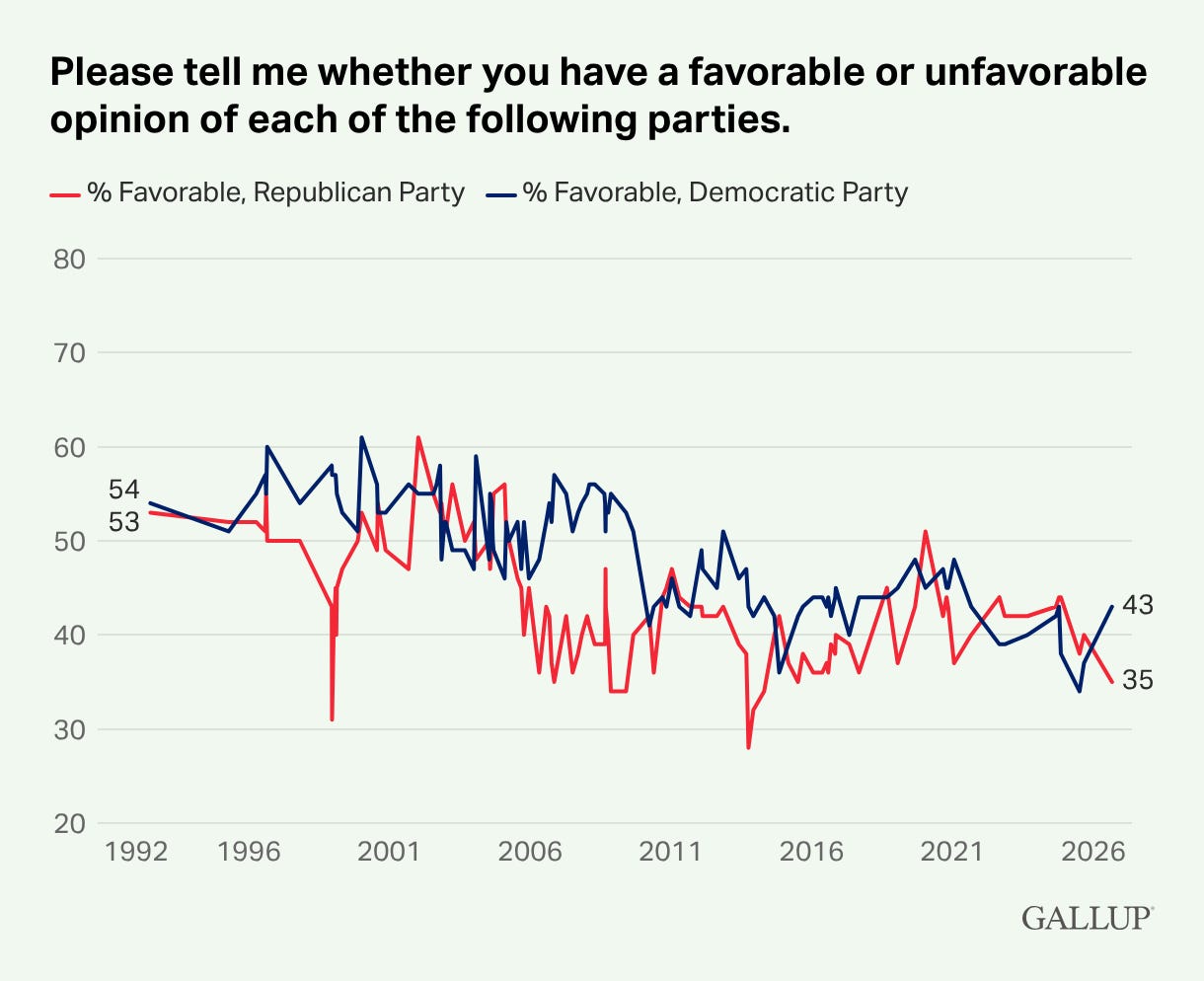
Independent voters can reshape primaries, especially when voters are not broadly attracted to either party. Gallup consistently finds that they are not.
In New Hampshire in 2020, 130,738 undeclared voters requested Democratic ballots – making independents almost 44% of the electorate. Many voted late, and Amy Klobuchar’s late third-place finish came mainly from late deciders. Michigan’s 2026 primary also drew about 600,000 more voters than 2024, with 28% having skipped the previous two primaries – and they nominated progressive Abdul El-Sayed.
Less room for partisan activists. About 23 million people will be eligible to vote in the 2028 early states, compared with 9.4 million in 2020. Michigan and Virginia each produced more Democratic primary voters in 2020 than the four early states combined. A bigger pool of voters diminishes the influence of a small band of partisans and expands the influence of paid, unpaid, and social media.
More time. Finally, the calendar is 16 days longer. This gives late-deciding voters, who skew independent, more time to react to early results.
Which Candidates Do These Changes Favor?
The changed calendar and a bigger role for Independents do not automatically help moderates because independent voters are not always more moderate than registered Democrats. About 47% of independents call themselves moderates, but they backed Bernie Sanders heavily in past primaries and have responded strongly to anti-establishment candidates like El-Sayed.
An independent voter can only vote in one party’s primary per election—never both. Independents voted in many Democratic primaries in 2020, but in 2028 they will help decide which candidates build momentum in the six early states. With no incumbent running for re-election in either party, it is difficult to project how many independents will turn out for either primary.
Independents who choose to vote in Democratic primaries skew younger and more liberal. But independents can also vote in most Republican primaries. And even though Democrats no longer plan to hold the first contest in Iowa, Republicans did not change, so the two parties will likely hold their primary elections on different days.
So who do the new rules help?
Candidates with name recognition. Because independents are often less engaged, and because Michigan and Virginia are large states, many analysts consider them to be more sensitive to name recognition. Pete Buttigieg may be rewarded for his work in Michigan and his many Fox News appearances. Currently, Kamala Harris and Gavin Newsom both enjoy high name recognition, as does Jon Ossoff. When name recognition matters more, so does fundraising.
Governors. Many independents vote based on issue salience, candidate trustworthiness, and perceived competence more than on specific policy positions. This tends to favor governors over legislators, since they can point to specific achievements, not just policy views. This helps Andy Beshear, Wes Moore, Gavin Newsom, JB Pritzker, and Josh Shapiro.
Candidates able to win young, moderate, and swing voters. The new calendar punishes candidates with a small, intense base in a few states and rewards candidates who appeal across factions and generations. Jon Ossoff’s strong performance in Georgia during the November midterms positioned him as a Democrat who can win in a critical southern swing state. This is the main reason that he has surged to the front of early prediction markets. He leads both Polymarket and Kalshi at 26-27%. AOC and Newsom are second and third. He is also benefiting from volunteer-led “Draft Ossoff” initiatives and favorable early polling.
Of course, presidential predictions will produce plenty of fools between now and the 2028 primaries. Even well-constructed polls are notoriously unreliable in primary elections. Recall that this summer in Michigan and Wisconsin, pollsters overstated progressive margins as late deciders and a shifting field moved the races.
Michigan polls predicted that El-Sayed would trounce Haley Stevens. The final five Senate primary polls showed Abdul El-Sayed leading Haley Stevens by 10, 13, 14, 15, and 16 points. He won by less than one point. An analysis of voter files showed that 29% of Democratic primary voters hadn’t voted in either the 2022 or 2024 primary.
Wisconsin polls showed Fran Hong winning by double digits. The final five Wisconsin gubernatorial primary polls showed Democratic Socialist Fran Hong leading David Crowley by 11, 13, 18, 20, and 22 points. She lost.
Successful Democrats Will Embrace Independent Voters
At a time when the popularity of the Democratic Party brand is as radioactive as the Republican one, Democrats should embrace and even imitate independents.
Successful candidates will reject party orthodoxies when necessary and not rely on Trump’s corruption and incompetence to carry them forward. Successful Democrats should create “Sister Souljah” moments to:
Denounce education policies that serve organized teachers more than students;
Use “affordability” to mean “higher real incomes”, not only “cheaper stuff”;
Promote patriotism over fashionable, urban, college-educated cynicism’
Reject tax policies that pretend that “taxing billionaires” will resolve chronic deficit spending; and
Learn from and support Ukraine to stop Russia and thoroughly reform and modernize our own warfighting capability.3
It is not sufficient for Democrats to resist destructive, pronoun-obsessed, land-acknowledging, BIPOC/Latinx cultural memes that originate in the leafier neighborhoods of Oakland and Brooklyn.
To become a mainstream party that can govern for multiple generations and not simply play ping-pong with American voters every four years, Democrats should embrace affordability-focused economic populism, political pragmatism, and the mainstream cultural values of independent voters. In many cases, they will need to run against the Democratic Party.
ICYMI
WSJ: Jensen Huang actively subverted US export controls.
NYT: Governments everywhere are struggling with debt.
Friedman: The Saudis bow to Houthis.
FT: Ukraine took out the damned Crimean Bridge. Without Starlink.
WSJ: Rayon shortages gate Patriot missile output. It’s very complicated.
South Carolina, Michigan and Virginia have no party registration at all. New Hampshire and New Mexico let unaffiliated voters pick a Democratic ballot. Nevada requires Democratic registration, but voters can sign up as Democrats on Election Day.
Independent voters are less independent than the label suggests, but not as partisan as cynics claim. Gallup reports that a record 45% of US adults and 56% of young people identified as political independents in 2025. Democrats and Republicans each drew 27%. Three important observations.
Most independents either lean or stay on the sidelines. The classic argument in John Petrocik’s The Myth of the Independent Voter is that most independents are “closet partisans.” Most pick a side. Gallup counts 47% of Americans as Democrats or Democratic leaners and 42% as Republicans or Republican leaners. The nonpartisan share has stayed under 10% since Pew started tracking in 1994 and, in many cases, nonpartisan means disinterested and unlikely to vote.
Leaners are not clones of party members. On immigration, for example, independents on both sides view immigrants more positively than partisan identifiers do. Brookings has also noted that independents shift more than partisans in many races, so they can swing. A leaner with a weak attachment is easier to move than a card-carrying partisan.
Independence is mostly an identity. It’s a way of saying “I don’t like the parties,” and it is growing, even if truly unattached voters are few in number and the least likely to show up.
During his 1992 presidential campaign, Bill Clinton spoke at a conference hosted by Jesse Jackson’s Rainbow Coalition. The night before, hip-hop artist and activist Sister Souljah had spoken at the same event. Weeks earlier, in a Washington Post interview following the Los Angeles riots, she had remarked: “If Black people kill Black people every day, why not have a week and kill white people?”
Standing beside Jackson, Clinton condemned her remarks, comparing them to the rhetoric of former KKK Grand Wizard David Duke: “If you took the words ‘white’ and ‘Black’ and you reversed them, you might think David Duke was giving that speech.”
Today, a Sister Souljah moment occurs when a candidate publicly repudiates a member of the candidate’s own party or coalition and signals ideological independence and moderation to independent voters, even at the risk of alienating a segment of the party's base. To Jackson’s eternal irritation, it worked very well for Bill Clinton.