
“I am not a member of any organized political party. I am a Democrat.”
— Will Rogers
Republican mid-cycle gerrymandering has handed the GOP roughly a three-point structural advantage in House races this November. It must drive Donald Trump crazy that this won’t be nearly enough. Popular revulsion at the daily cost of his incompetence and lavish corruption has overwhelmed his efforts to redraw district lines. Whether you trust polls, models, or prediction markets, Democrats are heavy favorites to retake the House later this year.
The Senate is the harder prize and the more valuable one because it controls several constitutional checks that the House does not.
Confirmation power. Only the Senate confirms lifetime judges. It confirms cabinet secretaries and the heads of regulatory agencies, which the Supreme Court has now made far easier for the President to fire and replace at will.
Committee gavels. The majority party runs the committees. Chairs control the budget, decide which bills get a hearing, and wield subpoena power to investigate the executive branch or private companies.
Budget reconciliation. The majority controls budget reconciliation, the tool that can pass certain tax, spending, and debt-limit bills with 51 votes, thus avoiding the filibuster. (The majority can also rewrite Senate rules, including the filibuster.)
Fifty-three seats are Republican today. To reach 51, Democrats need to flip four seats without losing any of their own. The electoral arithmetic makes winning the Senate possible — but it takes a functioning party to get there.
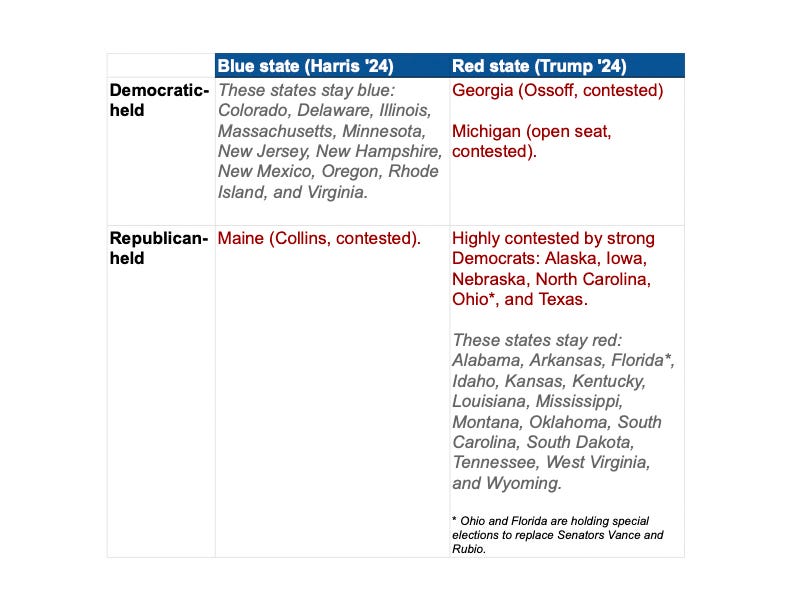
The 2026 Senate Grid
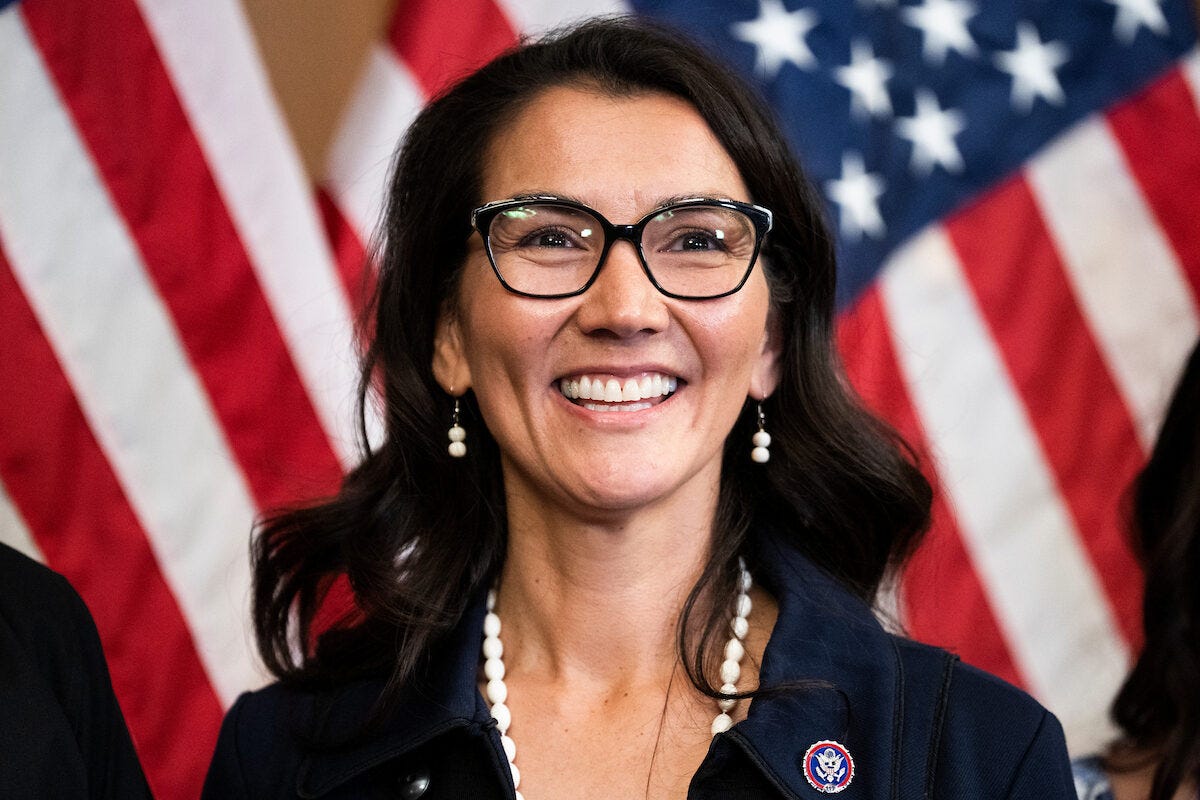
Alaska: Mary Peltola. Peltola served in the US House from 2022 to 2025 on an Alaska-first platform built around “fish, family, and freedom”. She served in the Alaska House from 1999 to 2009 and spent years in commercial fishing before that. She is Yup’ik, the first Alaska Native ever elected to Congress.
Trump carried Alaska by 13 points in 2024, and Peltola is running even with or slightly ahead of Republican incumbent Dan Sullivan. The often-maligned Chuck Schumer deserves credit for talking her into this race when a run for governor would have been the easier path. Take a look.
Iowa: Josh Turek. Another state Trump won by 13. Schumer could not land Iowa’s strongest Democrat, Rob Sand, who is running for governor. So Democrats have Josh Turek, a gold-medal Paralympic basketball player who holds a red district in the statehouse and won the Democratic primary. He faces Republican Ashley Hinson. His numbers are close, his campaign is smart, and having Sand at the top of the ticket may help him “push harder for change”.
Nebraska: Dan Osborn. This state is as red as California is blue – Trump won by more than 20 points. Democrats ran a candidate committed to dropping out to back independent Dan Osborn. Osborn is a veteran and former union leader who lost a 2024 Senate bid by fewer than 7 points. He’s a long shot against former governor Pete Ricketts, but he is a hell of a candidate and worth every minute of your attention.
North Carolina: Roy Cooper. Democrats put their best foot forward here. The seat opened when Republican Thom Tillis voted against the Big Beautiful Bill and, dreading Trump’s revenge, decided not to run for reelection. Republicans nominated a lightweight in Michael Whatley, and Schumer convinced the popular former governor, Roy Cooper, to run. He leads decisively — and like most candidates, he speaks to local issues first and Trump a distant second, if at all.
Ohio: Sherrod Brown. Brown served three terms as a progressive senator before Bernie Moreno narrowly defeated him in 2024. When Vance became vice president, Governor DeWine appointed Jon Husted to the seat, and Brown is running to reclaim it. His populist playbook is a bit dusty, but Brown is winning in the polls. Not a lock, but a real shot.
Texas: James Talarico. Democrats nominated Talarico, every progressive’s favorite Christian, and he is running a smart race. He wants all-of-the-above energy, and an end to Trump’s war on renewables, which is a knife in the back of the state that leads the nation in green energy production. Talarico is making inroads with Hispanic voters in South Texas — and this grocery-store ad has 8.5 million views.
The race in Texas got interesting when, with Trump’s last-minute blessing, Ken Paxton knocked off incumbent John Cornyn by more than 25 points. This is a gift to Democrats because Paxton is a legendary sleazeball and a much weaker general-election candidate. This is a man who faced 20 impeachment counts for securities fraud, bribery, abuse of public trust, whistleblower retaliation, and obstruction, all as the sitting Attorney General. But Texas is still Texas, and the money sent on this campaign will be obscene. Polls are tied, but prediction markets Polymarket and Kalshi heavily favor Paxton to beat Talarico.
Missed layups.
Harris carried Maine by seven points and lost Michigan by a whisker. Both should be Democratic seats, but instead, they’re a mess.
Maine: Graham Platner. Maine has a deep Democratic bench. Hannah Pingree carries a strong coalition and high favorability. Shenna Bellows has name recognition and a grassroots network from an earlier Senate run. Nirav Shah ran the Maine CDC to statewide acclaim. The obvious heavyweight, though, was Governor Janet Mills, and the party establishment lined up behind her. But she entered late, could not raise the money or generate much enthusiasm, and suspended her campaign in April.
That cleared the lane for Graham Platner, who won the June primary going away. Platner is an Iraq and Afghanistan Marine vet and an oyster farmer, and he may yet win. But he is spending his days explaining a tattoo critics tie to an SS symbol, a trove of ugly deleted Reddit posts, and reports of sketchy texts to other women that surfaced through his own wife. He is facing Susan Collins, who is slippery, skilled, and always outruns her polls. This race should have been a runaway. Instead, Democrats are doing it the hard way. Here is Plattner’s launch video:
Michigan: tbd. This is a political snafu, in the military sense: Situation Normal, All Fugged Up. Governor Gretchen Whitmer, who is both popular and term-limited, could have taken the nomination and the seat without breaking a sweat. Michigan should have been North Carolina: Democrats recruit a popular governor, run a clean primary, and win a Trump state by fifteen. Instead, a talented but DSA-curious public health doctor named Abdul El-Sayed leads the primary, running on Gaza and thin distinctions between his two more moderate rivals.
If he wins the August primary, El-Sayed may struggle to gain the support of independents, Reagan Democrats, and anti-MAGA Republicans that a Michigan Democrat must earn to carry the state. This is not Mamdani running leftists in New York districts with a twenty-point Democratic cushion. Michigan is a state Trump won. Nominating a candidate built for the bluest voters could put a winnable seat in play. El-Sayed’s campaign video is smart, but like Maine, Michigan should have been easy.
So what happens now?
Dems will hold their blue seats. Jon Ossoff is very likely to hold Georgia against Mike Collins, and Democrats will probably figure out how to hold Michigan. If either state falls, control of the Senate is lost.
Alaska and North Carolina are winnable. If Peltola wins a state Trump took by 13, she becomes a national figure overnight — the smart Alaskan alternative to Sarah Palin. Expect the election to be closer than today’s polls. Cooper, on the other hand, appears to own North Carolina.
Maine and Ohio are possible. Markets favor Platner and Brown, but both races will tighten. Trump’s incompetence is keeping Democratic hopes alive in states like these. But Trump is not incompetent every single day, and he can raise a lot of money.
Dems cannot count on Iowa, Nebraska, or Texas. I would deeply love to be wrong about any of these three races.
Does this give Democrats control of the Senate? This week, Polymarket gives Ossoff an 83% chance of winning Georgia. It gives Democrats 71% odds in Michigan, Cooper 87% odds in North Carolina, Peltola 64% in Alaska, Platner 62% in Maine, and Brown 57% in Ohio.
So Polymarket predicts that Democrats will flip four seats and win control of the Senate? No — it does not. Imagine that these elections are independent events (which they emphatically are not), and calculate the odds:
Hold Georgia and Michigan: 0.83 × 0.71 ≈ 59% odds
Flip North Carolina, Alaska, Maine, Ohio: 0.87 × 0.64 × 0.62 × 0.57 ≈ 20% odds
Together: 0.59 × 0.20 ≈ 12%
Twelve percent. These odds are far below any single race, because winning several bets at once is harder than winning any of them alone. But of course, the true number is much higher, because these races are not independent. The same national weather moves all Democrats together: party favorability, Trump’s approval, and the shared news cycle. A good month for Democrats lifts Ossoff, Cooper, Peltola, and Brown together. Polymarket’s betting on who will control the Senate gives Democrats nearly 42% odds, not 12%. That 30% gap is the correlation between these races.
This is the argument for a stronger party, whose purpose is to win elections to further shared political values. A stronger party does two things.
Develop candidates. The first thing a real party does is decide who runs and who steps aside, before a primary settles anything. In 2006, Chuck Schumer’s Senate committee did exactly that, recruiting candidates built for their states: Jim Webb in Virginia, Jon Tester in Montana, and Bob Casey in Pennsylvania. Democrats flipped six seats and won control of the chamber. Republicans have spent the years since demonstrating the cost of not developing strong candidates — handing winnable seats to nominees their own leaders could not stop. Todd Akin, Richard Mourdock, and in 2022, the whole Trump-blessed slate of Oz, Walker, Masters, and Bolduc. Mitch McConnell diagnosed it in two words, “candidate quality,” and conceded he’d lost control of his own primaries. That is Maine and Michigan today. A party that can’t shape a nomination is at the mercy of whoever turns out to vote on a slow Tuesday in August.
Frame national issues. A party does more than pick candidates. It sets a national frame, designed to improve the odds that its slate of candidates wins. When the message comes from the party rather than from 35 campaigns paying 75 consultants, a good month can lift the whole slate at once.
A real party also says no, withholding money and endorsements from a candidate who drags the others down, or better, talking weaker candidates out of running before the primary begins. Democrats could not do this in solid blue California, whose primary was a total cluster, much less in Maine, where their strongest candidate faded, and nothing stood between the nomination and a man now explaining his tattoos.
There is, obviously, a catch. Party control over nominations helps win elections, but it runs counter to the open primary that Americans cherish. But the party’s grip is terribly weak — there is no chance that somebody will run Maine out of a smoke-filled room. Between a functioning party and a loose confederation of campaigns, consultants, and donors, there is enormous room to develop — and Democrats are camped out at the wrong end of the spectrum. Democrats will win more elections today if they take seriously the wisecrack that Will Rogers offered them almost a century ago.
ICYMI
The collapse of cousins.
A smart discussion of the impact of AI on jobs.
Finland no longer has landlines.
Taiwan imports nearly all of its energy and has only 11 days of LNG.
Did typewriters reduce fertility by employing large numbers of women?
Norwegian soccer fans stomp hard enough in Bergen to move seismometers.
US infant mortality has hit an all-time low.
Evidence that companies hire more, not less, when they start using generative AI.