
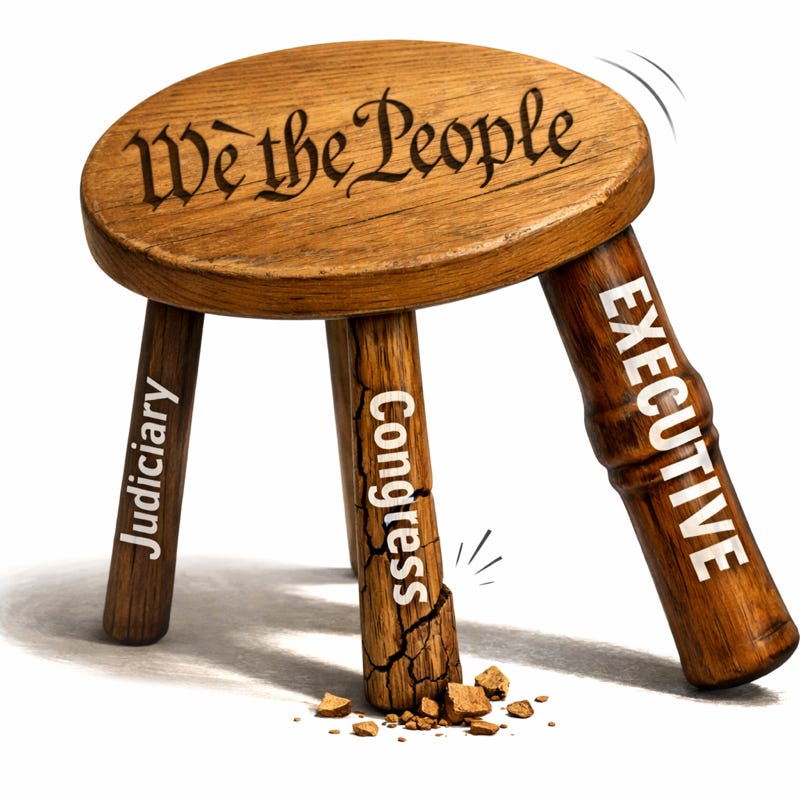
“The accumulation of all powers, legislative, executive, and judiciary, in the same hands…may justly be pronounced the very definition of tyranny.”
— James Madison, The Federalist Papers: No. 47
The founders expected the president to overreach. They designed the branches of government to compete with one another. Laws that enabled the branches to check each other’s power were a feature, not a bug. The very first provision in the new constitution vested Congress with broad authority to combat the tendency for a president to accumulate tyrannical power.
The skeptics who framed the Constitution saw Donald Trump coming — and said so at the time.
A century from now, historians will try to explain the Trump era. Students of the presidency will focus on his alarming mental decline, his impulsive use of domestic and military force, and his seemingly bottomless personal corruption. Foreign policy experts will document how his deliberate weakening of American alliances strengthened Russia and China. Judicial scholars will discuss the Supreme Court’s expanded use of the shadow docket to justify Trump’s unprecedented use of executive orders.
Historians seeking to understand the conditions that enabled Trump to rule as an authoritarian president are likely to describe how the decline of Congress greased the expansion of presidential power. They will note that, although Congress has been quietly dissolving itself for decades, Trump took greater advantage of its enfeebled condition than any other president.
A key question facing our wobbling Republic is whether this Congress, or the one we elect later this year, will recognize that a constitutional system built on three legs cannot stand upright when one leg collapses. America depends on Congress reasserting itself as a coequal federal branch.
Many Democrats offer a partisan explanation of how Congress was neutered: Trump ran over the hapless Biden/Harris regime, quiescent Congressional Republicans saluted, and the courts shrugged. There’s some truth to that story. But it misses a deeper, less comforting reality: Congress has been willingly and even gratefully giving up its authority for many years. Today, it finds itself buried in powerful political, cultural, and financial incentives to subordinate itself to the White House.
The Broken Branch
When Congress fails to legislate, presidents will attempt to fill the resulting vacuum, not necessarily because they crave power (though some obviously do), but because modern governance requires action. In the absence of an effective Congress, presidents rely on regulatory rulemaking and executive orders. Clinton did it to advance environmental and civil rights. Obama ran an end-run around a gridlocked Congress when he created DACA (Deferred Action for Childhood Arrivals) by executive action, allowing certain undocumented immigrants to stay in the U.S. despite the absence of legislative reform. Unable to get student loan relief through Congress, Biden twice attempted to use executive action to cancel student debt.
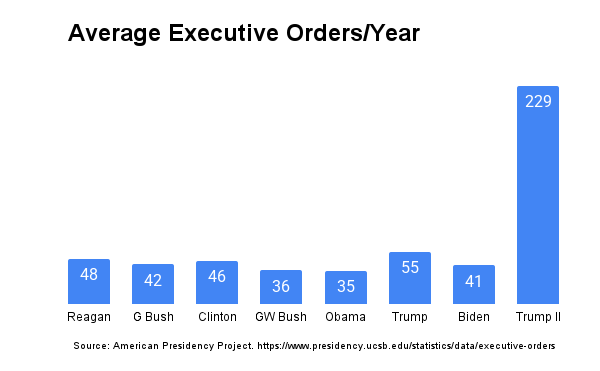
Except for occasionally menacing them, Donald Trump does not bother with Congress. Even by the standards of his predecessors, he has taken extravagant advantage of executive orders during the past twelve months. This turns constitutional design on its head.
Congressional hibernation has made Trump’s job easy. Congressional legislative output has plummeted.1 According to GovTrack, the 118th Congress passed just 274 bills—the fewest of any Congress in modern history. The current Congress, halfway through its term, has passed fewer than 75 laws, putting it on track to be even less productive. For comparison, Congress passed 700–800 bills per session as recently as the early 1990s.
Partisanship is part of the problem. Unlike European parliamentary systems, the U.S. Constitution is not built to withstand deep partisanship (the founders did not even provide for the rise of political parties, which they termed “factions”). In a system with separate branches, divided government, many veto points, and hard-to-pass legislation, parties can face a strong incentive to engage in parliamentary-style “us vs. them” behavior and to deliberately obstruct lawmaking.
In a system full of choke points, if one party decides to maximize confrontation and “stop the other side at any cost”, they can lock up the government and undermine democracy. An extreme party can punish moderates by rewarding “asymmetric polarization”, the term political scientists coined to describe the decision by one party to treat compromise as illegitimate. The result is a Congress that can’t do basic bargaining, budgeting, or problem-solving. This further erodes public legitimacy and worsens the problem. 
Not long ago, Congress seated both liberal Republicans and conservative Democrats. It routinely passed major legislation with overwhelming bipartisan support. The 1982 Voting Rights Act extension passed the House 389–24 and the Senate 85–8. Likewise, immigration reform was passed by comfortable margins in both chambers in 1986. Those margins signaled legitimacy and constrained executive overreach.
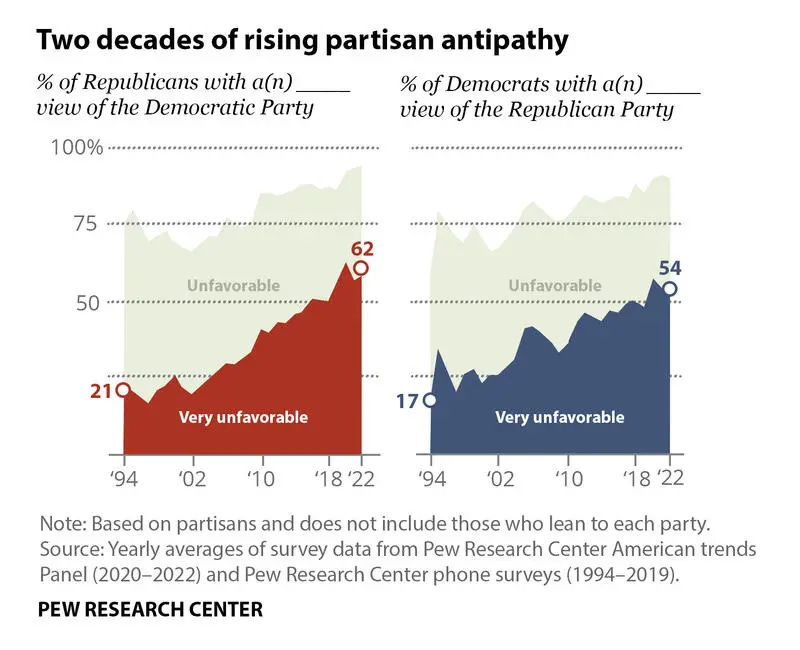
Today, party distinctions are tribal. States not only send vastly more partisan legislators to Congress, but in an evenly divided legislature, power shifts constantly. The House has had five speakers in the past ten years. Frequent shifts in political control create bad incentives for lawmakers. Especially those from safe seats are tempted to ask, “Why compromise today if we might control the chamber next year?” The resulting surrender of legislative responsibility helps transfer power to the executive.
Five examples of Congressional abdication loom especially large.
The Budget. The single most basic job of Congress is to fund the government, but Congress has not passed all appropriations bills on time since 1997. Absent these bills, lawmakers rely on massive continuing resolutions—vague, last-minute funding packages that cede to executive agencies enormous discretion usually retained by the legislature.
This isn’t just sloppy governance; it’s a transfer of power. When Congress refuses to specify how money should be spent, the executive branch decides instead.
War Authorization. A terrified Congress forfeited enormous power to the executive following the September 11 attacks. Congress hasn’t passed a meaningful war authorization since. Presidents of both parties have used the post-9/11 Authorizations for the Use of Military Force and the Patriot Act to justify more than two dozen military operations across multiple continents, often decades removed from the original Congressional intent.
Too many Senators and Representatives have no interest in a controversial vote to authorize military force. Why take a potentially divisive vote when the president is willing to act alone? Again, the Constitution is upended: the executive acts unilaterally and reduces Congress to complaining.
Immigration reform. Americans strongly agree on the need to reform immigration laws to enable pathways to citizenship for long-term residents who have obeyed the law, paid taxes, and contributed to their communities. Congress last passed a comprehensive immigration reform bill in 1986. Since then, demographic change, globalization, and humanitarian crises have radically altered migration patterns—but Congress has remained frozen. Failed reform attempts in 2006, 2007, and 2013 all collapsed under partisan pressure – most recently from Trump, who wished to campaign for president on a broken immigration system.
Presidents of both parties have filled that vacuum through executive orders, emergency declarations, and discretionary enforcement. Trump enthusiastically makes immigration policy from the Oval Office. He has no interest in reforming immigration laws, preferring instead to build a massive deportation enforcement apparatus and to deploy it against cities and states that have historically voted against him. But Trump is only able to deport people with well-established, productive lives who work, pay taxes, and would happily become American citizens because Congress abandoned its responsibility to reform immigration law.
Tariffs. Congress does not always retreat from its authority – sometimes it simply abdicates altogether. In recent decades, lawmakers have passed statutes granting presidents unilateral jurisdiction over trade, national emergencies, and foreign commerce. There are at least five laws that allow presidents to impose tariffs without congressional approval. Trump uses them all enthusiastically.2
Abortion. The U.S. national consensus on abortion is not terribly different than the one that prevails in Europe: permit abortions on demand in the first trimester and permit them later only for specific reasons (serious risks to the woman’s health, fatal fetal anomalies, rape, or incest). It is much more like the modal European framework than either a total nationwide ban (which only 13% of Americans support) or fully on‑demand access until birth (which 30% support).
For decades, Congress refused to enshrine Roe v. Wade in legislation, thus effectively outsourcing policymaking to the courts. When the political balance on the Supreme Court changed, there was no legislation to rule on, so it was trivially easy for the Court to radically restrict women’s reproductive rights.
The Path Back
Today, Congress is a self-reinforcing ecosystem of partisan district design, permanent and often negative campaigns, perpetual fundraising, restrictive legislative rules, and a media environment that often rewards maximalism and punishes compromise. No single reform can fix all of it. Still, several reforms can help Congress regain the standing the Constitution demands and recover the lost respect of the American people.
Enlarge the House. I have argued elsewhere that America still has the same 435 seats it had during the Gilded Age. This distorts representation, magnifies the Electoral College’s small-state bias, and leaves many voters functionally voiceless. Expanding the House is the most straightforward way to build a legislature that is less straitjacketed by partisanship.
When Representatives have fewer people to serve, they can plausibly know more of them. Smaller districts reward grassroots campaigns. Door-knocking and town halls become feasible once again. Additional seats would also allow minority communities or distinct regions to elect someone of their choice, rather than being subsumed into a single mega-district.

Design less partisan, multi-member districts and use rank-choice voting. Instead of 12 single-member districts in a state like Massachusetts, you might have 3 districts that each elect 4 members. Ideally, a judicial commission would draw the district lines. Voters would rank candidates in order of preference. Many states and cities have adopted rank-choice voting (also known as “instant runoff”). It works well.
Seats would be allocated proportionally: roughly every 20–25 percent of the vote in a 4-member district should translate into one seat. The result? A 60% Democratic state like Massachusetts would be far more likely to elect 8 Democrats and 4 Republicans than 12 Democrats. All would tend to be more moderate than they are in a winner-take-all by district structure. This reform does not require a constitutional amendment.
End the filibuster. Restoring majority rule is especially important in the Senate, where a tiny state like Wyoming, Vermont, or Delaware can outvote states like Texas and California that are 40-50 times larger. Allowing 41 senators—who can represent less than 18% of the U.S. population—to block bills supported by a majority of both chambers and the president undermines electoral accountability and democratic responsiveness.
The filibuster imposes a routine supermajority requirement that can stop most legislation. By encouraging minorities to block legislation rather than negotiate, the filibuster promotes obstruction rather than deliberation and halts even popular, relatively modest measures. It pushes policy to the courts and the executive branch. Filibusters are an extra-constitutional veto point created by Senate rules, not the framers’ design. It has long been a favorite tactic to block civil and voting rights legislation. Removing it (or carving out additional exceptions) would promote federal laws that align with public opinion on high-salience issues and reduce the incentive for presidents to govern by unilateral executive action.
Fund campaigns confidentially and with vouchers. Secret ballots curbed vote-buying by making it impossible to verify how an individual voted. We can likewise weaken the “market for politicians” by anonymizing contributions through a federal blind trust. Citizens, companies, PACs, and others could donate freely (including government-provided vouchers, or “Patriot Dollars”, to encourage small contributions), but candidates would receive funds without knowing the sources. It would eliminate repayable favors. It would also empower voters outside swing states by creating an incentive for candidates to compete for Patriot Dollars.

There are flickers of change. Congressional appropriators recently issued what one observer called a “near-total rebuke” of the administration’s attempt to reshape the National Institutes of Health. Some Republicans publicly objected when the Justice Department challenged the Federal Reserve’s independence. Others have spoken out against seizing Greenland or cutting health care subsidies. Trump may even pay a price for ICE overreach in the coming budget battle.
These are small but hopeful steps that point towards the possibility that Congress might remember how power works—not as a stage for public theater, but as a lawmaking institution.
The question facing the Republic in 2026 is not whether the Supreme Court will check presidential power, but whether Congress will. The Constitution provides our legislature with powerful tools for controlling an autocratic executive. We need a Congress that will use them.
Musical Coda
Plainly, legislative output is not the only way to measure the legislative branch. Passing fewer, higher-impact, higher-quality bills would be a big step forward. But assuming no change in legislative quality, if output declines by two-thirds, it is reasonable to conclude that there is a problem.
While Article I grants Congress the power to regulate commerce and to levy tariffs, Congress has delegated much of this authority to the executive through “emergency” and “national security” provisions. Recent administrations have invoked Section 232 of the Trade Expansion Act (1962) and Section 301 of the Trade Act (1974) to impose sweeping tariffs on allies and competitors, citing national security threats, thereby bypassing the legislative process.
“A constitutional system built on three legs cannot stand upright when one leg collapses.” Right on!