With Russia reeling militarily and economically, Europe accelerating defense production, and Gulf states desperate to repel Iranian drones, countries around the world are calling Kyiv for advice and help. Suddenly, Ukraine is the one holding cards.
But war is an uncertain enterprise. A wounded and isolated Russia could still lash out at the Baltics or Poland. In the near term, Europe needs Ukraine’s help to rearm – and Ukraine needs EU financial support. In the medium term, the EU is now far more likely to invite Ukraine into its security architecture, and possibly NATO. The United States should support both efforts – but doing so will require Congressional leadership, since the Trump White House has surrendered its leadership of the free world.
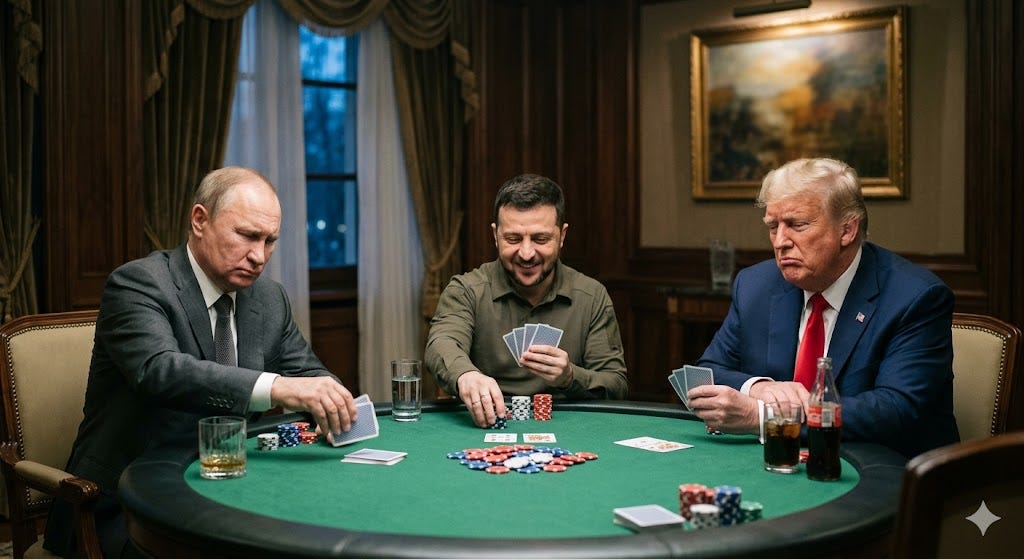
On the final day of February 2025, the Trump administration reached a new low. Meeting in his gold-curtained office, President Trump attempted to humiliate Ukrainian President Volodymyr Zelenskyy on live television, telling him he would be excluded from peace talks with Russia because he “had no cards” -- Trumpese for negotiating leverage.
Zelenskyy, dressed as ever in the olive drab of a country at war, replied that he “didn’t come here to play cards.” Trump scolded him for not being more grateful for the US support he was cutting. The whole thing felt like a staged ambush from a bad gangster movie, with Vice President JD Vance playing the hapless Fredo Corleone to the Don. Brown-nosing for the camera, Vance even had the temerity to ask Zelenskyy whether he had said, “thank you.”
But the arc of the moral universe is now bending towards Ukraine. Fifteen months later, it is Zelenskyy who is holding aces.
The Cards
Since that rebuke in Washington, Ukraine has steadily shifted the battlefield’s underlying physics through rapid innovation in drone warfare. Its drones are now destabilizing Russia economically and politically. It’s war, so the picture can change.
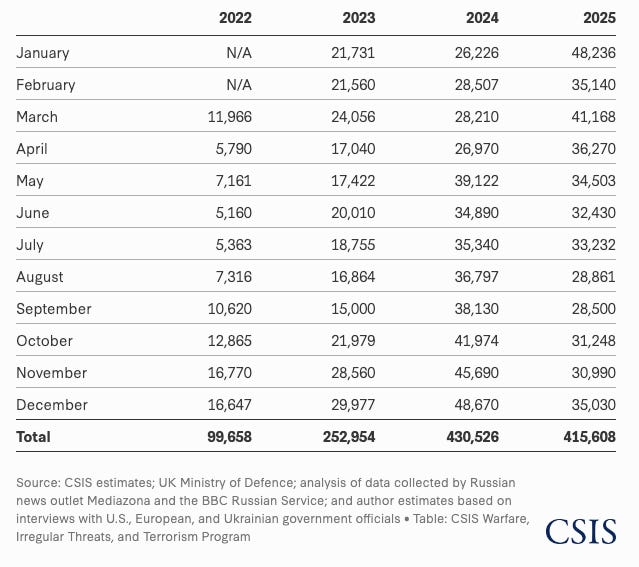
Russian losses are huge. By every honest metric, Russia is suffering badly. Its front lines have barely moved since 2022, despite roughly 1.2 million killed or wounded, according to the Center for Strategic and International Studies.
The Institute for the Study of War has assessed that Ukrainian drone innovations have shifted the battlefield advantage in Ukraine’s favor. Russian advances have stalled. During March, Russia lost more than 30,000 men – as it has nearly every month for over two years -- and suffered net territorial losses in both March and April 2026. Meanwhile, Ukraine’s air defenses now intercept roughly 90% of Russian drones and missiles – up from the low 80s last year.1
Lethal drones. Ukrainian drone pilots inflicted nearly a quarter of a million Russian casualties last year, and have destroyed thousands of tanks and tens of thousands of armored vehicles and artillery pieces. Since December 2025, Ukrainian forces have killed or wounded more than 1,000 Russian soldiers every day; drones now account for the vast majority of those casualties.2 Social media is full of clips showing Russian soldiers cornered by drones in fields, buildings, and trenches. For the first time in history, families are watching videos of their sons and fathers die in combat.
Gameification. Ukraine has gameified the very serious business of FPV drone warfare. Drone teams of fast-thumbed millennials compete on a national leaderboard to hunt priority Russian targets. Teams earn points redeemable on the Brave1 defense marketplace — basically an Amazon-for-war run by the Ministry of Digital Transformation. As CBC and Time have detailed, units get 12 points for killing a Russian infantryman and 8 for wounding one; 25 for taking out a Russian drone operator; and 40 for destroying a tank. Bonus values reward harder targets -- a captured Russian, taken alive by drone, is worth ten times more than a kill, because intelligence and prisoner exchanges matter.
The scale of Russian losses. For perspective: the United States incurred about 60,000 killed and wounded in two decades of war in Iraq and Afghanistan. This means that a country half our size, with living standards a quarter of ours, is taking casualties roughly a hundred times faster than America did in our most recent ground wars. Russian losses now exceed any plausible replacement rate. The country faces an acute labor shortage as a result.
Less money and influence. Sanctions have made it expensive for the Kremlin to borrow on international markets. Putin has lost his detestable pal Viktor Orbán in Budapest. He lost his friend Maduro in Caracas. And he has been forced to scale back his May 9 Victory Day parade because of Ukrainian drones flying over his capital.
Scaling up production. Ukraine is not standing still. The country produced roughly 4 million drones in 2025 and is on track for around 7 million in 2026 – more, by some estimates, than the rest of NATO combined. The mix is shifting too: alongside short-range FPVs, Ukraine is fielding long-range strike drones with ranges of hundreds of miles, culminating in cruise missiles like the Flamingo, which can reach targets up to 3,000 km away with a one-ton warhead.
Those longer-range systems are now routinely punching through to Russian refineries and ports. Reuters estimates that Ukrainian strikes have knocked out roughly 40% of Russia’s oil export capacity, forcing Moscow to cut crude production by 300,000 to 400,000 barrels a day in April. This collapse is the sharpest monthly decline since the pandemic. That damage has drastically reduced the windfall Putin hoped for when Trump ended sanctions on Russian oil and prices spiked thanks to the US attack on Iran.
The drone war has even reached the Kremlin’s most cherished pageantry: Russia announced it would drastically scale back the May 9 Victory Day parade, with no military vehicles or heavy weaponry on Red Square for the first time in nearly two decades. On May 4, a Ukrainian drone slammed into a high-rise just six kilometers from the Kremlin. Zelenskyy then teased Putin for not putting his vulnerable rockets on display.
New Alliances Against Russia and Iran
America abandoned Ukraine, but to its eternal credit, Europe did not. In its lumbering way, the EU has come to recognize Ukraine as part of its eastern front in a long fight against Russia. Hungary, under Viktor Orbán, had blocked European aid to Kyiv for years; his ouster on April 12, after sixteen years in power, cleared the political logjam. Less than two weeks later, the EU approved a €90 billion ($106 billion) loan package for Ukraine – roughly two-thirds of it earmarked for military needs – and a fresh round of sanctions targeting Russia’s shadow fleet, banks, and crypto channels.
In return, Zelenskyy is helping Europe stand up the post-NATO defense architecture it now needs – led, for the moment, by Germany, Britain, France, and Poland. That work is overdue. Europe no longer trusts a US president who has openly threatened to seize Greenland from a NATO ally and who routinely casts doubt on his Article 5 treaty obligations.
Meanwhile, US allies in the Middle East are no longer relying on Washington to protect them from Iranian drones. They are dialing Kyiv. They have grasped what the Pentagon already knows: just as the Gulf War was the first “space war,” reliant on satellite communications and GPS, and the Nagorno-Karabakh conflict was the first decisive drone war, the Russia-Ukraine war is the first conflict fought at scale with drone countermeasures, AI-enabled targeting, and continuous cyber operations.
Saudi Arabia, Qatar, and the UAE. Ukraine’s lightning-fast innovations have captured the attention of Europeans worried about Putin as well as Gulf states battered by Iran. In late March, Saudi Arabia, Qatar, and the UAE each signed 10-year defense cooperation agreements with Ukraine to access its combat-proven expertise against Iranian drone and missile attacks. Kyiv had already deployed more than 200 drone-warfare specialists to the region by mid-March to help counter Shahed swarms.
Oman, Kuwait, and Bahrain are also calling Kyiv. The trade they want is straightforward: in exchange for cheap Ukrainian interceptors, they will send Ukraine the expensive missile-defense systems needed to fend off Russian attacks. Many are offering to host Ukrainian-licensed manufacturing.
The US military understands that war is increasingly a contest of rapid learning and adaptation, and is impressed with what Ukraine has achieved. American officers and combat units have visited Ukraine repeatedly to study, observe, and learn.
Just before the US attacked Iran in Operation Epic Fury, the Pentagon’s counter-drone task force -- Joint Interagency Task Force 401 -- was in Kyiv specifically to learn how Ukraine defends against the Iranian Shahed drones Russia has been launching at Ukrainian cities for years.
US forces in the Gulf now run Ukrainian command-and-control software at Prince Sultan Air Base in Saudi Arabia, with Ukrainian officers training their American counterparts.
The Pentagon is also studying Ukraine’s MacGyvered approach to technology – rapid iteration of drone and counter-drone designs, which led to the use of thin fiber-optic cables to evade electronic jamming, and acoustic sensor networks for detecting low-flying threats.
The Army has bought thousands of Ukrainian-tested Merops interceptor drones, at roughly $15,000 each, to defend against Shaheds that cost Iran $30,000 to $50,000 to build. As Army Secretary Dan Driscoll put it: “That puts us on the right end of the cost curve.”
Under any other administration, the United States would by now have entered into joint ventures with Kyiv to build drone factories, electronic-warfare suites, acoustic sensors, and interceptor drones on American soil. Those deals would dramatically increase US military capability on land, sea, and at forward bases.
Ukraine has offered exactly that – including its low-cost interceptor drones, such as the Wild Hornets “Sting,” which intercepts Shaheds for roughly $2,100 a shot, compared to $4 million for a Patriot that we shoot in pairs. That the Trump White House has slow-walked this offer defies belief – although, as the Saudi airbase example shows, the US military is finding ways to work around its commander in chief.
Attracting foreign allies is impressive, given that Ukraine itself is hardly an ideal environment for innovation. It is under constant military attack, its energy infrastructure is badly diminished, and many of its state-owned defense enterprises are moribund or corrupt. Zelenskyy himself is also an unlikely hero. A former comedian and actor who was elected by a landslide and remains popular, he came to office with few of the skills, experiences, and relationships that most elected heads of state need to be effective.
There is little question that Ukraine’s effectiveness against the Russian army, Trump’s dismissive view of NATO, and Russian aggression towards Europe have changed the calculus for admitting Ukraine into EU security arrangements and quite possibly into NATO. Previously, Ukraine needed NATO. Now NATO needs Ukrainian technology and combat experience.
A Wounded Bear is Dangerous
So long as Putin is alive, a weakened Russia will not be more conciliatory. An important study published in March 2026 by Eugene Rumer, a former US national intelligence officer for Russia and Eurasia now at the Carnegie Endowment, warns of precisely this. His title says it all: “Belligerent and Beleaguered: Russia After the War with Ukraine.”
“Having invaded Ukraine under the false pretext of needing to secure its western flank,” Rumer writes, “Russia is poised to emerge from the war less secure, more resentful, and more threatening to Europe than before the war. Its threat perceptions will cast a long shadow over Europe.”
Putin sees Ukraine as a threat precisely because it wants to be part of Europe rather than a junior partner in a revanchist Russian empire. “From the Kremlin’s perspective, as stated repeatedly by senior Russian officials, Europe is at war with Russia,” Rumer writes.
NATO Secretary General Mark Rutte made much the same point from the opposite direction in his January 2025 remarks to the European Parliament: “When you say you are on the eastern flank, it is the Hague, London, and New York at the eastern flank…we are all in this together.”
Even before its reversals on the battlefield, Russia was conducting a coordinated, escalating campaign of hybrid warfare against Europe. Putin has ordered sabotage, cyberattacks, arson, and infrastructure targeting. Russian operatives have severed undersea cables and pipelines in the Baltic Sea, jammed regional aviation GPS, used drones to scout sensitive sites in Sweden, Finland, and Norway, sponsored arson plots in the UK, Poland, and the Baltics, attacked Estonian government systems, and weaponized migration flows into Finland, Lithuania, Latvia, and Poland.
In mid-April, former Russian president Dmitry Medvedev took to X to threaten European companies supplying parts for Ukrainian drones, warning that “the list of European facilities which make drones & other equipment is a list of potential targets for the Russian armed forces.” He signed off with a chilling flourish: “Sleep well, European partners!”
That posture, combined with closer day-to-day cooperation between Kyiv and European capitals, has shifted Europe’s view of Ukraine from a potential burden into something closer to an indispensable partner. Whatever else it is, Ukraine now operates the most capable military in Europe – and the only one battle-tested against Russia.
Only fifteen months ago, Donald Trump used the Oval Office to blindside Volodymyr Zelenskyy. On behalf of the country that had led the free world since the Second World War, he threatened to undermine Ukrainian freedom fighters rather than support them. Instead of carrying the torch of freedom, Trump carelessly dropped it on the floor.
Zelenskyy picked it up and now has a stronger claim to leading the free world than Trump has. Every military and many citizens of the world have noticed this. Europe, the Gulf, and even the US military are showing overdue respect for a country that has led the fight for freedom against those who threaten it.
Slava Ukraini!

ICYMI
Elon Musk is launching X-Money, a WeChat-style “everything app.”
Many of those short videos on your phone come from AI labs in China.
Some Chinese EVs project movies onto walls, shake off snow, and jump.
Korea is making building insulation from coffee grounds.
The shock from a billion barrels of missing oil is about to crash demand.
Reuters/Ipsos poll finds strong support for birthright citizenship.
The best study on restricting phones in classrooms: it’s fine, but it does not improve educational performance.
Why do airlines lose so much money and go bankrupt so often?
Russia and Ukraine guard closely the figures on how many troops they have deployed and how many casualties they have suffered. Based on current intelligence reports and independent military analyses as of May 2026, Russia has deployed between 550,000 and 650,000 troops in Ukraine, while Ukraine has mobilized between 800,000 and 1,000,000 defenders.
Casualty figures are highly contested. Ukraine’s Ministry of Defense and Western intelligence agencies (such as the UK MoD and CSIS) provide the most frequently cited estimates. Commonly cited estimates suggest that Russian casualties (killed, wounded, and missing) have reached ~1.3 million, while estimates of Ukrainian casualties are generally lower but still severe, placed between 500,000 and 600,000 total (killed and wounded) as of early 2026. Independent analysts often observe a casualty ratio of 2:1 or 3:1 in favor of Ukraine, largely attributed to Ukraine’s defensive posture and the use of high-precision Western munitions.
Beyond personnel, the war of attrition has devastated hardware. As of May 2026, Russia has lost an estimated 11,900+ tanks and 24,500+ armored vehicles, while Ukraine has seen significant damage to its energy infrastructure, with energy capacity falling from 33.7 GW pre-invasion to approximately 14 GW by early 2026 due to persistent long-range strikes.
Estimated Russian battlefield Casualties (Killed, Wounded, or Missing) 2022-2025