

I just spent a couple of weeks cycling around Ireland and the UK. The Republic of Ireland is outside the United Kingdom, so it was unaffected by Britain’s decision to leave the European Union (”Brexit”). As a result, economists often contrast the benefits of EU membership for a small, open, English-speaking Ireland with the cost of leaving for Great Britain.
Ireland always wins this comparison – although damage from Brexit is only part of the reason. Brexit didn’t make Ireland richer so much as it made Britain poorer. Since 2015, UK GDP per capita has flatlined, while Ireland’s tax engineering attracted foreign investment that partially offset its own trade losses. Apples-to-apples comparisons are tricky – but even a casual visitor sees the damage the UK inflicted on itself. The aging country voluntarily shrank its own talent pipeline for reasons that were more cultural than economic. As with many ruinous economic decisions, the cost of Brexit was slow, diffuse, and deniable, while the benefits were immediate and politically resonant.
The results are terrible. The UK now faces horrible fiscal arithmetic and severe labor shortages in labor-intensive sectors like construction, agriculture, and elder care. Research talent is fleeing to competing nations. And it’s a tough policy to undo, since the UK can only rejoin the EU by begging it for unfavorable terms.
While in Edinburgh, I visited the grave of Adam Smith, one of the earliest and most astute observers of capitalism. I recalled an exchange from 1777, when Smith’s young friend John Sinclair brought him news of General Burgoyne’s surrender to the American rebels at Saratoga and despaired that “if we go on at this rate, the nation must be ruined.”
Smith replied: “Be assured, my young friend, that there is a great deal of ruin in a nation.” Smith’s quote was both a warning and a timeless reminder of human resilience. He thought that successful societies were structurally robust and could absorb economic mismanagement, political blunders, and monumental crises without collapsing entirely. Smith was right about Britain in 1777. Whether he stays right depends on how much of its ruin the United Kingdom decides to spend.
America’s Brexit
The 250th anniversary of The Wealth of Nations and of our national founding is an occasion to reflect on one of America’s own stupid, Brexit-like decisions. A century ago, nativist forces in the United States built a strong public consensus to sharply reduce the number of people we would allow to move here.
Two Republicans championed the cause: Representative Albert Johnson, a eugenics advocate who chaired the House immigration committee, and Senator David Reed, who explained the logic of banning Asian immigrants and severely restricting southern Europeans to the New York Times a month before passing his bill. Until the mid-1880s, Reed wrote, immigrants had come from “the same sources from which our country was originally colonized” and were easily assimilated. Then:
“Beginning about 1885, new types of people began to come. For the first time in our history, men began to come in large numbers from Italy, Greece, Poland, Turkey in Europe, the Balkan States, and from Russia.
“As these new sources of immigration began to pour out their masses of humanity upon our shores, the old sources in Northwestern Europe seemed to dry up, and whereas in 1890 the natives of Southern and Eastern Europe constituted about 8 percent of our foreign-born population, in 1910 they constituted 39 percent. This change brought new difficulties in the problem of assimilation. These new peoples spoke strange languages. It was not to be expected that they would readily fuse into the population that they found here.”
This view was widespread. The founder of the American Federation of Labor, Jewish immigrant Samuel Gompers, welcomed the Johnson-Reed Act because it reduced the supply of immigrant labor, which he believed threatened the wages of native-born workers. Adam Smith had a phrase for those who lobby the state to shut out their competitors: “the wretched spirit of monopoly.” Gompers wanted the AFL to monopolize the labor supply, and he died in December 1924, months after helping pass the law he believed would achieve that goal.
The Ku Klux Klan, which had resurged as an anti-immigrant organization, backed the bill, citing the benefits of racial purity. The Klan knew that the underlying motive for the law was ethnic, not economic, since it left Mexican immigrants untouched. After all, growers needed farmworkers.
Only six Senators and 71 House members voted against the bill, which Calvin Coolidge promptly signed. Among the dissidents was a freshman from Brooklyn named Emanuel Celler, who spent the next 41 years fighting the law and championing immigrant and civil rights.
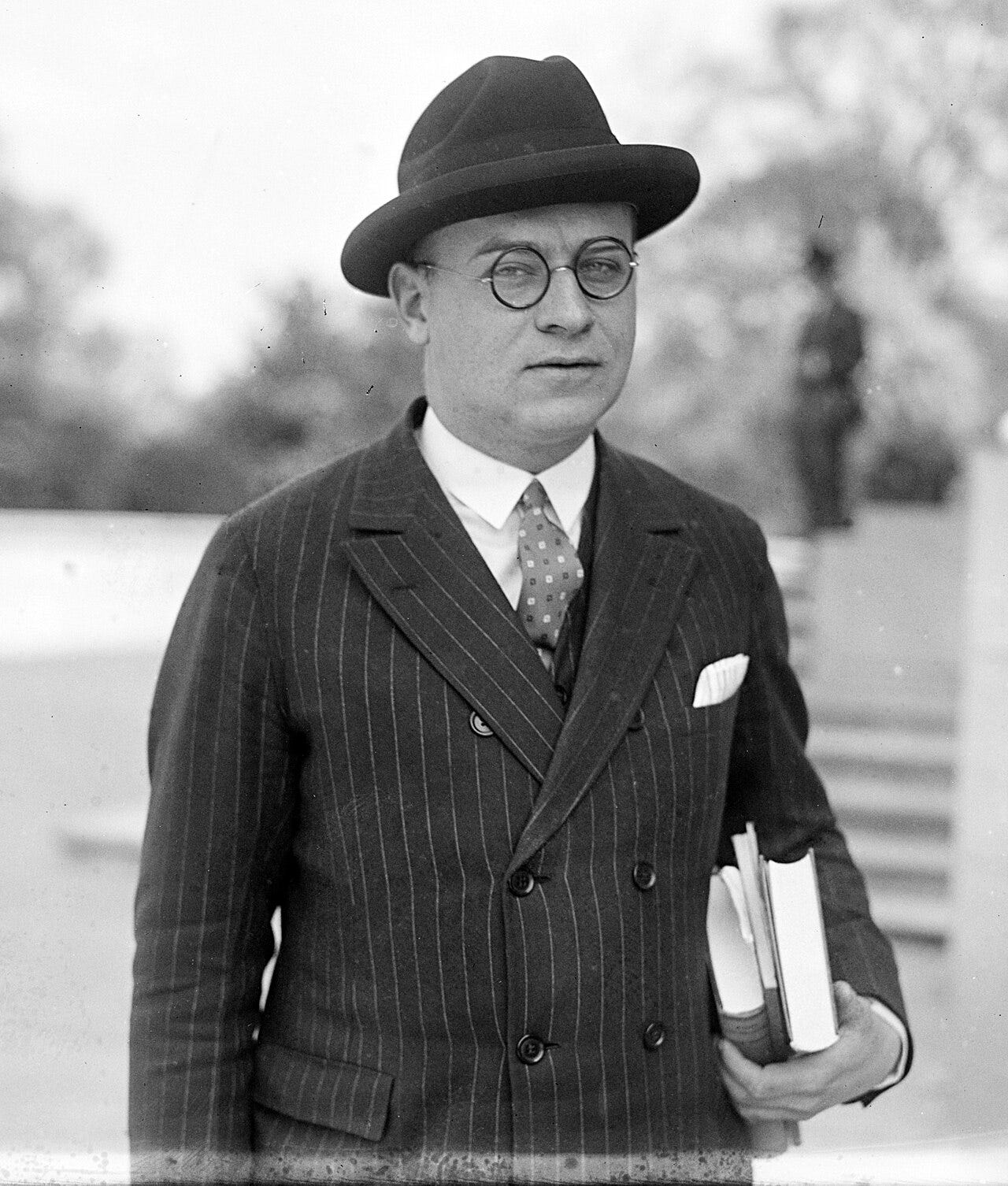
The impact of the Johnson-Reed Act was swift: it cut annual immigration by 80 percent using national-origin quotas pegged to the 1890 census, which predated the waves of Italian, Polish, Jewish, Armenian, and Greek immigrants. The act categorically excluded all Asians, building on the Chinese Exclusion Act. Italy’s quota fell from over 40,000 to under 4,000. Almost as an afterthought, the law also created the US Border Patrol and the consular visa system, which is still the administrative foundation of American immigration enforcement.
Ruinous Legislation
Most historians and economists today judge the use of national and racial categories to restrict immigration in 1924 as a massive, Brexit-caliber error. It slammed the door just before the refugee crises of the 1930s, starved American science and industry of talent for a generation, and took 41 years to undo. As with Brexit and Trump’s anti-immigrant rants, the underlying passions behind the legislation were more cultural than economic.
The results endured for decades. The foreign-born share of the US population fell from roughly 13 percent in 1920 to under 5 percent in 1970. A century later, the legislation looks like an economic and humanitarian own goal.
Economic effects. Adam Smith had seen this before. In The Wealth of Nations, he attacked England’s Law of Settlements, which barred poor laborers from moving between parishes in search of work, calling the removal of a man who had committed no crime “an evident violation of natural liberty and justice.” Johnson-Reed was the Settlement Acts scaled up to a hemisphere, and it failed the same way.
Research by Ran Abramitzky, Leah Boustan, and others finds the law fell short even on its own terms. It promised that cutting immigrant labor would raise wages for native-born workers. It mostly didn’t. In areas that lost the most immigration, native workers saw little wage gain; instead, farmers mechanized, employers recruited Mexican and Canadian workers where they could, and some industries simply shrank. Marginal mines closed rather than paying more. Native-born workers actually shifted into lower-paying occupations in some affected areas because immigrant-fueled growth had been pulling them up the ladder.
The act also cut off the flow of scientific and entrepreneurial talent for four decades. The counterfactual is unknowable, but the US won the twentieth century in physics substantially on refugee scientists who got in before or despite the quotas: Einstein, Fermi, Szilard, Bethe, von Neumann. Many more were kept out.
Social and humanitarian effects. The quotas were still in force in the 1930s, and the US held to them, often under-filling them through consular obstruction, while European Jews sought to escape rising anti-semitism. In a dark chapter of US immigration history, the US refused to admit the 937 passengers of the MS St. Louis, who were fleeing Nazi Germany and sought refuge in Florida after Cuba revoked their landing permits. Worse, the German immigration quota went unfilled in most years of the Nazi era, even as hundreds of thousands waited. Anne Frank’s father applied for a US visa and never got one. The act ensured America’s doors were largely closed during the Holocaust, thanks to legislators who had been explicit in 1924 that keeping out Jews was among their goals.
Johnson-Reed was openly and proudly built on racialist eugenics. Harry Laughlin of the Eugenics Record Office served as the House committee’s official “expert eugenics agent,” and the congressional record is full of racial pseudoscience that reads as simply grotesque today. Smith’s other book, the one his tombstone lists first, is about the human capacity to extend sympathy to strangers; the 1924 congressional record is a study in its refusal. Adolf Hitler’s praise for the quota system in Mein Kampf is not an endorsement that successful laws usually receive.
Political effects. Within two generations, descendants of the groups excluded by Johnson-Reed became fully assimilated, prosperous, and politically powerful. This made the original premise (i.e., that Italians, Jews, and Slavs were racially unassimilable) look not just wrong but absurd. The alliance between organized labor and nativism lasted until the law’s economic realities and moral decrepitude forced the AFL-CIO to reverse its position in 2000. And it was Celler, by then the dean of the House, who co-authored the 1965 repeal.
Unexpectedly, the law was so successful that it helped demobilize the Ku Klux Klan. Once the immigration issue was won, decisively and seemingly permanently, the Klan lost its most potent recruiting grievance outside the South (a lurid murder scandal involving its Indiana leader in 1925 did the rest). Membership cratered after 1925, and by 1930, the organization was a shell.
Were there any benefits? A minority of economists and historians argue that the immigration pause aided assimilation and compressed wages at the bottom, and that the Great Migration of Black southerners into northern industry was partly enabled by the cutoff of European labor. These effects are real but modest, and they cannot salvage the law’s reputation because it classified immigrants by race rather than using a more neutral Canadian-style points-based immigration selection scheme.
It had taken the United States four decades to admit that racial and national restrictions were a serious mistake. In six more decades, we would repeat the error.
Spending Our Ruin
The 1924 immigration law produced echoes a century later, when the share of foreign-born residents in the US once again approached 15 percent. Public revulsion at the chaos associated with Joe Biden’s neglect of border security contributed directly to the election of Donald Trump to a second term. The deportation machinery Trump inherited, from the Border Patrol to the consular visa system, was itself a Johnson-Reed legacy.
A report released this week by the Peterson Institute quantifies the costs of Trump’s executive orders that imitate the Johnson-Reed Act. By cutting out two-thirds of international student visas, for example, the US cuts off STEM workers with PhDs, 35% of whom are foreign-born. Peterson expects this will shrink the high-skill STEM workforce by about 6% overall and by 11.5% at the PhD level. That decline “would cut annual US growth by $240 billion to $481 billion within a decade – a loss the size of a mid-sized US state like Wisconsin or Utah.”
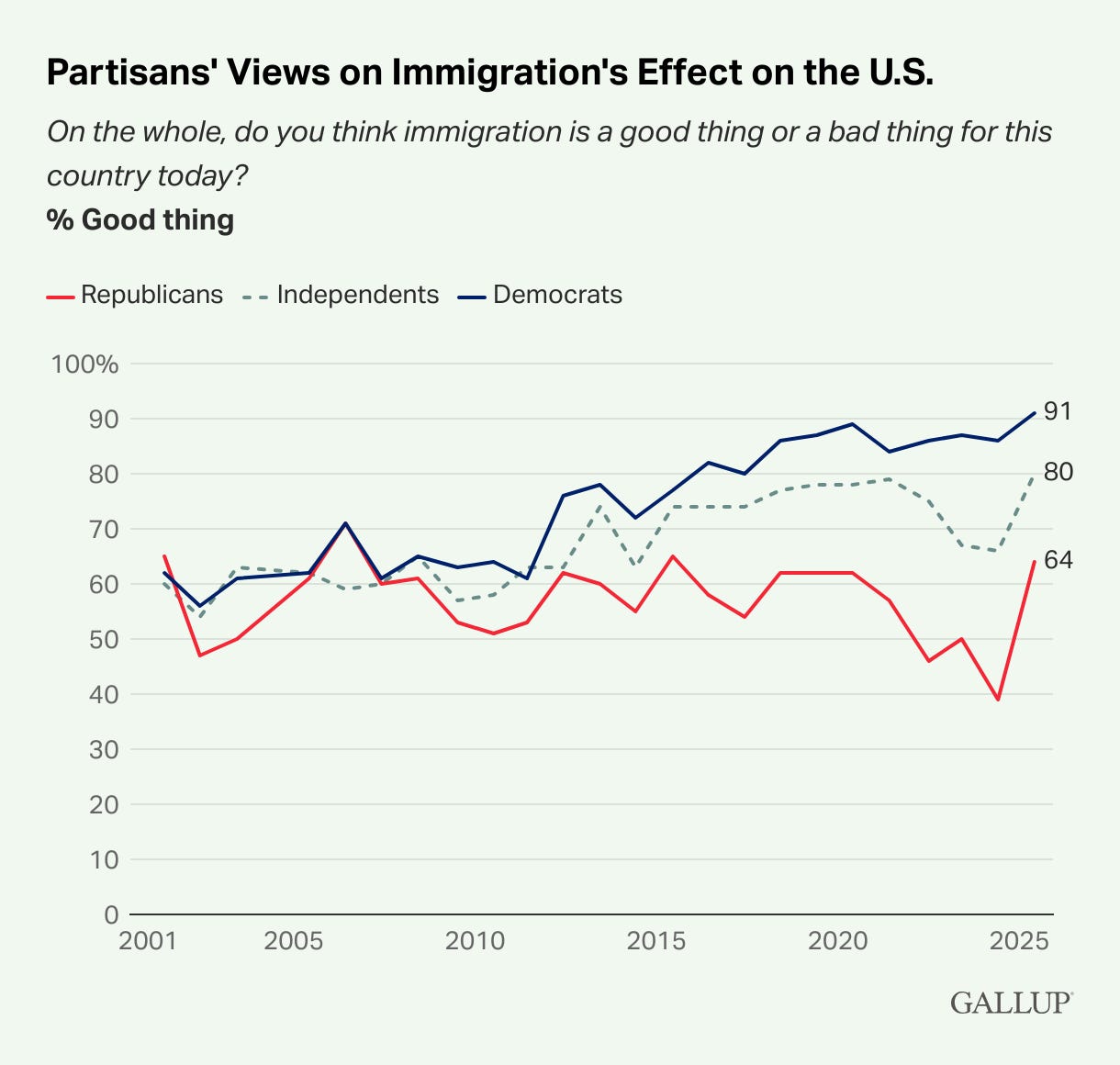
The public is starting to grasp these costs, and public opinion is swinging back as the costs of deportations become more visible and concrete. As with “Bregret” in the UK, Gallup found record-high shares of Americans calling immigration a good thing by mid-2025.
Standing at Smith’s grave, I took his sentiment as reassurance. But it’s also a warning. There is a great deal of ruin in a nation, but the quantity of ruin is finite. Johnson-Reed shows what a single act of self-harm can cost: forty-one years of closed doors, a generation of lost science, and the St. Louis turned away within sight of Miami. Britain is drawing down its stock of ruin on Brexit. America spent heavily in 1924 and is reaching for its wallet again. Smith assured young Sinclair that Britain would survive the loss of America. He never said ruin was free.
ICYMI
Trump is trying to gin up a Red Scare without Reds.
A serious paper finds that a reduced population may increase GDP per capita rather than decrease it. Important!
Class shock: worries about job loss are now concentrated at the top.
Ukrainian drones disable Russia’s largest refinery, 1,500 miles from Kyiv.
China is crushing the German Mittelstand, the small and medium-sized manufacturers that form the spine of the German economy.
MIT named a former volunteer at Glide Memorial Church in San Francisco, who once taught computer skills to disadvantaged students, as Chairman of its Economics Department. (David Autor is an excellent choice and co-authored the population paper cited above.)
Thank-you. Great essay. So much information. And it goes to prove that old saw, that failing to learn from history dooms us to repeat it. Of course abject stupidity, fueled by racism, helps.